ON THIS DAY · JULY 26, 1971
Expanding the Lunar Radius: How Apollo 15 Carried the First Electric Lunar Roving Vehicle to Hadley Rille
On previous Apollo missions, astronauts were tethered by foot to within a few hundred yards of their lander. On July 26, 1971, Apollo 15 launched with a foldable electric automobile that expanded human exploration across miles of mountainous lunar terrain.
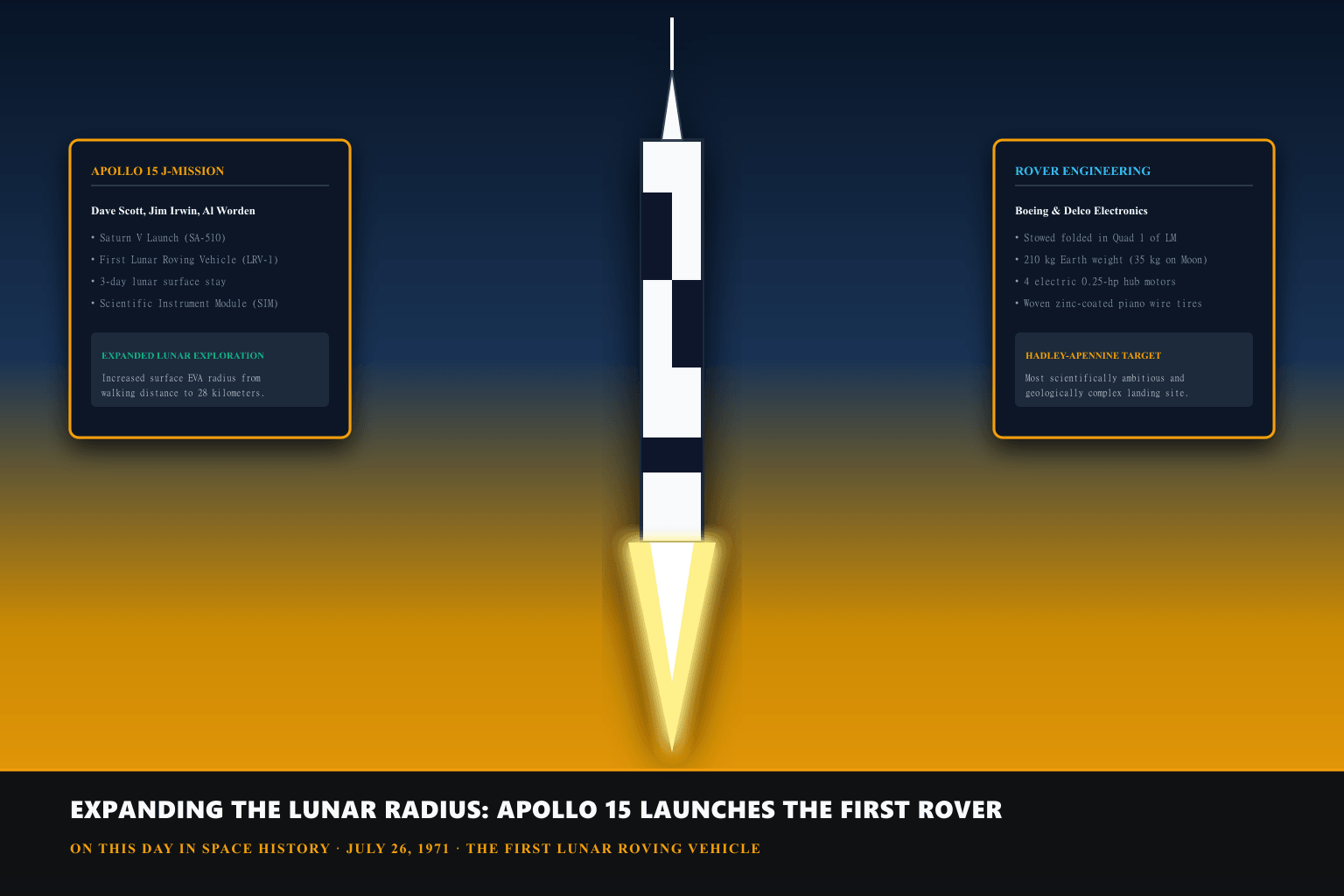
The J-Mission Upgrades: Science Over Symbolism
With the initial lunar landings of Apollo 11, 12, and 14 successfully completed, NASA transitioned Apollo into high-yield scientific expeditions known as J-missions. These missions carried heavier payloads, advanced orbital cameras in the Scientific Instrument Module (SIM) bay, and expanded life-support tanks allowing astronauts to conduct three 7-hour moonwalks.
However, walking across soft lunar regolith in bulky 180-pound spacesuits consumed massive metabolic energy. To reach distant geological formations like the 1,000-foot-deep Hadley Rille canyon and the Apennine Mountains, astronauts required motorized transportation.
The Boeing/GM Moon Buggy: 17 Months from Blueprint to Launch
In 1969, Boeing's aerospace division in Huntsville, Alabama, and General Motors Delco Electronics in Santa Barbara were awarded the high-speed contract to design and build the LRV in just seventeen months. The engineering constraints were brutal: the vehicle had to weigh under 460 pounds (210 kg), survive vacuum thermal swings of 500°F, and fold into an impossibly tight 5-foot-by-5-foot quadrant on the Lunar Module.
Engineers used lightweight aluminum 2219 tubing for the three-part hinged chassis. Each wheel was powered by its own independent 0.25-horsepower DC electric motor geared through an 80:1 harmonic drive, powered by dual 36-volt non-rechargeable silver-zinc potassium hydroxide batteries producing a total capacity of 121 amp-hours.
Wire-Mesh Wheels and Origami Deployment
Standard rubber pneumatic tires were completely unusable on the Moon because vacuum and extreme cold would cause rubber to crack and burst. General Motors engineer Ferenc Pavlics invented innovative wire-mesh wheels woven from zinc-coated piano wire, inlaid with chevron titanium treads that provided excellent traction on powdery lunar dust.
To deploy the rover on the Moon, astronauts pulled two external nylon deployment tapes. Spring-loaded bungees and friction reels caused the rover to unfold automatically from the descent stage, locking its wheels and lowering its chassis to the lunar surface in under five minutes without requiring tools.
What the evidence does not settle
While the LRV had a theoretical range of 40 miles, mission safety rules strictly enforced a 'Walkback Limit': astronauts were never permitted to drive further from the Lunar Module than the distance they could safely walk on foot using remaining spacesuit oxygen reserves if the rover broke down.
PRODUCT IDEA 01
NASA Apollo Lunar Roving Vehicle Detailed Scale Model Kit
An authentic multi-part plastic scale model kit of the Apollo Lunar Rover featuring wire-mesh styled wheels, high-gain umbrella antenna, and astronaut seats.
Buying limit: Look for precision-molded scale parts with color decals included. Quality model kits cost $25 to $45.
Original editorial illustration, not a retailer photograph. No exact Amazon offer passed our verification gate.PRODUCT IDEA 02
Apollo 15 Lunar Rover Hadley Rille Embroidered Tactical Flight Jacket
A premium weather-resistant nylon flight jacket featuring authentic Apollo 15 mission patches, Lunar Rover shoulder insignia, and heavy-duty ribbed cuffs.
Buying limit: Ensure durable windproof nylon shell with genuine brass zipper closures. Quality aerospace jackets range from $65 to $130.
Original editorial illustration, not a retailer photograph. No exact Amazon offer passed our verification gate.SOURCES, METHOD, AND LIMITS
Researched using Boeing LRV Operations Handbooks (LS006-002-2H), NASA Marshall Space Flight Center Lunar Roving Vehicle project histories (NASA SP-4204), and Apollo 15 flight transcripts. No commercial products were physically tested.
- NASA Marshall Space Flight Center — The Lunar Roving Vehicle Technical History — Official comprehensive historical monograph documenting Boeing and GM design contracts, harmonic drive gearboxes, and wire-mesh wheel physics.
- Smithsonian National Air and Space Museum — Apollo 15 Lunar Roving Vehicle Engineering Model — Curatorial technical record detailing the silver-zinc battery layout, T-handle steering controller, and folding chassis mechanisms.