ON THIS DAY · JULY 15, 1975
Détente in Low Earth Orbit: How Apollo-Soyuz Engineered the First International Androgynous Space Docking
At the height of the Cold War, two superpower rivals that had spent fifteen years competing in the space race launched toward a shared rendezvous. On July 15, 1975, the Apollo-Soyuz Test Project took flight, proving that diplomacy and aerospace engineering could bridge geopolitical divides.
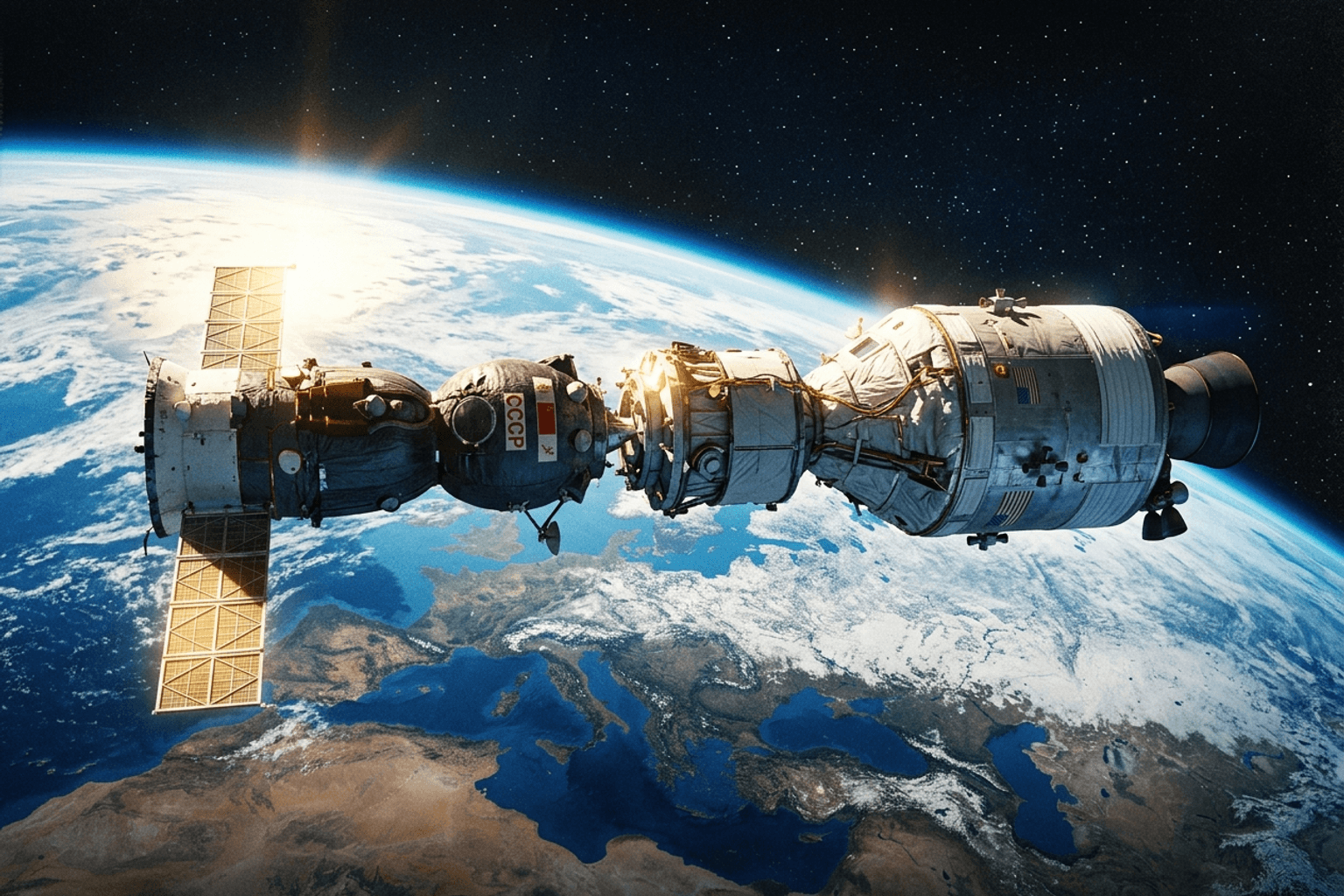
The Atmospheric Incompatibility: 5 PSI Oxygen vs. Sea-Level Air
The greatest technical hurdle facing ASTP was not orbital mechanics, but atmospheric chemistry. NASA's Apollo spacecraft operated with a low-pressure, 100% pure oxygen atmosphere at 5.0 pounds per square inch (psi). Conversely, Soviet Soyuz spacecraft operated at standard sea-level atmospheric pressure (14.7 psi) using a nitrogen-oxygen mix.
If an astronaut stepped directly from Soyuz into Apollo, the sudden decompression would cause fatal bends (nitrogen gas bubbles in the bloodstream). Rockwell International engineered a 10-foot-long, 5-foot-wide cylindrical Docking Module (DM) that acted as an orbital airlock. Astronauts spent two hours inside the module gradually breathing pure oxygen to purge nitrogen from their blood before entering Apollo.
The APAS-75 Androgynous Docking Mechanism
Previous docking mechanisms utilized a 'probe-and-drogue' male/female design, requiring one active chasing spacecraft and one passive target. Neither superpower was politically willing to play the submissive 'female' role.
Led by Soviet engineer Vladimir Syromyatnikov and NASA engineer Caldwell Johnson, the teams developed the APAS-75 (Androgynous Peripheral Attach System). Featuring three petal-shaped guide vanes and perimeter latching rings, either spacecraft could act as the active or passive vessel. This androgynous mechanical geometry became the direct architectural ancestor of the docking adapters used on the International Space Station and modern commercial space capsules.
The Orbital Handshake and Lasting Space Cooperation
On July 17, at 3:17 PM UTC, Apollo and Soyuz completed hard docking. An hour later, Stafford and Leonov opened the hatches, smiled, and shook hands through the open portal in a live global television broadcast, sharing a ceremonial meal of space borscht in tubes labeled playfully with Russian vodka brands.
ASTP was the final flight of the Apollo spacecraft and the Saturn rocket family. It proved that complex technological systems from rival nations could interoperate with millimeter precision, establishing the diplomatic and technical foundation for the Shuttle-Mir program and the multi-national International Space Station.
What the evidence does not settle
During Apollo's final ocean re-entry on July 24, 1975, the crew accidentally left the reaction control thrusters active during descent, drawing toxic nitrogen tetroxide oxidizer fumes into the cabin through the cabin pressure relief valve, requiring hospitalization of the three astronauts in Hawaii for chemical lung irritation.
PRODUCT IDEA 01
Official NASA Apollo-Soyuz Test Project 1975 Embroidered Mission Patch
A full-sized 4-inch embroidered reproduction of the historic 1975 ASTP dual-language mission patch, featuring Cyrillic and English lettering and orbital spacecraft embroidery.
Buying limit: Look for officially licensed NASA commemorative emblems with heat-sealed borders. Quality mission patches cost $8 to $16.
Original editorial illustration, not a retailer photograph. No exact Amazon offer passed our verification gate.PRODUCT IDEA 02
Precision Metal Aerospace Satellite & Spacecraft Docking Adapter Model
A machined aluminum desktop model demonstrating the petal-shaped guide vanes, mechanical perimeter latches, and androgynous locking principles of space docking rings.
Buying limit: Look for smooth articulating linkages and solid heavy display bases. Quality aerospace models trade between $45 and $95.
Original editorial illustration, not a retailer photograph. No exact Amazon offer passed our verification gate.SOURCES, METHOD, AND LIMITS
Researched using NASA Johnson Space Center ASTP mission reports (NASA SP-4209: The Partnership), Soviet space program archival transcripts from Roscosmos/Glavkosmos historical collections, and Thomas Stafford's memoir We Have Capture. No commercial products were physically tested.
- NASA History Division — The Partnership: A History of the Apollo-Soyuz Test Project (NASA SP-4209) — Official comprehensive historical monograph documenting the joint US-Soviet engineering meetings, docking module thermodynamics, and bilingual flight manuals.
- Smithsonian National Air and Space Museum — Apollo-Soyuz Test Project Flight Hardware Collection — Curatorial technical record detailing the APAS-75 androgynous docking collar, environmental life-support airlock, and mission logs.