ON THIS DAY · JULY 19, 1985
A Machine Ahead of Its Time: How the 1985 Commodore Amiga 1000 Pioneered Custom Coprocessors and True Multitasking
In 1985, personal computers were monochrome word processors or slow 8-bit machines. On July 19, 1985, pop artist Andy Warhol took the stage at Lincoln Center to digitally paint Debbie Harry on a machine with 4,096 colors, 4-channel stereo sound, and pre-emptive multitasking.
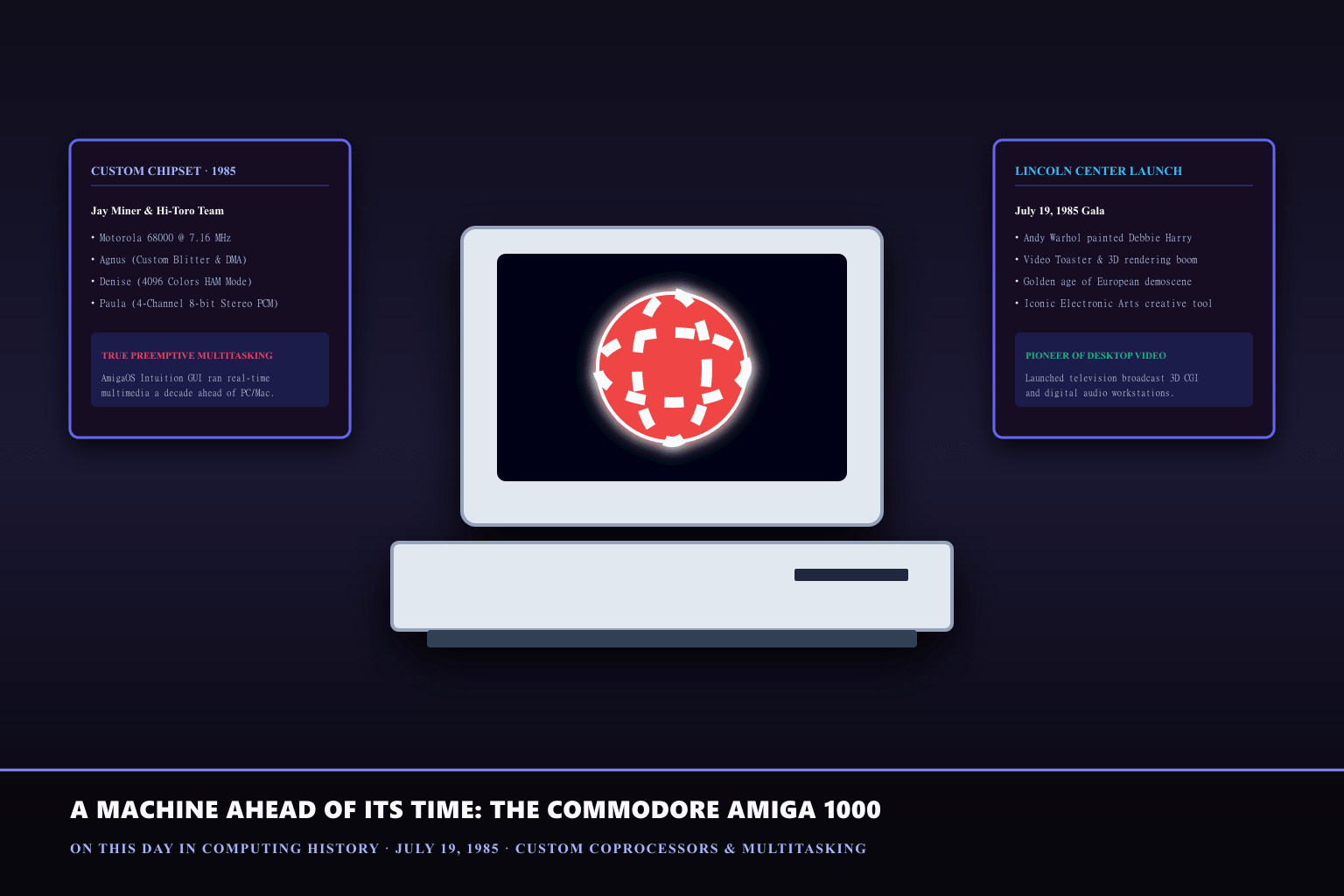
Jay Miner's Vision: The Custom Chipset Architecture
In the early 1980s, personal computers like the IBM PC and Apple Macintosh forced their main CPU to handle every calculation: updating screen pixels, playing audio tones, and processing user keyboard input. This created severe computational bottlenecks during graphics and audio rendering.
Jay Miner and his team at Amiga Corporation designed an architecture inspired by arcade game machines. They created three specialized custom coprocessors that offloaded heavy I/O and graphics tasks directly from the Motorola 68000 CPU via Direct Memory Access (DMA): Agnus contained a high-speed 'blitter' that moved rectangular graphics blocks at lightning speed without CPU intervention; Denise handled sprite animation and Hold-And-Modify (HAM) 4,096-color palettes; and Paula generated 4-channel hardware stereo audio.
AmigaOS: True Pre-Emptive Multitasking on a Desktop
While contemporary operating systems like MS-DOS could run only one program at a time and Apple's System 1 lacked multitasking entirely, AmigaOS featured the Intuition graphical user interface and the Exec core kernel—a lightweight, blazingly fast pre-emptive multitasking microkernel written by Carl Sassenrath.
Users could simultaneously play a 4-channel audio tracker, render a 3D ray-traced image, format a 3.5-inch floppy disk, and type in a word processor without screen stutter or input lag—a capability mainstream Windows and Mac operating systems would not fully achieve until the late 1990s.
The Lincoln Center Gala and the Creative Revolution
To announce the $1,295 computer, Commodore held a black-tie gala at Lincoln Center on July 19, 1985. Pop art icon Andy Warhol and Blondie lead singer Debbie Harry demonstrated the system live: Warhol captured Harry's face using a video digitizer, used ProPaint to fill her hair with vibrant digital colors, and famously proclaimed: 'The thing I like most about it is that it looks like my work.'
The Amiga 1000 and its successor, the Amiga 2000 with the NewTek Video Toaster expansion card, democratized desktop video editing and broadcast television graphics, powering visual effects for Hollywood TV shows like Babylon 5 and SeaQuest DSV while inspiring the European 'demoscene' digital art and music culture.
What the evidence does not settle
Despite its revolutionary hardware superiority, the Amiga suffered from inconsistent marketing and corporate mismanagement under Commodore leadership, who struggled to position the machine effectively between serious business spreadsheets and consumer gaming.
PRODUCT IDEA 01
Commodore: The Amiga Years — Brian Bagnall
Brian Bagnall's comprehensive, insider journalistic history chronicling the engineering battles, brilliant chip designers, and turbulent corporate drama behind the legendary Amiga.
Buying limit: Available in illustrated trade paperback (Variant Press) and digital formats. Copies typically retail between $22 and $38.
Original editorial illustration, not a retailer photograph. No exact Amazon offer passed our verification gate.PRODUCT IDEA 02
Retro 1980s Beige Mechanical Keyboard with Dye-Sub PBT Keycaps
A high-performance mechanical productivity keyboard featuring vintage warm-beige casing, tactile switches, and dye-sublimated PBT keycaps reminiscent of classic 80s computing workstations.
Buying limit: Look for hot-swappable switch sockets and multi-mode 2.4G/Bluetooth/USB-C connectivity. Quality retro keyboards range from $65 to $130.
Original editorial illustration, not a retailer photograph. No exact Amazon offer passed our verification gate.SOURCES, METHOD, AND LIMITS
Researched using original Commodore Amiga Hardware Reference Manuals (Addison-Wesley), Computer History Museum oral histories with Jay Miner and Carl Sassenrath, and Brian Bagnall's definitive history Commodore: The Amiga Years. No commercial products were physically tested.
- Computer History Museum — The Amiga at 30: History and System Architecture — Technical retrospective documenting Jay Miner's custom chip designs, the 1985 Lincoln Center launch, and Carl Sassenrath's Exec microkernel.
- Commodore-Amiga Inc. — Amiga ROM Kernel Reference Manual (Addison-Wesley, 1985) — Original primary documentation defining Exec task scheduling, copper coprocessor display lists, and Paula audio DMA channels.