ON THIS DAY · JULY 5, 1996
Reprogramming Biology: How the Birth of Dolly the Sheep in 1996 Shattered Dogma in Cellular Genetics
For decades, biological textbooks taught that once an adult cell specialized into skin, bone, or tissue, its developmental clock could never be reversed. On July 5, 1996, a healthy Finn-Dorset lamb born in Scotland proved that the genome of an adult cell could be completely reprogrammed to create a new life.
The Cellular Dogma: Irreversible Genetic Differentiation
Throughout the twentieth century, the central dogma of developmental embryology held that cell differentiation was a strictly one-way street. When a fertilized egg divides, embryonic stem cells progressively specialize into muscle, neurons, skin, or organ cells, with non-essential genes permanently locked away by epigenetic methylation.
Previous cloning experiments in frogs and mice had only succeeded using cells extracted from early-stage embryos. Most geneticists believed that the DNA of a fully specialized adult mammal had undergone irreversible structural changes that prevented it from ever directing the development of an entire living organism.
The SCNT Technique and the Quiescence Breakthrough
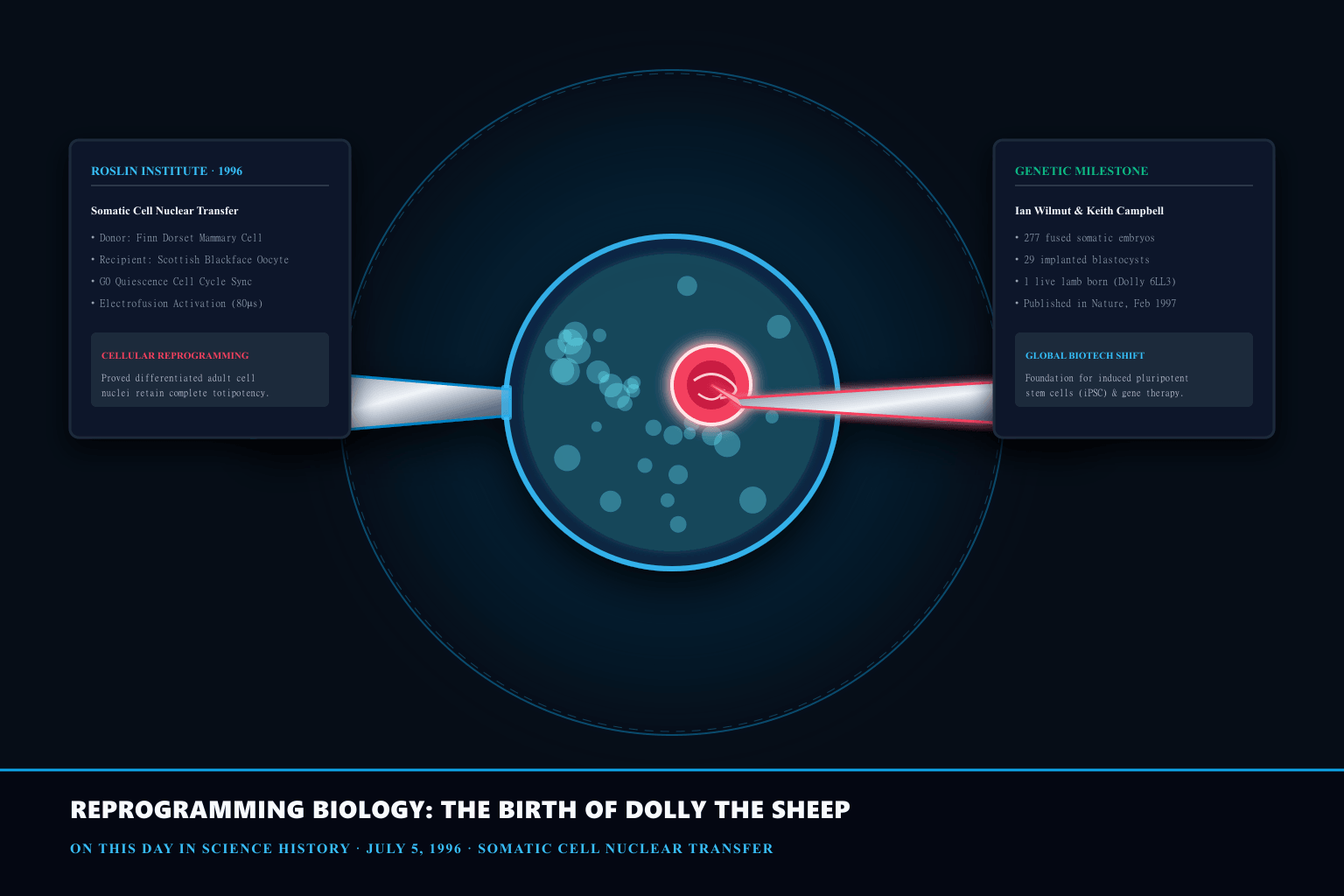
Keith Campbell and Ian Wilmut's crucial technical breakthrough was realizing that the donor adult cell and the recipient egg had to be synchronized in their cell cycle phases. They starved the cultured adult mammary cells of nutrients, forcing them into a dormant state of cellular hibernation known as the G0 (quiescence) phase.
The team removed the genetic nucleus from an unfertilized Scottish Blackface sheep egg (oocyte). They then placed the dormant donor nucleus beside the hollow egg and applied microscopic electrical pulses. The electrical shock performed two miracles simultaneously: it broke down the cell membranes so the nucleus fused into the egg, and it mimicked the electrical trigger of fertilization, kickstarting embryonic cellular division.
From 277 Embryos to Modern Regenerative Medicine
SCNT was a test of extraordinary laboratory patience. The team created 277 reconstructed cell pairs, which yielded twenty-nine viable embryos implanted into thirteen surrogate sheep. Only one pregnancy resulted in a live birth: Dolly, born healthy on July 5, 1996, and named affectionately after country music singer Dolly Parton.
When the team published their findings in Nature in February 1997, it triggered an international media storm and ethical debates. However, the scientific legacy was monumental: Dolly proved that adult specialized cells could be reset to an embryonic state, directly inspiring Shinya Yamanaka's 2006 Nobel Prize-winning discovery of induced pluripotent stem cells (iPSCs), which allows doctors to generate patient-specific nerve, cardiac, and retinal cells from ordinary skin biopsies without using embryos.
What the evidence does not settle
While Dolly lived a healthy life and gave birth to six lambs naturally, she developed osteoarthritis at age five and was euthanized in 2003 at age six due to jaagsiekte sheep retrovirus lung infection. Extensive telomere and health studies on subsequent clones confirmed that cloning does not cause accelerated premature aging when performed under modern protocols.
PRODUCT IDEA 01
Molecular Biology DNA Double Helix 3D Educational Model Kit

A color-coded, tactile molecular model kit demonstrating nucleotide base-pairing (A-T, G-C), phosphate backbones, and genetic replication mechanics.
Buying limit: Look for durable high-impact plastic components with sturdy desktop mounting stands. Quality molecular kits cost $18 to $35.
Original editorial illustration, not a retailer photograph. No exact Amazon offer passed our verification gate.PRODUCT IDEA 02
The Gene: An Intimate History — Siddhartha Mukherjee

Pulitzer Prize-winner Siddhartha Mukherjee's sweeping, deeply human narrative exploring the history of genetics from Mendel and Darwin to Dolly the Sheep and CRISPR gene editing.
Buying limit: Available in trade paperback (Scribner) and unabridged audio. Copies typically retail between $15 and $26.
Original editorial illustration, not a retailer photograph. No exact Amazon offer passed our verification gate.SOURCES, METHOD, AND LIMITS
Researched using primary scientific papers in Nature (Wilmut et al., 1997, Vol 385, Issue 6619), archival records from the Roslin Institute at the University of Edinburgh, and National Museum of Scotland curatorial collections. No commercial products were physically tested.
- Nature — Viable Offspring Derived from Fetal and Adult Mammalian Cells (Wilmut et al., 1997) — Original landmark scientific publication documenting the SCNT somatic cell nuclear transfer protocol, G0 synchronization, and Dolly's genetic fingerprinting.
- National Museums Scotland — Dolly the Sheep Curatorial Collection & Roslin Archives — Official curatorial retrospective documenting the preservation of Dolly, lab apparatus, and the lineage of subsequent Finn-Dorset cloned flocks.