ON THIS DAY · AUGUST 9, 1993
When Demons Invaded Office Computers: How id Software's Doom Shareware Revolutionized 3D Graphics and LAN Gaming
In late 1993, an independent team in Mesquite, Texas, released a first-person shooter that pushed PC hardware to its absolute limits. Powered by John Carmack's revolutionary rendering engine, Doom overwhelmed university networks, popularized multiplayer deathmatches, and defined 3D gaming.
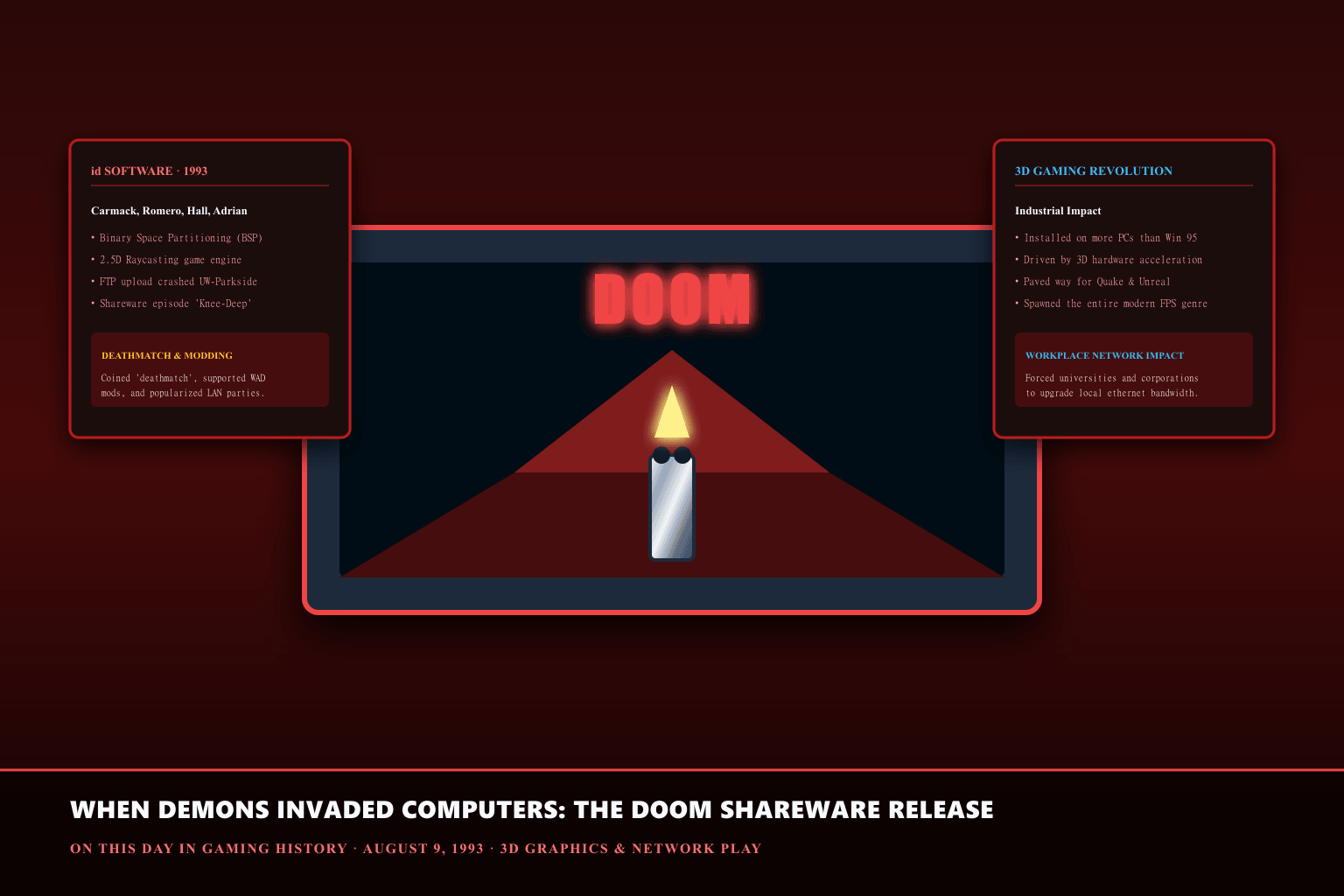
John Carmack's Rendering Breakthroughs: Binary Space Partitioning
Prior to Doom, 3D computer graphics on consumer PCs were hindered by CPU rendering bottlenecks. Carmack's previous engine for Wolfenstein 3D required flat floors, uniform ceiling heights, and strictly orthogonal 90-degree grid walls. To create immersive, atmospheric environments with variable elevations, curved stairs, and realistic shadows, Carmack turned to Binary Space Partitioning (BSP) algorithms.
By pre-computing the spatial geometric relationships of level geometry into a binary search tree, the game engine eliminated the costly need to sort polygons in real-time. The renderer only drew the visible surfaces closest to the player's camera viewpoint, enabling complex, non-grid map layouts to run smoothly on contemporary Intel 80486 processors.
The Shareware Distribution Engine and Modding Culture
id Software bypassed traditional retail software publisher distribution by embracing the shareware model. The complete first episode ('Knee-Deep in the Dead') was freely uploaded to University of Wisconsin FTP servers and BBS networks with explicit permission for users to copy and distribute it freely, while the remaining episodes were unlocked via direct mail-order phone sales.
Equally revolutionary was the software architecture: Carmack deliberately separated the core game engine executable from the game asset data, which was packaged into modular WAD ('Where's All the Data?') files. This modular design spawned the modern PC game modding community, allowing fans worldwide to create custom levels, sound packs, and total conversion games.
Network Deathmatches and the Strain on Corporate LANs
Doom popularized the term 'deathmatch' and pioneered competitive local area network (LAN) multiplayer over IPX network protocols. In 1994, Doom was so ubiquitous across university computer labs and corporate offices like Microsoft and Intel that system administrators wrote specialized scripts to detect and terminate Doom network packets during business hours.
The game's technical legacy extended far beyond gaming: its real-time graphics techniques influenced 3D computer simulation, virtual reality research, and GPU microarchitecture development for decades to follow.
What the evidence does not settle
Despite its revolutionary 3D visual appearance, Doom's engine was technically '2.5D' rather than true six-degrees-of-freedom 3D: rooms could not be placed directly above other rooms on the map coordinate grid, and players could not look vertically straight up or down due to planar projection limitations.
PRODUCT IDEA 01
Masters of Doom: How Two Guys Created an Empire and Transformed Pop Culture — David Kushner

David Kushner's acclaimed biographical masterpiece detailing the exhilarating rise of John Carmack and John Romero, from teenage hacker beginnings to the creation of Wolfenstein, Doom, and Quake.
Buying limit: Available in trade paperback (Random House) and audiobook formats. Copies typically retail between $14 and $24.
Original editorial illustration, not a retailer photograph. No exact Amazon offer passed our verification gate.PRODUCT IDEA 02
Retro Mechanical Gaming Keyboard with RGB Backlighting

A high-performance mechanical keyboard featuring tactile blue or linear red switches, anti-ghosting rollover, and customizable per-key backlighting for retro PC gaming sessions.
Buying limit: Ensure the deck includes dedicated media keys and braided USB-C cable routing. Quality mechanical gaming decks range from $40 to $90.
Original editorial illustration, not a retailer photograph. No exact Amazon offer passed our verification gate.SOURCES, METHOD, AND LIMITS
Researched using primary engine source code releases from id Software/GitHub, David Kushner's definitive journalistic account Masters of Doom, and IEEE Annals of the History of Computing technical profiles. No commercial products were physically tested.
- GitHub — id Software Doom Engine Source Code Repository (GPL v2) — Primary C programming source code documenting Carmack's BSP tree traversals, fixed-point arithmetic math tables, and IPX network sockets.
- IEEE Computer Society — The Architectural Evolution of 3D Game Engines — Academic retrospective analyzing ray-casting algorithms, column-based texture rendering, and early PC graphics memory optimization.