ON THIS DAY · AUGUST 22, 1994
The First Slice of E-Commerce History: How an Encrypted Pizza Order in 1994 Unlocked Trillion-Dollar Web Commerce
Before August 1994, putting a credit card number on the internet was considered suicidal computer security. When a 21-year-old entrepreneur sold a Sting CD over encrypted PGP software and Pizza Hut launched PizzaNet, the modern digital retail economy was born.
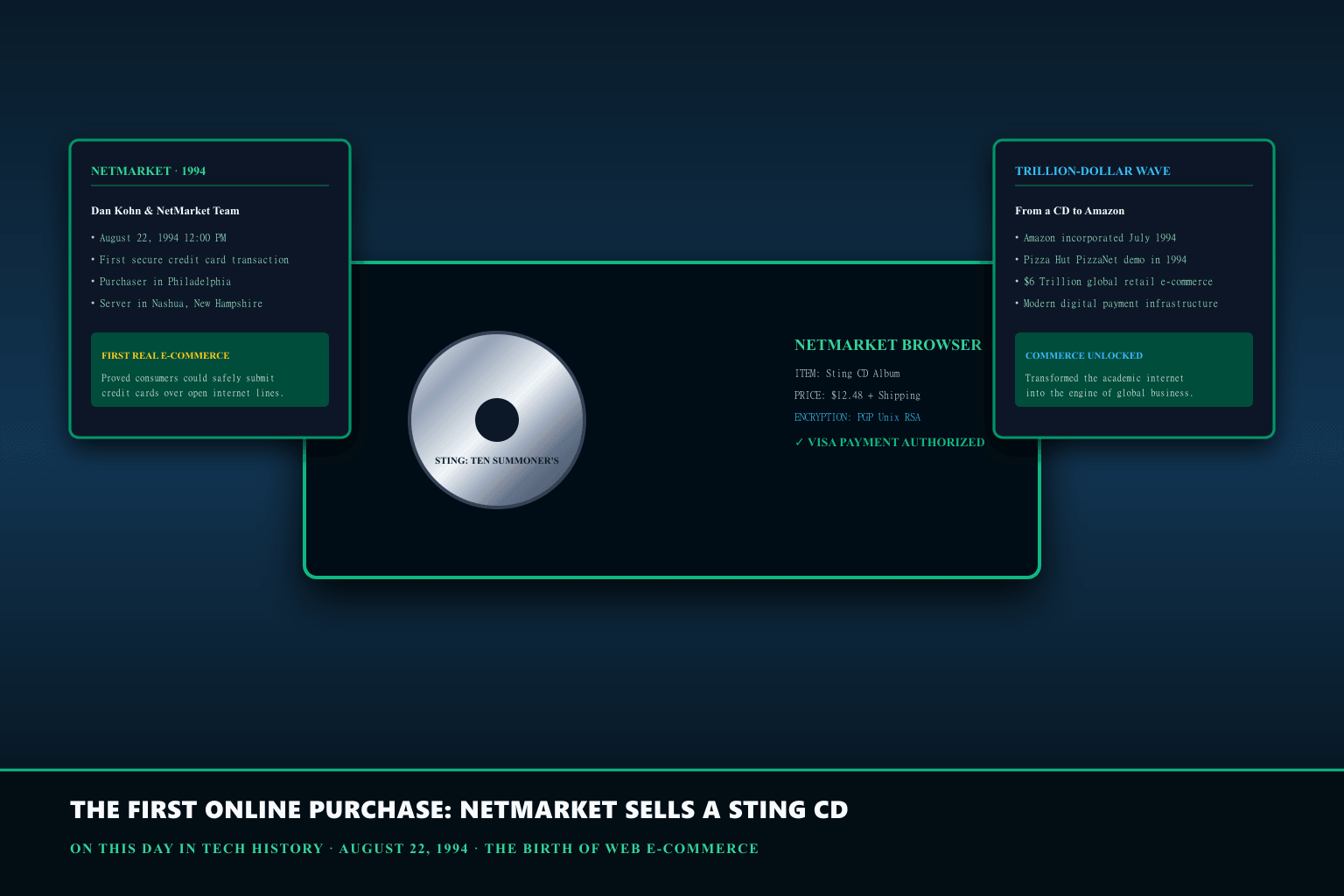
The Security Barrier: Why E-Commerce Seemed Impossible
In the early 1990s, commercial activity was explicitly prohibited on the academic National Science Foundation network (NSFNET) backbone under its Acceptable Use Policy. Even after the NSF lifted these commercial restrictions in 1991, consumer fear and lack of encryption protocols paralyzed digital trade.
Early internet connections were unencrypted plain-text streams. If a user sent a credit card number over standard HTTP or email, any packet sniffer or server node along the routing path could intercept and steal the credentials. Financial institutions strictly forbade merchants from accepting online transactions without secure cryptographic proof.
NetMarket, PGP, and the $12.48 Sting CD
Operating out of a house in Nashua, New Hampshire, Dan Kohn and his college friends built NetMarket. Rather than waiting for standard commercial browser encryption protocols to emerge, Kohn implemented Phil Zimmermann's command-line Pretty Good Privacy (PGP) encryption into the ordering workflow.
On August 11, 1994, buyer Phil Brandenberger used a customized Unix terminal running the Mosaic browser to submit his credit card number, which was encrypted with NetMarket's public key. The transaction cleared automatically via credit card merchant accounts, prompting The New York Times to declare on its front page: 'The internet is open for business.'
Pizza Hut PizzaNet: Bringing Digital Ordering to the Consumer
Simultaneously, Pizza Hut partnered with Santa Cruz Operation (SCO) to develop PizzaNet. Deployed as an experimental pilot in Santa Cruz, California, the website featured a simple grey HTML form where users typed their name, address, phone number, and pizza toppings.
Because backend credit card processing was still primitive, PizzaNet transmitted the order digitally to the local store, and store staff placed a confirmation phone call to verify the order before delivering the hot pizza for cash at the door. Within a decade, these experimental prototypes evolved into Amazon, Shopify, and a $6 trillion global e-commerce industry.
What the evidence does not settle
While NetMarket processed the first encrypted online credit card payment, early e-commerce required specialized software and technical expertise. Mainstream consumer e-commerce truly exploded in late 1995 following Netscape's introduction of automated SSL encryption into web browsers and the founding of Amazon and eBay.
PRODUCT IDEA 01
One-Click: Jeff Bezos and the Rise of Amazon.com — Richard L. Brandt
An insightful journalistic chronicle exploring how early 1990s digital retail experiments evolved into the world's most dominant e-commerce and cloud infrastructure powerhouse.
Buying limit: Available in trade paperback (Portfolio/Penguin) and digital formats. Copies typically retail between $12 and $20.
Original editorial illustration, not a retailer photograph. No exact Amazon offer passed our verification gate.PRODUCT IDEA 02
Cordierite Ceramic Pizza Grilling Stone & Bamboo Pizza Peel Set
A thermal-shock resistant cordierite ceramic baking stone with a bevel-edged bamboo peel, distributing heat evenly for restaurant-crispy pizza crusts in home ovens.
Buying limit: Ensure the stone is at least 15mm thick for optimal heat retention. Quality pizza stone kits range from $30 to $60.
Original editorial illustration, not a retailer photograph. No exact Amazon offer passed our verification gate.SOURCES, METHOD, AND LIMITS
Researched using contemporary front-page news reports from The New York Times (August 12, 1994), archival corporate documentation from NetMarket/Dan Kohn, and Pizza Hut corporate historical press releases. No commercial products were physically tested.
- The New York Times — Attention, Shoppers: Internet Is Open (August 12, 1994) — Original front-page report by Peter H. Lewis documenting Dan Kohn's NetMarket encrypted Sting CD transaction.
- Smithsonian National Museum of American History — The History of Early E-Commerce and Digital Retail — Curatorial technical review tracking the evolution of SSL, PGP payments, and Pizza Hut's PizzaNet interface.