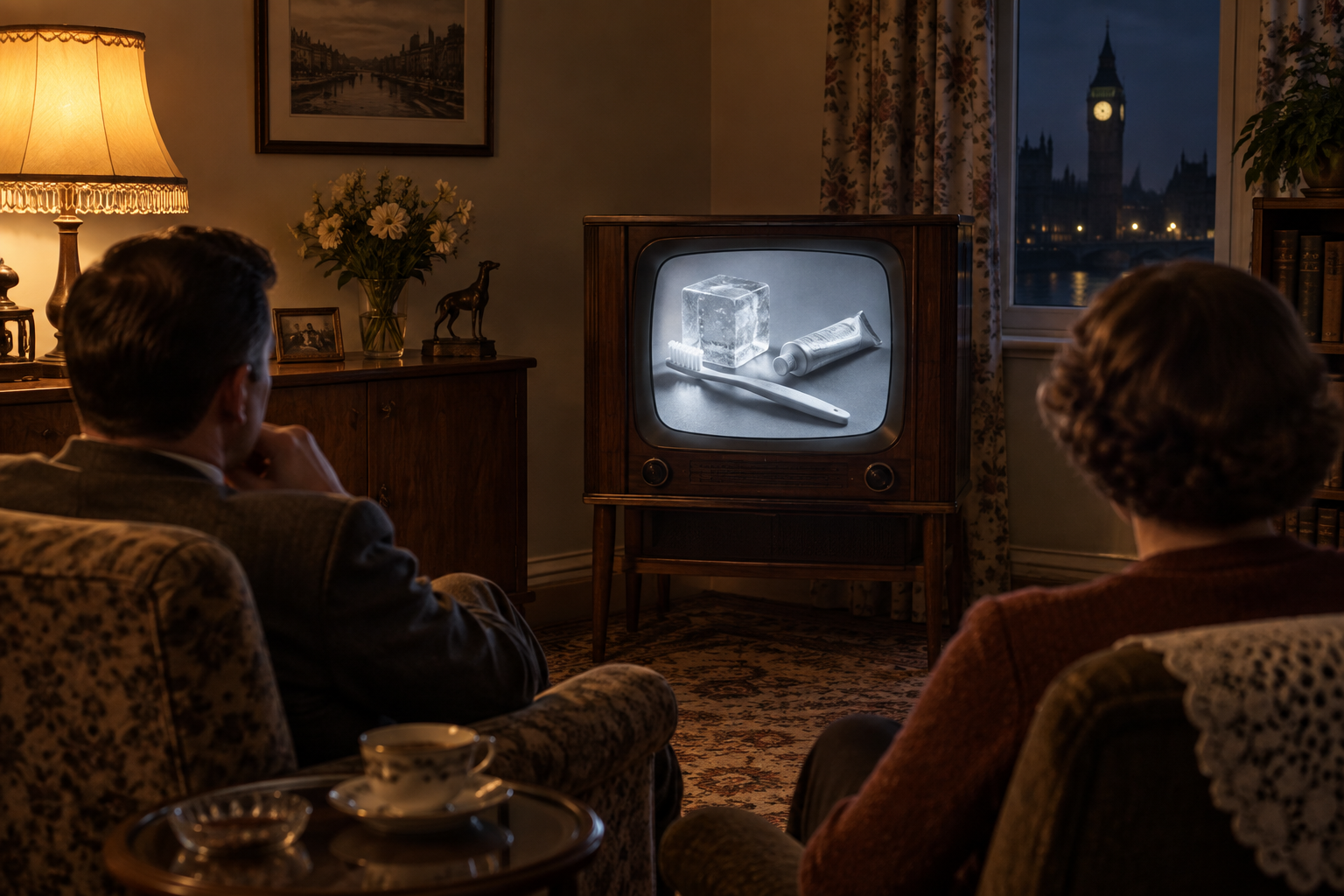
The three-second version of this anniversary is tempting: abrupt, strange, easy to repeat. It is also unsupported by the record we could find. The archive entry gives the film a running time of 1:00, while ITV's own anniversary account also calls it a one-minute commercial. A neat hook had apparently compressed the advert by 95 percent.
The correction matters because the real minute shows how advertisers imagined the new medium. This was not a modern logo sting. It was a miniature sales argument, built to move a familiar household product from newspaper and poster language into sound and motion.
Ice made an invisible ingredient visible
The film began with a toothpaste tube and toothbrush apparently locked in a block of ice. A woman then brushed her teeth while a chart connected the product to gum care. The repeated promise was a cold, tingling freshness. Gibbs SR's initials referred to sodium ricinoleate, an ingredient the maker promoted as beneficial for gums.
Television could not let viewers touch the product, and monochrome pictures could not lean on packaging colour. The ice solved both problems. It turned “fresh” into a scene the audience could almost feel. Whether the health message deserved equal confidence is a different question; the commercial's gum-disease framing belongs to 1955 advertising, not to current dental guidance.
The larger launch was commercial television itself
Gibbs SR did not interrupt an established ITV schedule. It appeared on Independent Television's opening night in London. The Television Act 1954 had created the Independent Television Authority and a broadcasting service additional to the BBC. Commercials supplied the revenue, but Parliament also placed advertising rules in the Act rather than treating the new market as a free-for-all.
The second schedule barred misleading advertisements, restricted some categories, and required a clear separation between programmes and commercials. That tension—commercial funding under public rules—was present before the first tube of toothpaste appeared on screen. It remains more consequential than the trivia question about which brand came first.
“First” needs a country attached
This was Britain's first television commercial, not the world's first. The date is also not the moment every British household suddenly gained commercial television. ITV's first service covered London, and the audience was small by later standards. The History of Advertising Trust estimates about 105,000 homes watched; ITV gives a rounded figure of 100,000.
Those figures are estimates, not a modern audience panel with minute-by-minute certainty. We therefore use them to describe scale, not as proof that exactly that many homes saw the opening advert.
One minute is the useful fact
The duration changes the meaning of the anniversary. A three-second spot would suggest that television advertising began as compressed interruption. A full minute shows an industry borrowing the pace of demonstration films and cinema advertising while learning what the living-room screen could do.
It also offers a practical test for historical technology stories: when a dramatic number appears without a source, check the catalogue record. Sometimes the correction is not a footnote. It is the most revealing part of the story.
PRODUCT IDEA 01 · TABLETOP DECOR
A retro TV shape without vintage electrical risk
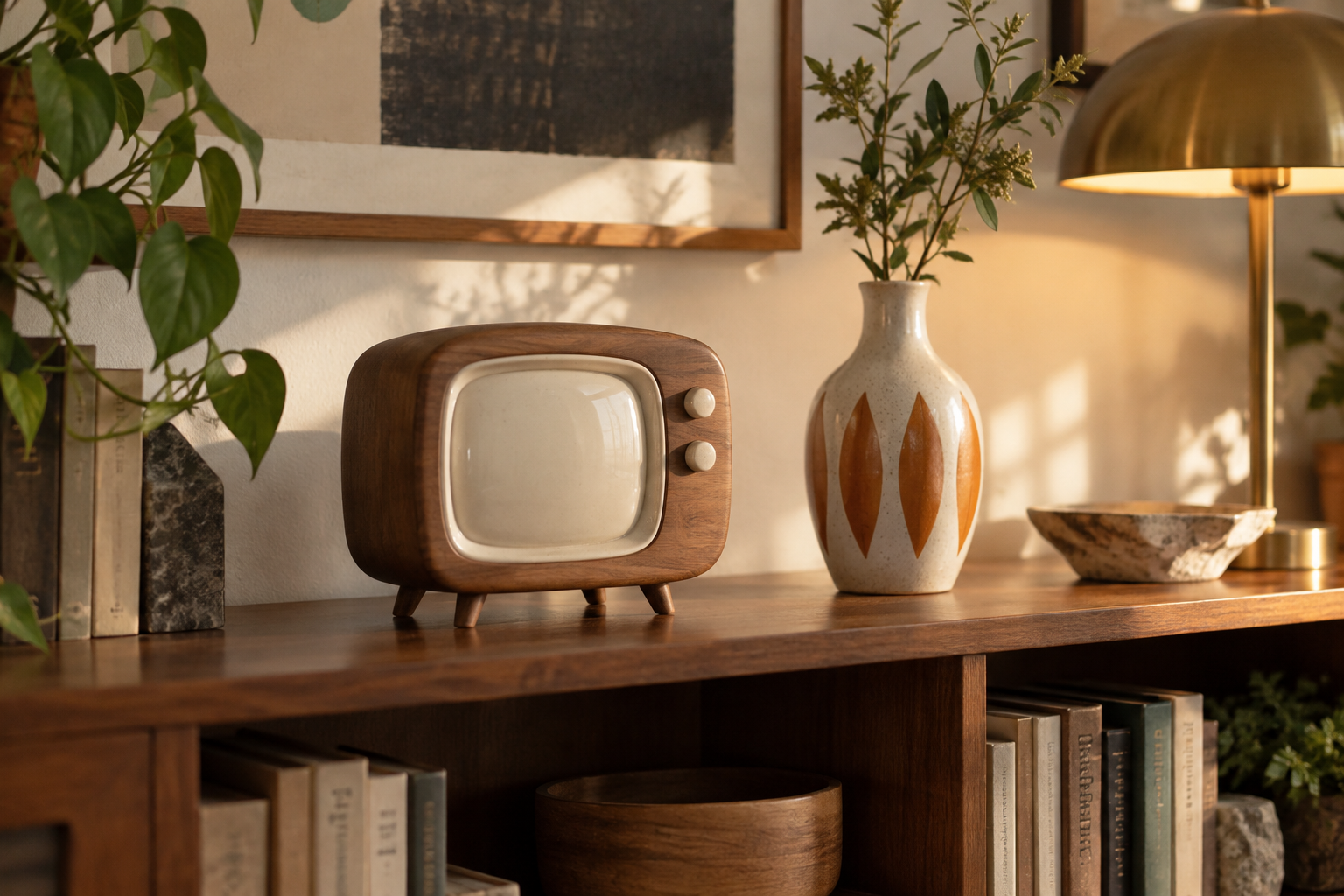
The calendar suggests retro-style tabletop TV decor. Treat it as sculpture, not as a miniature “working vintage set.” Check the dimensions against the shelf, choose a stable base, and avoid old powered CRT equipment unless a qualified technician has inspected it. A generic screen-shaped ornament is easier to place and carries none of the high-voltage and weight questions of an unrestored television.
Buying limit: “Retro TV decor” is a broad look, not an exact model. We could not verify one current Amazon.com offer with a clear seller, fulfillment route, materials, dimensions, and U.S. delivery today, so there is no affiliate link.
Original editorial image, not a retailer or manufacturer product photo.PRODUCT IDEA 02 · BOOK CHECK
Skip the title mismatch; choose actual broadcast history
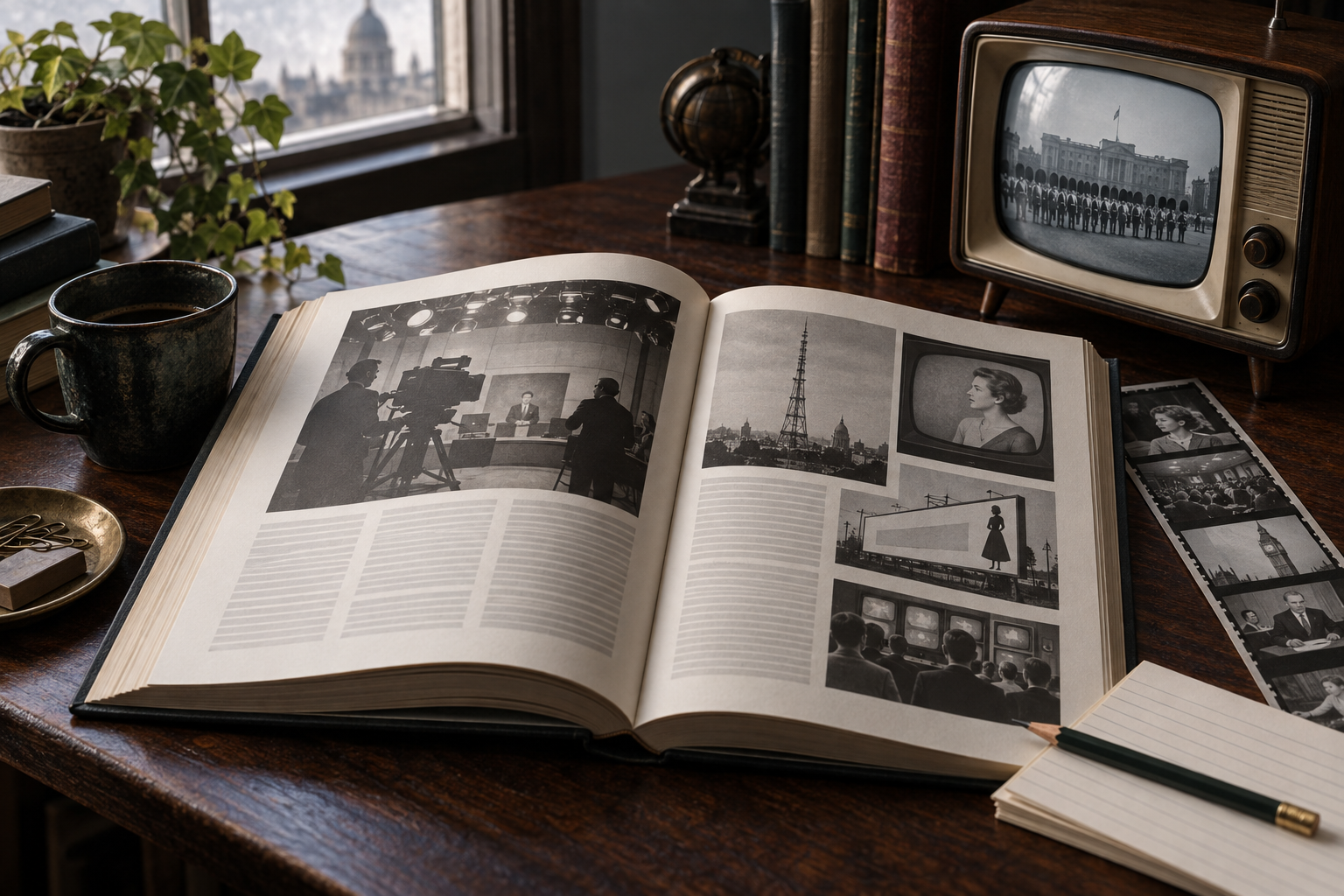
Our calendar named M. H. Abrams's The Mirror and the Lamp as media history. It is a major work of literary criticism about Romantic theory—not a history of British broadcasting. For this subject, look for a sourced book that covers the Television Act 1954, the regional franchise system, opening-night programming, and the regulation of advertising claims. Check the edition and index before buying.
Buying limit: Because the suggested title does not match the promised subject, we will not turn it into an affiliate recommendation. We also did not verify a replacement edition and exact Amazon.com offer today.
Original editorial image; it does not reproduce a publisher's cover or interior pages.FOUR QUESTIONS THAT FIX THE HEADLINE
What the anniversary shorthand leaves out
What was Britain's first television advert?
A one-minute commercial for Gibbs SR toothpaste, made by the advertising agency Young & Rubicam. It opened with toothpaste and a toothbrush apparently suspended in ice.
When did the Gibbs SR advert air?
ITV and the History of Advertising Trust record 8:12 p.m. on September 22, 1955, during the first evening of Independent Television broadcasting in London.
Was the first British TV advert only three seconds long?
No. The archival catalogue records a duration of one minute. We found no institutional source supporting the three-second claim in our planning calendar.
Was this the world's first television commercial?
No. It was the first television commercial broadcast in the United Kingdom. Commercial television advertising had already appeared elsewhere, including the United States.
SOURCES, METHOD, AND LIMITS
We checked the advert's date, time, duration, credits, slogan, and estimated audience against the History of Advertising Trust's Gibbs SR catalogue record and its advertising chronology. ITV's 60th-anniversary account independently describes a one-minute advert at 8:12 p.m. We used the Television Act 1954 for the authority and advertising rules, and the Science Museum Group's D & W Gibbs collection record for company and ingredient context. Oxford Academic identifies The Mirror and the Lamp as Romantic theory and literary criticism. We found no institutional support for the calendar's three-second wording or its claim about stunned viewers calling the station, so neither is repeated as fact. Product research was performed September 22, 2026; no product was hands-on tested, and no exact Amazon offer passed our verification gate.
CONTINUE THE THREAD
Browse the technology-history archive →How two punctuation marks became social technology →Practical technology guides →