ON THIS DAY · AUGUST 19, 1991
Where Every Website on Earth Began: The External Debut of info.cern.ch and Hypertext Publishing
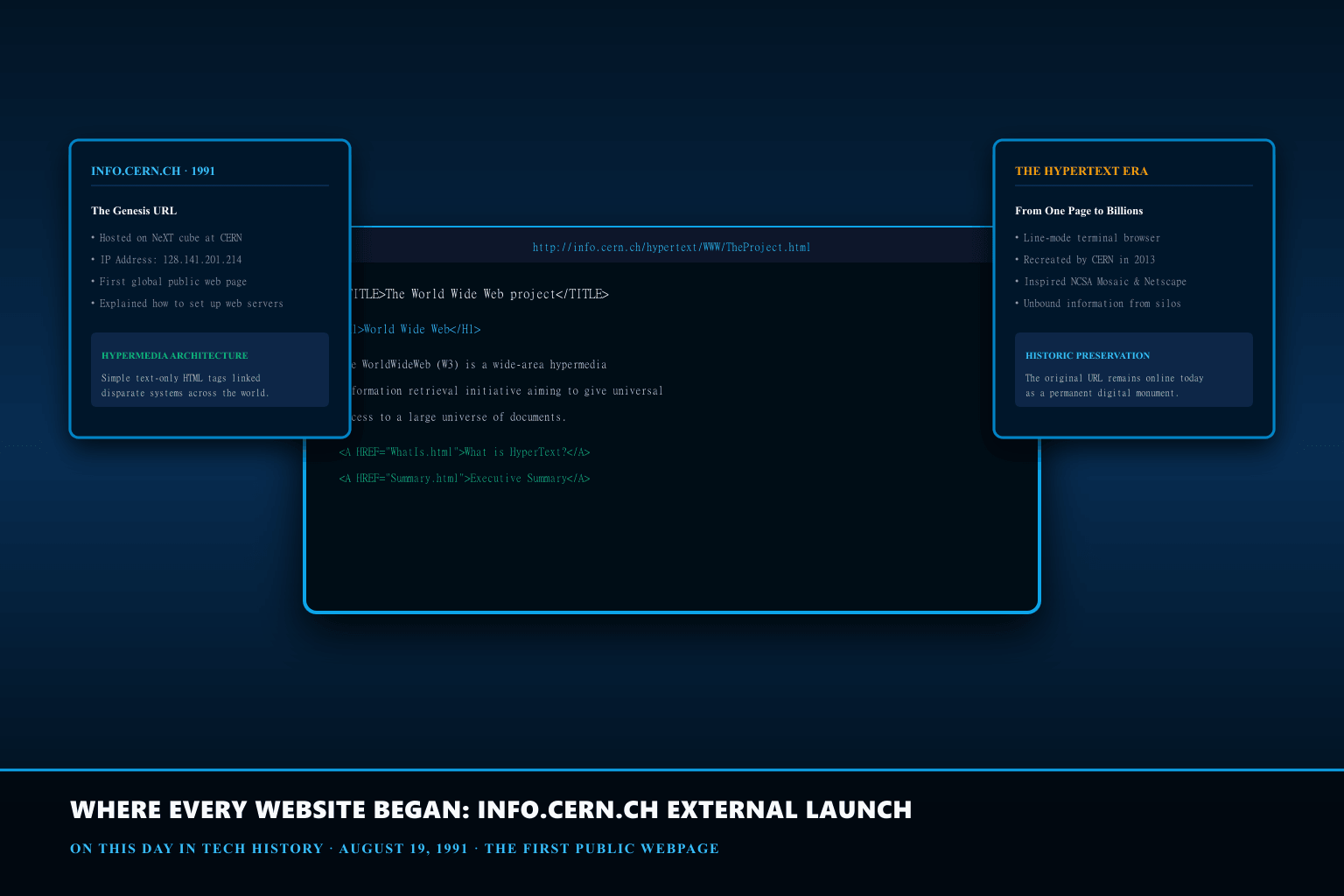
On a single desktop computer in a Swiss laboratory, a minimalist text document went live on the internet. Hosted at info.cern.ch, the world's very first web page explained what the World Wide Web was, how hyperlinks functioned, and how anyone on Earth could set up their own server.
The Machine in Building 31: The World's First Web Server
The entire World Wide Web originated from a single workstation located in Building 31 at the CERN particle physics laboratory outside Geneva. The computer was a black magnesium NeXTcube powered by a 25 MHz Motorola 68040 processor with 8 megabytes of RAM and a 400 MB magneto-optical hard drive.
To prevent colleagues or janitorial staff from accidentally unplugging the machine, Berners-Lee famously affixed a handwritten red label with Scotch tape: 'This machine is a server. DO NOT POWER IT DOWN!!' On this workstation, Berners-Lee ran the CERN httpd daemon, which answered incoming HTTP requests on port 80.
The Architecture of 'TheProject.html'
The first web page was not a flashy multimedia showcase; it was an austere, high-density hypertext document containing raw HTML markup. Because early HTML was strictly semantic, it featured simple `<HEADER>`, `<TITLE>`, `<P>`, and `<A HREF>` anchor tags designed to render legibly on any monochrome text terminal.
The page contained direct hyperlinks to sub-pages explaining: 'What is HyperText,' a bibliography of hypertext research, a technical summary of how to write basic HTML, and a list of CERN software personnel. It also hosted the 'WWW Virtual Library'—the world's very first subject directory of available online information.
The 2013 Restoration and the Preservation of Digital Heritage
In the early years of the web, digital preservation was not prioritized, and the original 1991 state of `TheProject.html` was continuously overwritten with updated software releases. In 2013, a dedicated team of CERN archivists and web developers launched the 'First Web Site' restoration project.
By scouring old backup magnetic tapes and historical archives, the team successfully reconstructed the earliest surviving 1992 version of the web page at its original URL (`http://info.cern.ch/`). The project highlighted the urgent need to archive internet history and preserve the open, non-proprietary spirit of early digital pioneers.
What the evidence does not settle
Because the NeXTSTEP graphical browser ran exclusively on Steve Jobs' proprietary NeXT workstations, the vast majority of early users in 1991 accessed info.cern.ch using the command-line Line Mode Browser, which navigated between hyperlinks by typing numbers rather than clicking a graphical mouse.
PRODUCT IDEA 01
HTML & CSS: Design and Build Websites by Jon Duckett

Jon Duckett's gorgeously illustrated, full-color visual masterpiece that teaches the fundamentals of HTML structure, CSS styling, and semantic modern web publishing.
Buying limit: Available in flexibound full-color editions and digital formats. Copies typically retail between $22 and $38.
Original editorial illustration, not a retailer photograph. No exact Amazon offer passed our verification gate.PRODUCT IDEA 02
Minimalist Extended Web Developer Desk Pad & Shortcut Mat
An extra-large, water-resistant micro-woven desk mat featuring reference guides for HTML tags, CSS box models, and terminal shortcuts with non-slip natural rubber backing.
Buying limit: Look for stitched anti-fray edges and thick 3mm natural rubber cushioning. Quality desk pads range from $18 to $35.
Original editorial illustration, not a retailer photograph. No exact Amazon offer passed our verification gate.SOURCES, METHOD, AND LIMITS
Researched using primary server logs and restored HTML files from the CERN Web Preservation Project, W3C historical archives, and Tim Berners-Lee's personal correspondence. No commercial products were physically tested.
- CERN — The Restored Original First Web Page (info.cern.ch Archive) — Primary restored HTML source code of the 1991/1992 World Wide Web project overview and server configuration documentation.
- CERN Document Server — The NeXT Workstation Web Server Preservation Monograph — Curatorial technical review detailing the hardware preservation of Tim Berners-Lee's NeXTcube and the CERN httpd daemon logs.