ON THIS DAY · JULY 14, 1995
The Three Letters That Upended the Music Industry: How Fraunhofer IIS Created the MP3 Audio Compression Format
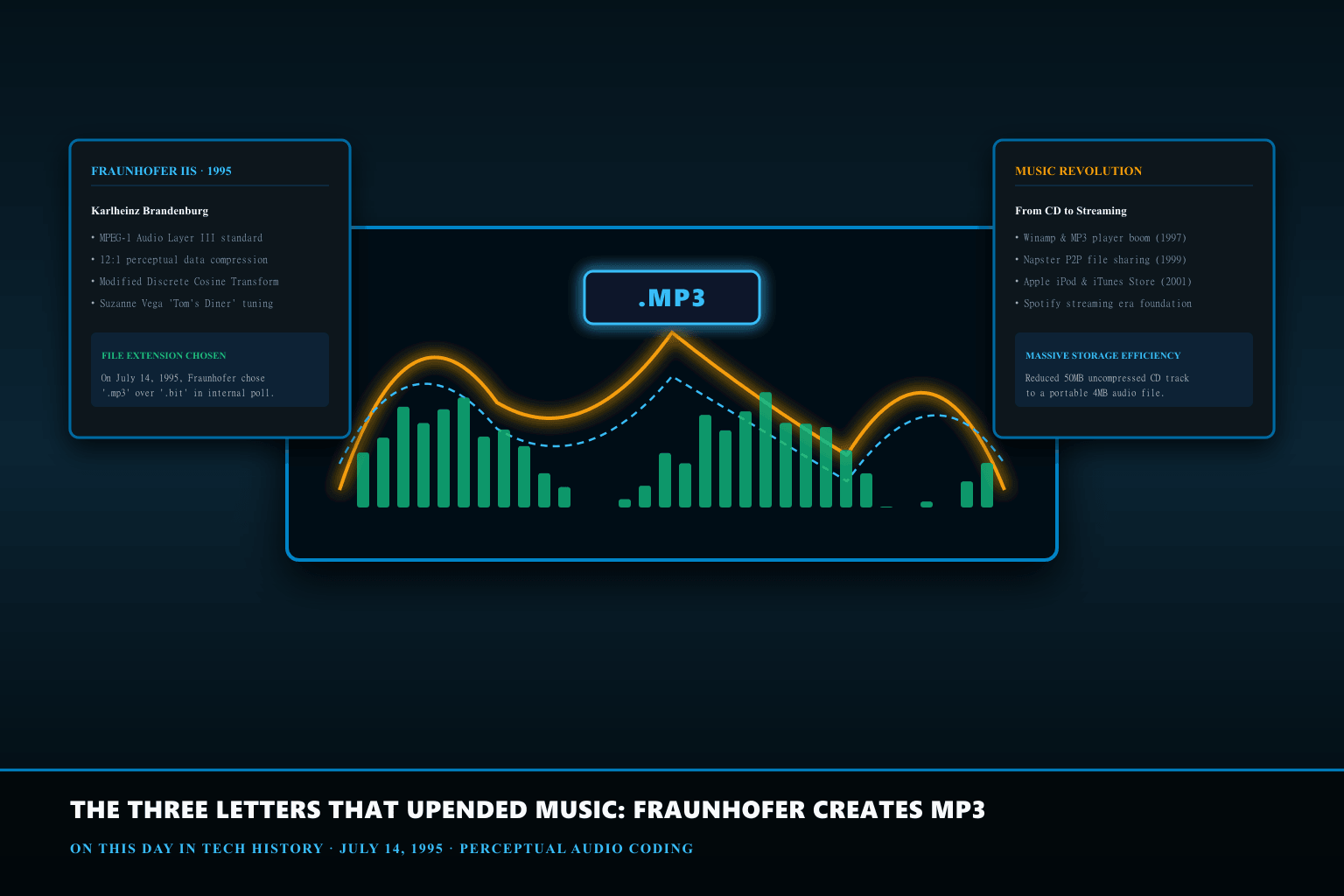
On Friday, July 14, 1995, German engineers at the Fraunhofer Institute held an internal poll to pick a file extension for their new compression algorithm. They chose '.mp3'—a decision that reduced music file sizes by 90%, birthed digital piracy, and created modern streaming.
The Psychoacoustic Principle: Eliminating What the Ear Cannot Hear
Standard uncompressed CD audio (Compact Disc Digital Audio) records 44,100 sixteen-bit stereo samples every second, consuming approximately 10 megabytes of storage per minute. In the early 1990s, when dial-up modems operated at 28.8 kbps and PC hard drives held only a few hundred megabytes, transmitting or storing full-resolution WAV files was virtually impossible.
Brandenburg and his team realized that the human auditory system is imperfect. Through a biological phenomenon called 'auditory masking,' when a loud sound occurs (such as a cymbal crash), the human brain is physiologically incapable of hearing quieter acoustic frequencies played immediately before, after, or adjacent to that frequency. The MP3 algorithm used a sophisticated perceptual model to calculate dynamic masking thresholds, ruthlessly discarding mathematically redundant inaudible sound data.
The 'Tom's Diner' Benchmark and the MDCT Transform
Tuning the perceptual model proved notoriously difficult for human vocals. Brandenburg frequently tested his algorithms using Suzanne Vega's 1987 acapella track 'Tom's Diner.' Because her warm, unaccompanied voice possessed sharp transient consonants and subtle reverberant decays, early MP3 encoders produced harsh, metallic ringing artifacts (pre-echo distortion).
By developing dynamic sub-band window switching within the Modified Discrete Cosine Transform (MDCT) mathematical engine, the engineers allowed the encoder to shift between long 576-sample windows for sustained chords and short 192-sample windows for rapid vocal transients, achieving warm, CD-transparent audio quality at a bit rate of 128 kbps (a 12-to-1 compression ratio).
The July 14 Poll and the Digital Music Explosion
On July 14, 1995, after an internal team email vote, Fraunhofer researcher Jürgen Zeller finalized the three-letter `.mp3` extension. Two years later, independent developer Tomislav Uzelac created the AMP MP3 Playback Engine, which college students Justin Frankel and Dmitry Boldyrev packaged into Winamp in 1997.
The tiny file size of MP3 allowed entire albums to download in minutes over high-speed university networks. In 1999, Shawn Fanning and Sean Parker launched Napster, unleashing peer-to-peer file sharing that fundamentally overturned global music distribution and directly motivated Steve Jobs to launch the iPod and iTunes Music Store in 2001.
Today, psychoacoustic compression principles pioneered by Fraunhofer IIS remain the bedrock of global music streaming, Bluetooth AAC codecs, and digital telephony.
What the evidence does not settle
While MP3 achieved astonishing compression ratios, early low-bitrate encoders (e.g. 64 kbps to 96 kbps) suffered from noticeable high-frequency roll-off above 16 kHz, phase distortion on stereo imaging, and flanging artifacts on complex orchestral music.
PRODUCT IDEA 01
High-Resolution Lossless Digital Audio Player with Dual DACs
A dedicated audiophile portable audio player featuring dual CS43198 DAC chips, balanced 4.4mm and 3.5mm outputs, and native DSD/FLAC/MP3 decoding.
Buying limit: Look for expandable MicroSD card slots (up to 1TB) and two-way Bluetooth LDAC streaming. Quality DAPs cost $80 to $200.
Original editorial illustration, not a retailer photograph. No exact Amazon offer passed our verification gate.PRODUCT IDEA 02
How Music Got Free: The Inventor, the Mogul, and the Thief — Stephen Witt
Stephen Witt's electrifying, brilliantly reported journalistic chronicle detailing how German engineers invented the MP3 and revolutionized the global music industry.
Buying limit: Available in trade paperback (Penguin Books) and unabridged audio. Copies typically retail between $14 and $24.
Original editorial illustration, not a retailer photograph. No exact Amazon offer passed our verification gate.SOURCES, METHOD, AND LIMITS
Researched using ISO/IEC MPEG-1 Audio standard documentation (ISO/IEC 11172-3), Karlheinz Brandenburg's technical retrospective papers at the Audio Engineering Society (AES), and Stephen Witt's definitive journalistic history How Music Got Free. No commercial products were physically tested.
- Fraunhofer IIS — The Story of MP3: History, Research & Development — Official research institute archive documenting Brandenburg's auditory masking models, the July 14, 1995 extension naming, and licensing patents.
- Audio Engineering Society (AES) — MP3 and AAC Explained: The Technical Architecture — Technical monograph analyzing MDCT transform filterbanks, Huffman coding entropy reduction, and psychoacoustic masking curves.