ON THIS DAY · TECHNOLOGY HISTORY
From a Menlo Park Garage to PageRank: How Google Was Built on Cheap Hard Drives and LEGO Bricks
Armed with an uncashed $100,000 seed check, ten 4GB drives stacked in toy building bricks, and a radical citation algorithm, two Stanford Ph.D. students turned a rented garage into the foundation of the modern web.
The Academic Genesis: From Backrub to Web Citations
In mid-1995, Larry Page and Sergey Brin met at Stanford University as computer science doctoral students searching for compelling dissertation topics. The World Wide Web was expanding rapidly, yet navigating it remained deeply frustrating: dominant portals such as AltaVista, Lycos, and Excite functioned primarily as brute-force keyword counters. If a webmaster repeated the word 'automobile' several thousand times in hidden white text at the bottom of an HTML page, search engines dutifully promoted that site to the top of search rankings. Searching for information was a contest easily manipulated by spammers, commercial aggregators, and link farms.
Page approached the web from a fundamentally different perspective: graph theory and bibliometrics. Inspired by Eugene Garfield’s Science Citation Index—the academic standard that measures the importance of a scientific research paper by the number and quality of other papers citing it—Page wondered if the World Wide Web's hyperlinks could serve a similar mathematical purpose. Working under the Stanford Digital Libraries Project, Page developed an experimental web crawler named 'Backrub,' so named because it analyzed backward links pointing into web pages. Collaborating with Brin, whose mathematical acumen focused on data mining, they developed the PageRank algorithm. Instead of treating all links equally, PageRank modeled the behavior of a hypothetical 'random surfer' traversing the web: a link from an authoritative, highly connected portal like Stanford.edu or Yahoo imparted far more weight than a link from an obscure personal home page. By calculating the stationary probability distribution of this Markov chain across tens of millions of interconnected nodes, Google could rank search results with astonishing, unprecedented relevance.
The $100,000 Check and Susan Wojcicki's Garage
By early 1998, the Backrub prototype running on Stanford’s campus network was consuming nearly half of the university’s total internet bandwidth, indexing roughly 24 million web documents. Stanford faculty and administrators were supportive but eager for the bandwidth-hungry research project to spin off into its own independent infrastructure. Page and Brin initially had no intention of founding an operating company; they hoped to license their search patents to existing internet giants. However, Silicon Valley portals like Yahoo and Excite repeatedly passed on the opportunity, fearing that providing users with instantaneous, accurate search results would cause visitors to leave their advertising-heavy portal directories too quickly.
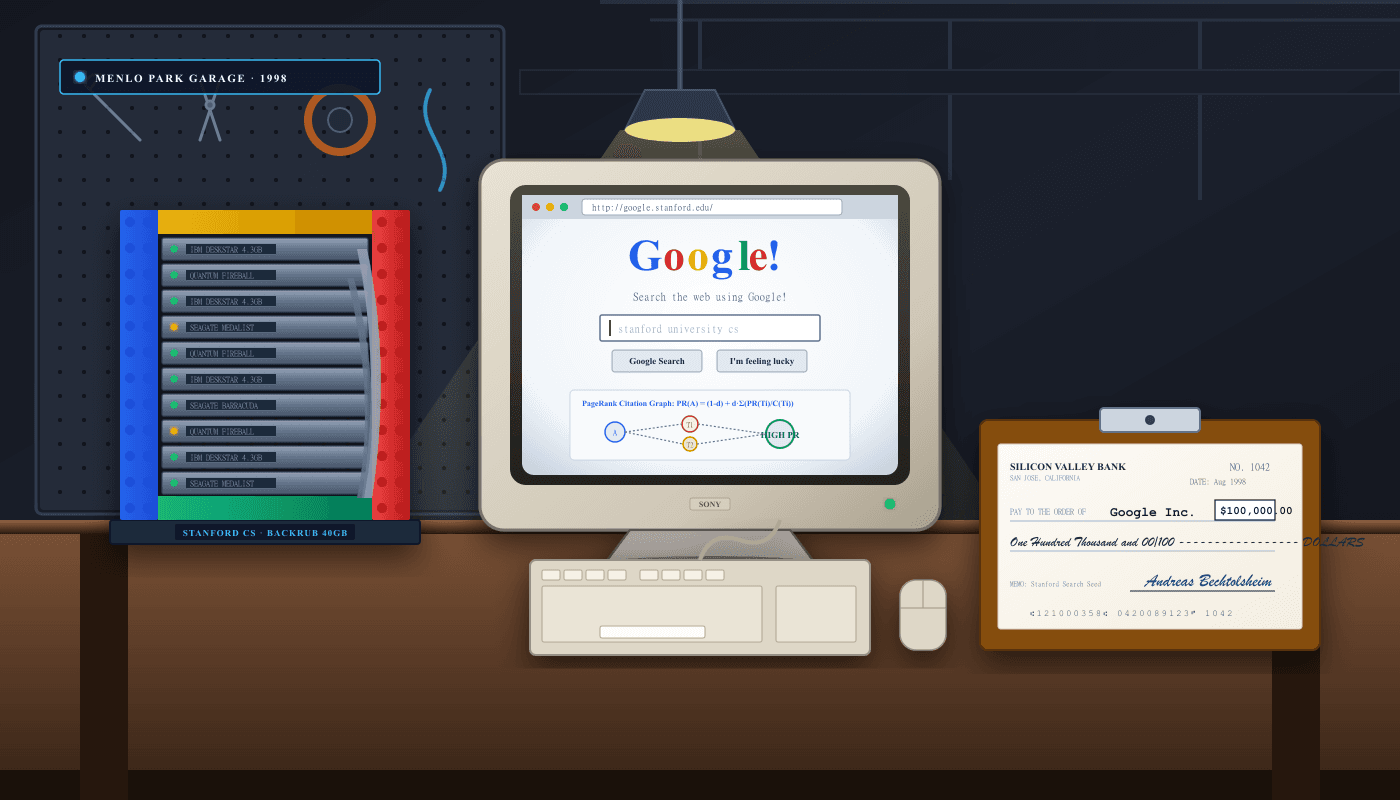
Faced with disinterest from established incumbents, the founders turned to angel financing. In August 1998, Stanford professor David Cheriton arranged an early morning meeting on his front porch in Palo Alto with Andy Bechtolsheim, the legendary hardware engineer and co-founder of Sun Microsystems. Page and Brin brought a laptop and demonstrated their live prototype. Bechtolsheim was instantly convinced by the speed and precision of PageRank. In a rush to attend another executive meeting, Bechtolsheim pulled out his checkbook, wrote a check for $100,000, and handed it to the young founders. There was only one problem: Bechtolsheim had made the check payable to 'Google Inc.'—a legal entity that did not yet exist. The check sat in Larry Page's desk drawer for several weeks while the pair scrambled to draft incorporation paperwork, file articles with the California Secretary of State on September 4, 1998, and open a corporate bank account. Flush with their first seed capital, they rented Susan Wojcicki’s attached garage at 232 Santa Margarita Avenue in Menlo Park for $1,700 per month, bringing in Craig Silverstein as their first employee and establishing Google's very first corporate headquarters.
The 40GB LEGO Server and Commodity Hardware Architecture
While modern hyperscale data centers feature custom liquid-cooled server blades and AI accelerators, Google's earliest physical infrastructure was an extraordinary exercise in frugal improvisation. Crawling and indexing the rapidly ballooning web required storing massive inverted index tables and document repositories. In 1996 and 1997, commercial high-reliability enterprise storage systems (such as high-end SCSI arrays and mainframe storage cabinets) cost tens of thousands of dollars—far exceeding the modest budget of graduate student research grants. Instead, Page and Brin purchased ten off-the-shelf 4-gigabyte consumer hard drives, totaling 40 gigabytes.
To house these ten bare hard drives, Page designed a custom modular chassis constructed entirely from primary-colored toy LEGO Duplo bricks. The choice was not merely playful or whimsical; it was brilliant practical engineering. Plastic LEGO blocks were non-conductive, lightweight, cost virtually nothing, and could be continuously snapped together or reconfigured as new drives were added or failed units were swapped out. Open-frame LEGO spacing allowed air to circulate freely around the hot drive platters without requiring expensive ducted sheet metal enclosures. More importantly, this scrappy Stanford experiment established Google’s foundational distributed computing philosophy: rather than relying on exorbitant, fault-tolerant enterprise hardware that would inevitably crash or become obsolete, software should be architected to handle redundancy and high failure rates across vast arrays of cheap, disposable commodity consumer components.
Deconstructing the Garage Myth and the September 27 Milestone
Popular Silicon Valley lore often frames Google as two rebellious college dropouts working entirely alone in a dark suburban garage against the world. In reality, Google’s miraculous emergence was the triumphant culmination of public research funding, institutional academic support, and dense Silicon Valley venture networks. Page and Brin's research was directly financed by the National Science Foundation, DARPA, and NASA under the Digital Libraries Initiative. Stanford University held the master patent for PageRank (U.S. Patent 6,285,999) and licensed it exclusively to Google in exchange for equity shares that later netted the university over $330 million.
Similarly, the question of Google’s official birthday highlights the pragmatic, evolving nature of corporate milestones. Legally, Google Inc. was incorporated on September 4, 1998. The domain google.com was registered on September 15, 1997. In the company’s earliest years, birthday doodles were posted on September 7, September 8, and September 26. It was not until September 2005 and 2006 that Google permanently anchored its birthday celebration on September 27, when the engineering team published a historic announcement marking the indexing of an unprecedented number of web pages—officially pulling ahead of rival Yahoo’s directory size. Today, September 27 serves as an annual reminder of the day Google stepped firmly out of Stanford's academic halls and into the world, demonstrating that clean mathematical insight combined with ruthless hardware pragmatism could index human knowledge and redefine the modern information age.
What the evidence does not settle
While Google's garage phase is celebrated in corporate mythology, retrospective accounts often compress timelines and obscure how heavily the project depended on public academic infrastructure. Larry Page and Sergey Brin developed Backrub within the Stanford Digital Libraries Project, which was funded by the National Science Foundation (NSF Grant IRI-9411306), DARPA, and NASA. Furthermore, Google's official celebration of September 27 as its birthday was adopted symbolically years later—first tied to an index-size milestone in the mid-2000s—even though California incorporation documents record September 4, 1998 as the formal legal entity birth date.
PRODUCT IDEA 01
In the Plex: How Google Thinks, Works, and Shapes Our Lives by Steven Levy
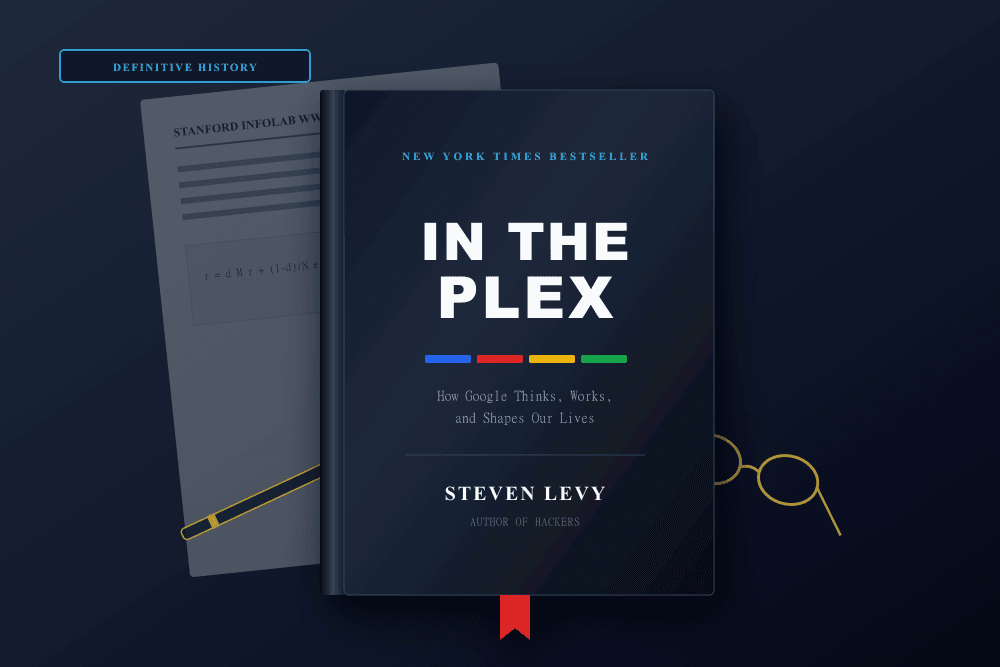
Steven Levy's definitive journalistic history provides unmatched insider access into Google's engineering culture, the development of PageRank, and the Menlo Park garage days. Drawing from hundreds of interviews with Larry Page, Sergey Brin, Eric Schmidt, and early engineers, Levy meticulously documents the mathematical philosophy, unorthodox management practices, and infrastructure decisions that allowed a Stanford research experiment to evolve into a global information utility.
Buying limit: While 'In the Plex' is widely available in trade paperback (ISBN-10: 1416596585) and unabridged digital audiobook formats, readers should note that secondhand hardcover printings often command inflated marketplace prices. Because direct real-time delivery and merchant fulfillment fluctuate across online booksellers, we recommend checking local independent bookshops or digital public library lending before paying reseller markups.
Original editorial illustration, not a retailer photograph. No exact Amazon offer passed our verification gate.PRODUCT IDEA 02
Google Nest Mini and the Ambient Computing Evolution
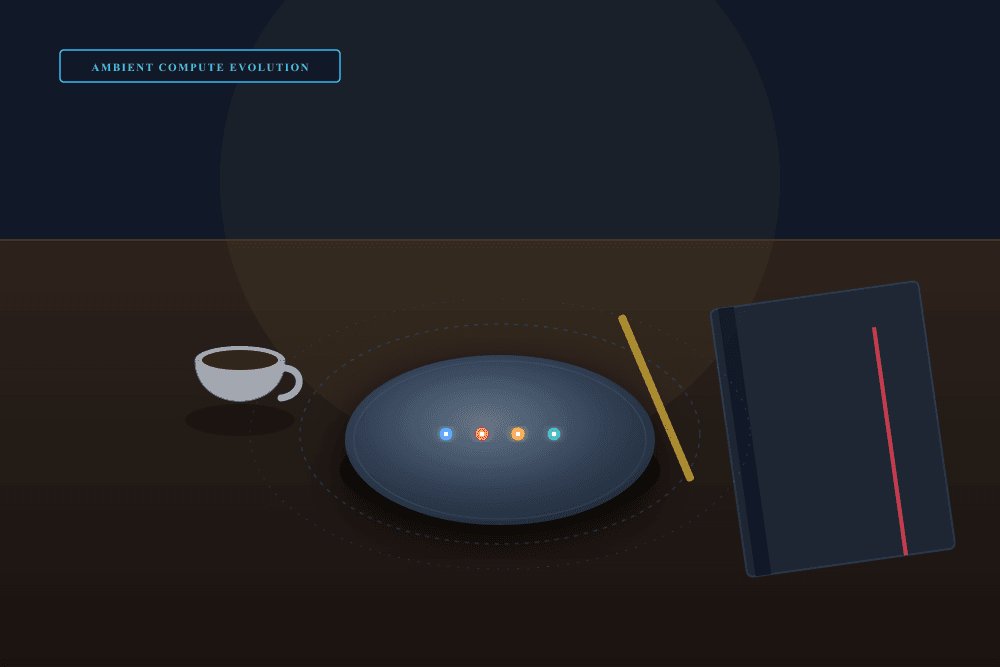
The journey from Larry Page and Sergey Brin's 40-gigabyte LEGO-cased disk array to ambient voice-driven computing represents one of the most remarkable hardware shifts in modern technology. The Google Nest Mini encapsulates this evolution by condensing machine-learning voice recognition, streaming query resolution, and smart home automation into a compact fabric-covered puck that connects back to global distributed clusters without requiring local storage drives.
Buying limit: Prospective buyers should evaluate their home smart ecosystem carefully before investing in Nest hardware. While the device excels at Google Search queries, YouTube Music integration, and Assistant commands, it requires a persistent Wi-Fi connection and an active Google account. Because third-party marketplace listings frequently bundle obsolete first-generation Google Home units under misleading titles, always verify hardware generation and manufacturer warranty before buying.
Original editorial illustration, not a retailer photograph. No exact Amazon offer passed our verification gate.SOURCES, METHOD, AND LIMITS
We investigated Google's origins by examining primary academic publications and institutional archives, starting with Sergey Brin and Larry Page's original 1998 Stanford InfoLab paper 'The Anatomy of a Large-Scale Hypertextual Web Search Engine' (WWW7). We cross-referenced primary incorporation filings from the California Secretary of State, oral history transcripts from the Computer History Museum (notably the Andreas Bechtolsheim Oral History, CHM Ref: X7546.2016), and official Google corporate retrospectives, verifying technical server specifications, seed investment details, and distinguishing established architectural facts from Silicon Valley folklore.
- Stanford InfoLab: The Anatomy of a Large-Scale Hypertextual Web Search Engine — Primary academic paper published by Sergey Brin and Larry Page for the Seventh International World Wide Web Conference (WWW7) documenting the initial PageRank algorithm, Google crawler architecture, and index data structures.
- Computer History Museum: Oral History of Andreas 'Andy' Bechtolsheim — Institutional oral history transcript (CHM Ref: X7546.2016) documenting Andy Bechtolsheim's August 1998 meeting with Larry Page and Sergey Brin and the issuance of the initial $100,000 seed investment check.
- Google Official Corporate History: From the Garage to the Googleplex — Primary corporate archival retrospective detailing the Menlo Park garage setup, the Stanford dorm transition, and the operational milestones leading to the September anniversary traditions.