ON THIS DAY · TECHNOLOGY HISTORY
TAT-1 in 1956: when thirty-six phone lines tamed the North Atlantic
On September 25, 1956, twin coaxial cables and flexible deep-sea repeaters linked Scotland to Newfoundland, replacing crackling radiotelephone traffic with the first permanent undersea voice bridge.
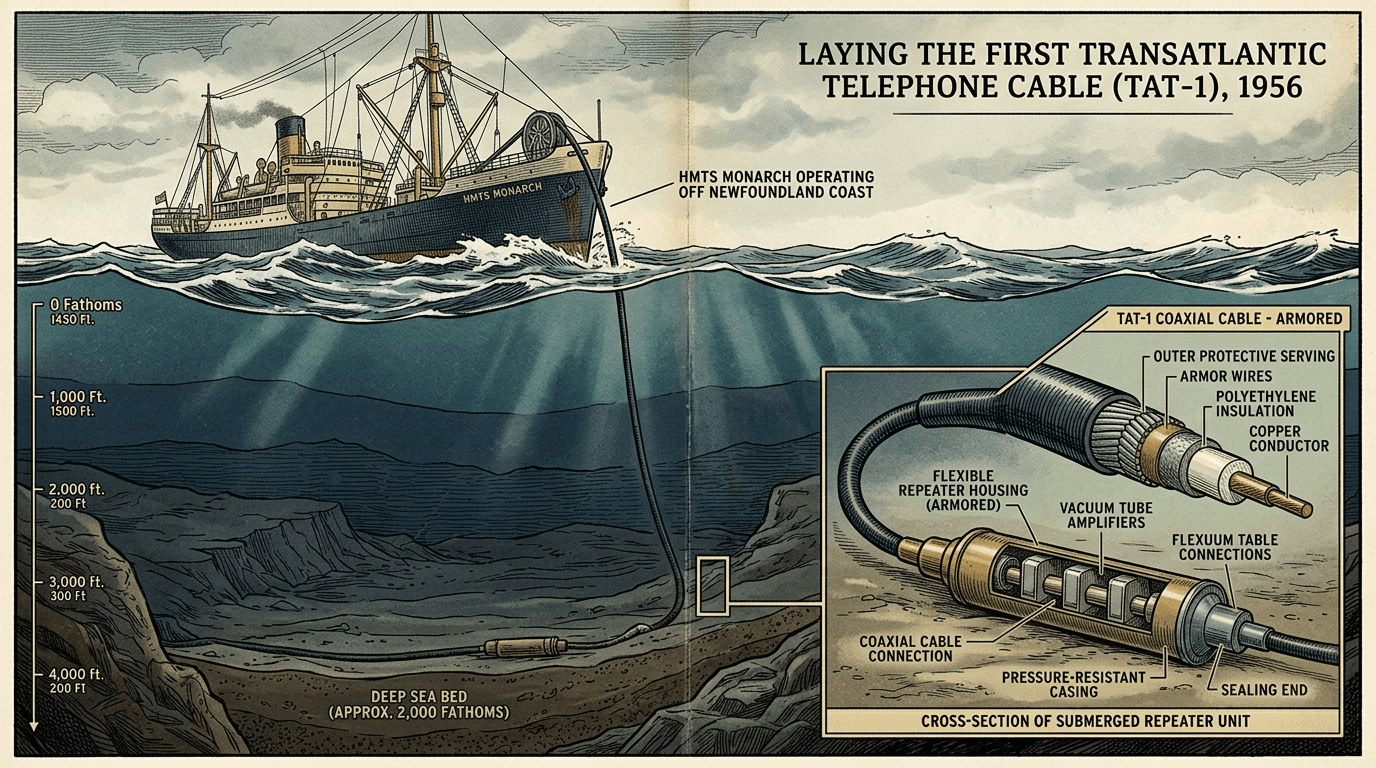
The crackling silence before the cable
Before the autumn of 1956, transatlantic telephony was an exercise in patience and atmospheric luck. Commercial voice calls between London and New York, first established in January 1927, relied exclusively on high-frequency shortwave radio circuits. These airwaves were hostage to geomagnetic storms, sunspot cycles, aurora interference, and unpredictable ionospheric fading that could render voices unintelligible for hours or days at a time.
Undersea telegraph cables had reliably traversed the ocean bed since Cyrus Field and the Great Eastern succeeded in 1866, but Morse code pulses demanded only a tiny slice of bandwidth. Transmitting the full human voice required hundreds of kilohertz of clean frequency spectrum. Because copper cables attenuate high-frequency alternating current over distance, an unamplified voice signal traveling beneath two thousand nautical miles of ocean water would fade into complete oblivion long before reaching the opposite coast.
Bridging that oceanic abyss required electronic amplification directly on the seabed. Yet in the mid-twentieth century, placing delicate vacuum-tube amplifiers two and a half miles beneath freezing North Atlantic waters seemed almost reckless. Any component failure meant dispatching an enormous cable vessel to grapple the sea floor, hoist the severed line, and splice a replacement amid gale-force seas at ruinous expense.
The vacuum tubes that could not be allowed to fail
To solve the amplification dilemma, Bell Telephone Laboratories spent nearly two decades engineering what would become the flexible submerged repeater. Unlike bulky overland relay stations, the deep-sea repeaters had to bend and pass smoothly over the standard cable drums and sheaves of H.M.T.S. Monarch, then the largest cable-laying ship afloat. The resulting housing was an engineering marvel: an eight-foot articulated steel tube tapering over twenty feet down to the cable's one-and-five-eighths-inch diameter, protected by overlapping copper and jute armor against pressures exceeding six thousand pounds per square inch.
Inside each of the fifty-one repeaters spaced every thirty-seven-and-a-half nautical miles sat three Western Electric 175HQ vacuum tubes. Bell Labs subjected these tubes to unprecedented quality screening: cathodes were manufactured with extraordinary metallurgical purity, filaments were operated at reduced temperatures to prolong life, and production batches underwent non-destructive continuous burn-in testing for years before selection.
Because these miniature repeaters could only amplify signals in a single direction, the main North Atlantic link required twin parallel cables—one carrying westbound transmissions and the other handling eastbound traffic across 1,950 nautical miles between Gallanach Bay near Oban, Scotland, and Clarenville, Newfoundland. Across twenty-two years of round-the-clock service from 1956 until retirement in 1978, not one of the 306 submerged vacuum tubes ever suffered a catastrophic failure.
September 25, 1956: Lancaster House to 195 Broadway
On the morning of Tuesday, September 25, 1956, dignitaries assembled at Lancaster House in London, AT&T headquarters at 195 Broadway in New York, and transport offices in Ottawa to open the line. Popular lore has occasionally claimed that the inaugural conversation was between Queen Elizabeth II and President Dwight D. Eisenhower. In reality, primary archival records and contemporary reports confirm a tripartite ceremonial call conducted by the operational leaders of the project.
Dr. Charles Hill, the British Postmaster General, lifted a telephone handset in London to converse with Cleo F. Craig, Chairman of the Board of AT&T in New York, while George C. Marler, Canadian Minister of Transport, joined from Ottawa. Listeners marveled that speakers thousands of miles away sounded as crisp and intimate as if they were sitting in an adjoining room. The initial circuit plan allocated twenty-nine channels between New York and London, six between Montreal and London, and a single channel subdivided into telegraph circuits.
The public response was immediate. In the first twenty-four hours of commercial operation, TAT-1 logged 588 calls between Britain and the United States, obliterating previous radio-telephone volumes. Within weeks, the system's thirty-six channels were so oversubscribed that engineers accelerated work on Time-Assignment Speech Interpolation (TASI), an ingenious voice-activated channel-sharing technique that later doubled capacity to seventy-two calls without laying a single extra inch of copper.
The modern legacy of physical cable discipline
Today, over ninety-nine percent of international internet traffic travels not through satellites, but through fiber-optic undersea cables that follow the very oceanic pathways surveyed for TAT-1. The vacuum tubes have been superseded by erbium-doped optical amplifiers and dense wavelength multiplexing, carrying hundreds of terabits per second inside glass strands thinner than a sewing thread. Yet the fundamental architectural truths uncovered in 1956 remain intact.
The triumph of TAT-1 was built on relentless physical discipline: impedance matching, absolute moisture sealing, mechanical strain relief, and systematic testing before deploying anything out of reach. In an era where everyday computing feels ethereal and wireless, the physical cables beneath our desks and across our oceans remain the stubborn, irreplaceable bedrock of global connection. Honoring that history reminds us that every seamless digital interaction still depends upon meticulous physical craft.
What the evidence does not settle
The original system supported only thirty-six simultaneous conversations at launch, was restricted to voice and telegraph frequencies, and required separate westbound and eastbound cables due to unidirectional repeaters.
PRODUCT IDEA 01
The Victorian Internet by Tom Standage

Tom Standage's classic technological history chronicles the nineteenth-century pioneers who laid the earliest transatlantic telegraph cables, establishing the foundational physical networks that TAT-1 eventually transformed into voice communication. It offers essential historical context for anyone interested in how global communications infrastructure evolved from Morse code to undersea telephone cables.
Buying limit: Best suited for technology history enthusiasts and network engineers looking for an engaging, well-documented narrative on early undersea connectivity. We verified the paperback edition directly on Amazon.com with active U.S. delivery confirmation.
Original editorial illustration, not a retailer photograph. As an Amazon Associate, we earn from qualifying purchases.PRODUCT IDEA 02
Vintage Rotary Dial Desk Telephone Replicas

The inaugural TAT-1 calls were conducted using weighted bakelite rotary desktop handsets, representing an era when telecommunication demanded deliberate physical engagement and quiet acoustic focus. Exploring classic desktop rotary telephone aesthetics offers a tactile antidote to screen fatigue and brings the mid-century design language of early transoceanic calling into a modern workspace.
Buying limit: While retro rotary phones make compelling desk centerpieces, many modern decorative reproductions cut corners on internal pulse-to-tone converters, ringer coils, and microphone elements. Because acoustic clarity varies wildly across unbranded online listings, we recommend inspecting vintage units or specialty refurbished models rather than purchasing unvetted novelties.
Original editorial illustration, not a retailer photograph. No exact Amazon offer passed our verification gate.SOURCES, METHOD, AND LIMITS
We verified technical parameters, route distances, and inaugural ceremony attendees against Volume 36 of the Bell System Technical Journal (1957) and the IEEE History Center Milestone records. We also checked that the inaugural call was between telecom executives and ministers rather than the often-repeated myth of Queen Elizabeth calling President Eisenhower.
- Bell System Technical Journal: Transatlantic Communications (Vol. 36, No. 1) — Primary engineering symposium paper by Dr. Mervin J. Kelly and Sir Gordon Radley documenting the route, flexible repeater design, and operational parameters of TAT-1.
- IEEE Milestone: The First Submarine Transatlantic Telephone Cable System (TAT-1), 1956 — Institutional engineering history documentation recording the formal opening ceremonies in London, New York, and Ottawa on September 25, 1956.