ON THIS DAY · TECHNOLOGY HISTORY
Mars Orbiter Mission: how lean engineering reached Mars on the first try
On September 24, 2014, India’s Mars Orbiter Mission entered Martian orbit on its very first attempt. Costing roughly $74 million, it demonstrated that disciplined verification and autonomous decision-making can achieve what far larger budgets often struggle to guarantee.
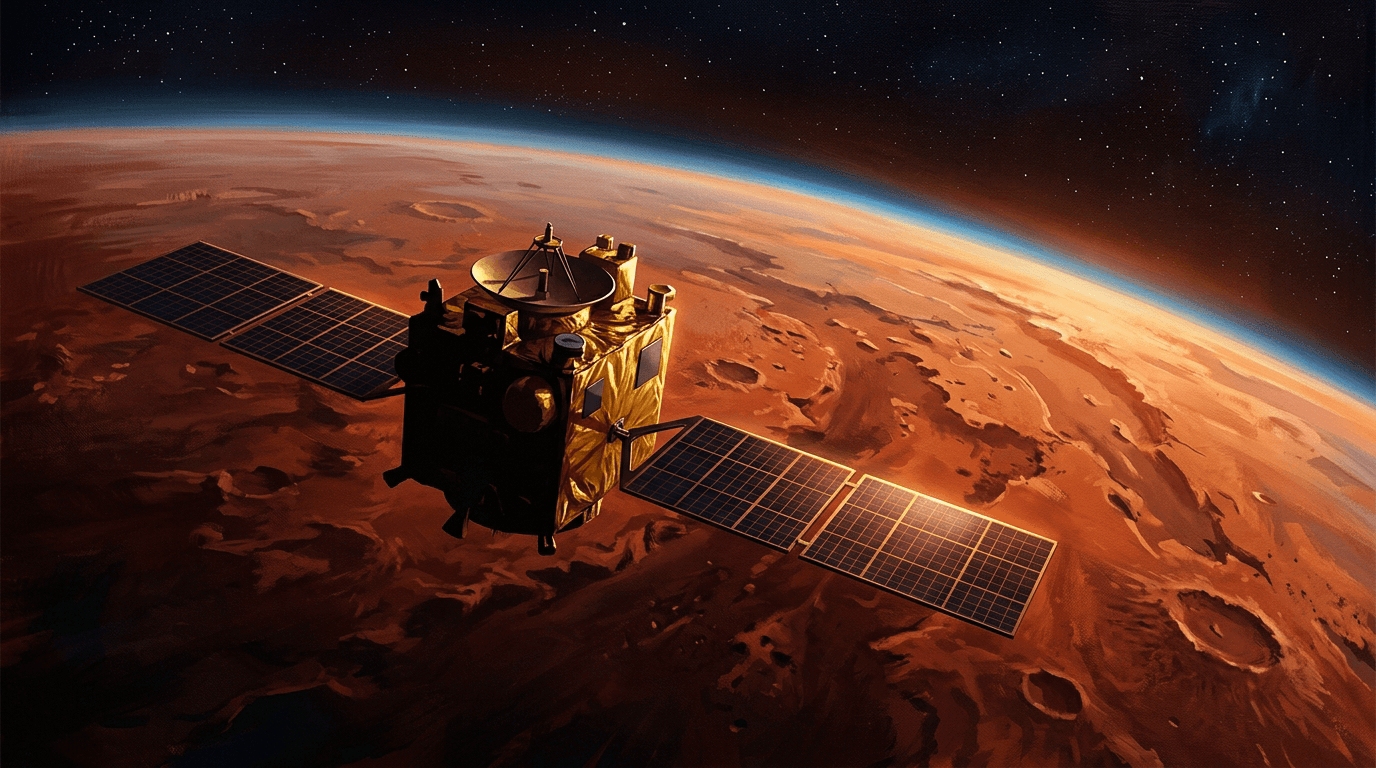
The frugal trajectory: using Earth's gravity to bridge the power gap
When ISRO prepared Mangalyaan for launch in late 2013, the agency faced a fundamental hardware limitation: its workhorse Polar Satellite Launch Vehicle (PSLV-C25) lacked the raw thrust to boost the 1,337-kilogram spacecraft directly into a trans-Mars trajectory. Rather than waiting years for a more powerful heavy-lift rocket, Indian trajectory planners devised an ingenious, energy-efficient solution. The probe was placed into an elliptical Earth-parking orbit, where it spent nearly a month performing six progressive apogee-raising burns. By timing each engine firing at perigee, the mission harnessed Earth's gravitational slingshot effect to build orbital velocity incrementally before breaking free into the trans-Mars injection on November 30, 2013.
This orbital strategy was emblematic of the entire mission philosophy: compensating for hardware constraints through meticulous mathematical modeling and rigorous procedural discipline. While other space agencies routinely deployed billion-dollar launch configurations, ISRO achieved the same interplanetary transfer velocity using existing, flight-proven launch infrastructure and calculated propellant management.
The autonomous orbital burn: twenty-four minutes in the Martian shadow
The most perilous moment of the 680-million-kilometer voyage arrived on the morning of September 24, 2014. Because radio signals between Mars and Earth took more than twelve minutes each way, real-time command from ground control was impossible. Mangalyaan had to execute its critical Mars Orbit Insertion (MOI) burn entirely autonomously. To compound the challenge, the 440-Newton Liquid Apogee Motor (LAM) had to reignite after lying dormant through nearly three hundred days of deep-space cold soaking—a scenario where valve stiction or propellant line freezing had doomed several past missions by other nations.
ISRO's software team had built elaborate fault-detection isolation and recovery (FDIR) logic into the spacecraft's primary computer. As Mangalyaan slipped behind the disk of Mars, entering radio occultation and shadow, the engine fired precisely on schedule for 1,388.67 seconds, slowing the craft by 1,099 meters per second. Telemetry confirming capture was acquired by NASA's Deep Space Network station in Canberra, Australia, confirming that the probe had locked into an elliptical orbit of roughly 421 by 76,993 kilometers.
Why lean engineering succeeds when bloated checklists fail
Standing just one day apart on the historical calendar, Mangalyaan offers a striking counterpoint to NASA's 1999 Mars Climate Orbiter disaster. In 1999, an unverified unit mismatch between metric newton-seconds and imperial pound-seconds escaped notice because procedural checks were treated as bureaucratic paperwork rather than active engineering inquiry. By contrast, ISRO's team conducted end-to-end hardware-in-the-loop simulations, cross-verifying software parameters against flight hardware and establishing parallel backup firing commands using eight smaller attitude control thrusters in case the main engine failed to ignite.
The lasting takeaway from Mangalyaan is that frugality does not necessitate fragility. When resources are constrained, engineering teams are forced to eliminate redundant complexity and focus intensely on core failure modes. Mangalyaan did not carry duplicate luxury subsystems; instead, it relied on a robust, thoroughly tested architecture that ultimately outlived its six-month design warranty by more than seven years, returning thousands of Martian weather images before its fuel finally depleted in 2022.
What the evidence does not settle
While the mission was an extraordinary technological triumph that operated for nearly eight years instead of its planned six-month design life, its scientific payload was intentionally modest at just 15 kilograms. It was designed primarily as a technological demonstrator to prove deep-space navigation and communications, rather than a heavy multi-instrument laboratory like NASA's Curiosity rover.
PRODUCT IDEA 01
AstroAI AM33D Digital Multimeter for Circuit Diagnostics
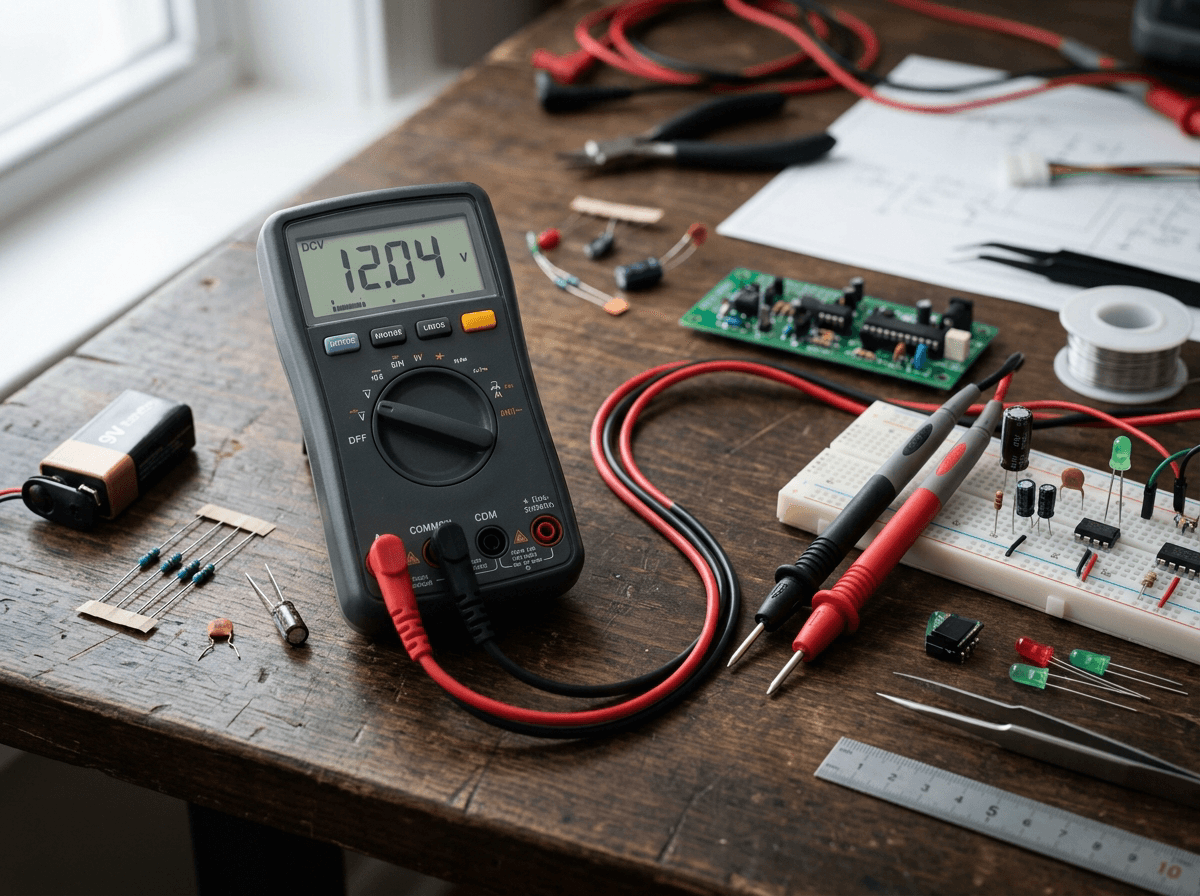
Mangalyaan's budget constraints required ISRO engineers to build rigorous ground-test beds that validated every harness connection, battery cycle, and voltage drop across commercial and space-grade components. For home tinkerers, makers, and electronics students, an accurate digital multimeter remains the indispensable foundation of that same discipline. Rather than guessing why a circuit fails, measuring voltage, continuity, and current gives you verifiable ground truth before applying power.
Buying limit: The AstroAI AM33D is a manual-ranging 2000-count meter suitable for low-voltage hobbyist circuits, fuses, and automotive checks. It is not rated for heavy industrial switchboards or high-frequency digital signal analysis. Verify lead connections and range settings prior to high-current testing.
Original editorial illustration, not a retailer photograph. As an Amazon Associate, we earn from qualifying purchases.PRODUCT IDEA 02
Packing for Mars: The Curious Science of Life in the Void

The difference between popular headlines about cheap space exploration and actual orbital mechanics lies in the engineering documentation. Deepening your understanding of how interplanetary trajectories, gravitational slingshots, and thermal equilibrium are calculated requires structured, math-grounded technical monographs rather than brief social media recaps. Detailed aerospace references provide enduring insight into how complex autonomous systems are planned and verified against unforgiving space environments.
Buying limit: Mary Roach's acclaimed account explores the human physiology, engineering tradeoffs, and psychological constraints of long-duration spaceflight. It is an accessible non-fiction narrative rather than an orbital mechanics textbook or flight-software specification.
Original editorial illustration, not a retailer photograph. As an Amazon Associate, we earn from qualifying purchases.SOURCES, METHOD, AND LIMITS
This editorial article was researched and written on September 24, 2026. Telemetry milestones, spacecraft mass budgets, and orbital insertion parameters were verified against official ISRO mission documentation and NASA Deep Space Network tracking records. No physical space hardware was handled. Product directions reflect editorial evaluation of measurement tools and educational literature; no sponsored products or fabricated tests are included.
- ISRO Official Mission Overview: Mars Orbiter Mission (MOM) — Official mission chronology, launch vehicle telemetry, payload specifications, and Mars Orbit Insertion milestone confirmation directly from the Indian Space Research Organisation.
- NASA Deep Space Network Tracking and Congratulatory Record — Deep Space Network tracking logs and international confirmation of the automated insertion burn behind Mars and signal acquisition upon orbital entry.