ON THIS DAY · AUGUST 12, 1981
The Machine That Built Corporate America: How IBM's Model 5150 Established the Global PC Standard
In just twelve months, a rogue team of twelve engineers in Boca Raton, Florida, bypassed IBM's legendary corporate bureaucracy. By utilizing off-the-shelf components, an Intel processor, and Microsoft software, they created the standard that still defines personal computing today.
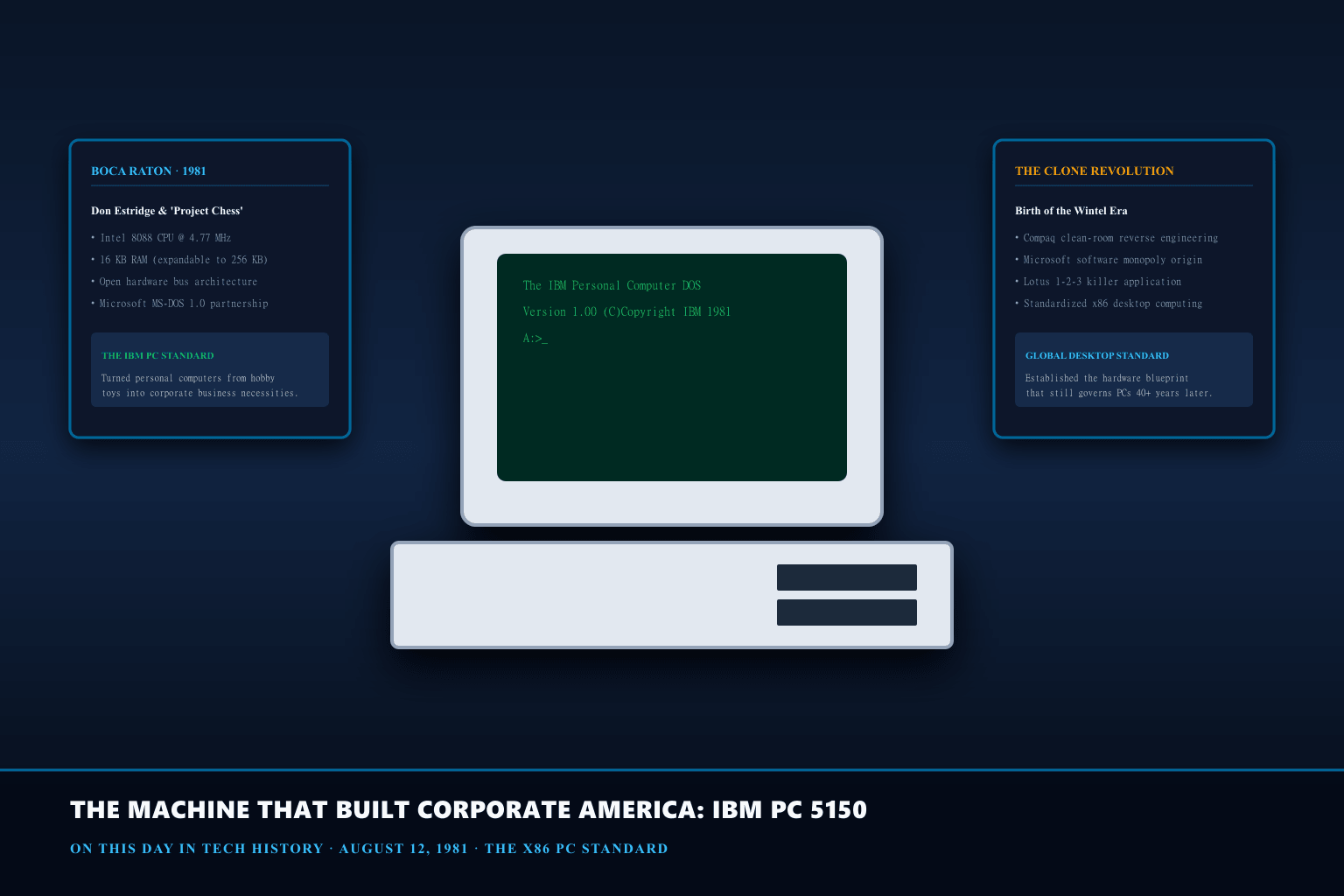
Project Chess: The Boca Raton Speed Run
In 1980, IBM was the undisputed titan of multi-million-dollar corporate mainframes, but the company was completely absent from the rapidly growing microcomputer market led by Apple, Commodore, and Tandy. IBM's traditional internal development cycle took four to five years to design bespoke chips and proprietary operating systems—an eternity in the fast-moving microcomputer world.
IBM executive Bill Lowe proposed establishing an autonomous skunkworks unit in Boca Raton, Florida, insulated from corporate red tape. Under engineering director Don Estridge, 'Project Chess' was granted permission to break sacred IBM tradition: rather than building proprietary components in-house, they would assemble the machine entirely from commercial off-the-shelf (COTS) parts.
The Hardware Architecture: Intel 8088 and the Open Bus
Estridge chose the Intel 8088 microprocessor over the Motorola 68000 because the 8088 possessed a 16-bit internal architecture with an 8-bit external data bus, allowing IBM to use inexpensive, widely available 8-bit circuit boards and peripheral chips. The system included an 83-key Model F buckling-spring mechanical keyboard that set a legendary benchmark for typing tactile precision.
Most importantly, IBM adopted an 'open architecture' philosophy. The IBM PC Technical Reference Manual included complete circuit schematics, timing diagrams, and fully commented ROM BIOS assembly source code. This allowed third-party hardware manufacturers to design expansion cards for memory, color graphics (CGA), and hard disk controllers for the motherboard's five 8-bit ISA expansion slots.
The Microsoft Deal and the Rise of the Clone Industry
When IBM sought an operating system, they famously partnered with Bill Gates and Paul Allen's Microsoft. Microsoft acquired 86-DOS (QDOS) from Seattle Computer Products, modified it to create PC DOS for IBM, and crucially retained the non-exclusive commercial rights to license the operating system as MS-DOS to other manufacturers.
Because IBM's only proprietary intellectual property was the copyrighted BIOS chip, companies like Phoenix Technologies and Columbia Data Products legally reverse-engineered the BIOS using clean-room techniques. Within three years, Compaq and dozens of clone makers released 100% compatible machines, cementing the x86/DOS platform as the universal standard of global personal computing.
What the evidence does not settle
The base $1,565 model of the IBM 5150 included only 16KB of RAM, no floppy disk drive, and required a user-supplied cassette recorder and television screen. A realistic business setup with dual 5.25-inch floppy drives, 64KB RAM, and IBM's green phosphor monochrome monitor cost over $3,000 in 1981 currency.
PRODUCT IDEA 01
Buckling-Spring Mechanical Keyboard with USB Interface
An authentic reissue of the iconic Model M/F buckling-spring mechanical keyboard, delivering unmatched acoustic feedback, tactile snap, and legendary typing precision.
Buying limit: Look for high-quality PBT dye-sublimated keycaps and heavy steel backplates. Premium buckling-spring keyboards cost between $100 and $150.
Original editorial illustration, not a retailer photograph. No exact Amazon offer passed our verification gate.PRODUCT IDEA 02
Big Blue: IBM's Use and Abuse of Power — Richard Thomas DeLamarter
A gripping insider chronicle of IBM's golden era, detailing the corporate strategies, technological triumphs, and intense legal antitrust battles that defined enterprise computing.
Buying limit: Available in vintage hardcover and digital reference editions. Standard trade paperbacks range from $15 to $30.
Original editorial illustration, not a retailer photograph. No exact Amazon offer passed our verification gate.SOURCES, METHOD, AND LIMITS
Researched using the original IBM PC 5150 Technical Reference Manual (IBM Publication 6025008), Computer History Museum oral histories with Don Estridge's engineering team, and historical corporate filings. No commercial products were physically tested.
- IBM Archives — The Birth of the IBM PC Model 5150 (August 12, 1981) — Official IBM corporate retrospective detailing the Boca Raton skunkworks team, original price lists, and marketing campaign with the Charlie Chaplin 'Little Tramp' character.
- Computer History Museum — The Silicon Engine: Intel 8088 and the IBM PC — Technical analysis documenting microprocessor selection, memory bus constraints, and ISA expansion slot architectures.