ON THIS DAY · AUGUST 23, 1991
Opening the Doors to the Digital World: How Internaut Day in 1991 Transformed Academic Research into a Public Utility
Before August 23, 1991, the World Wide Web was an internal research network restricted to high-energy physics laboratories. When CERN opened public access to external users across the globe, it sparked the digital revolution and birthed the 'internaut.'
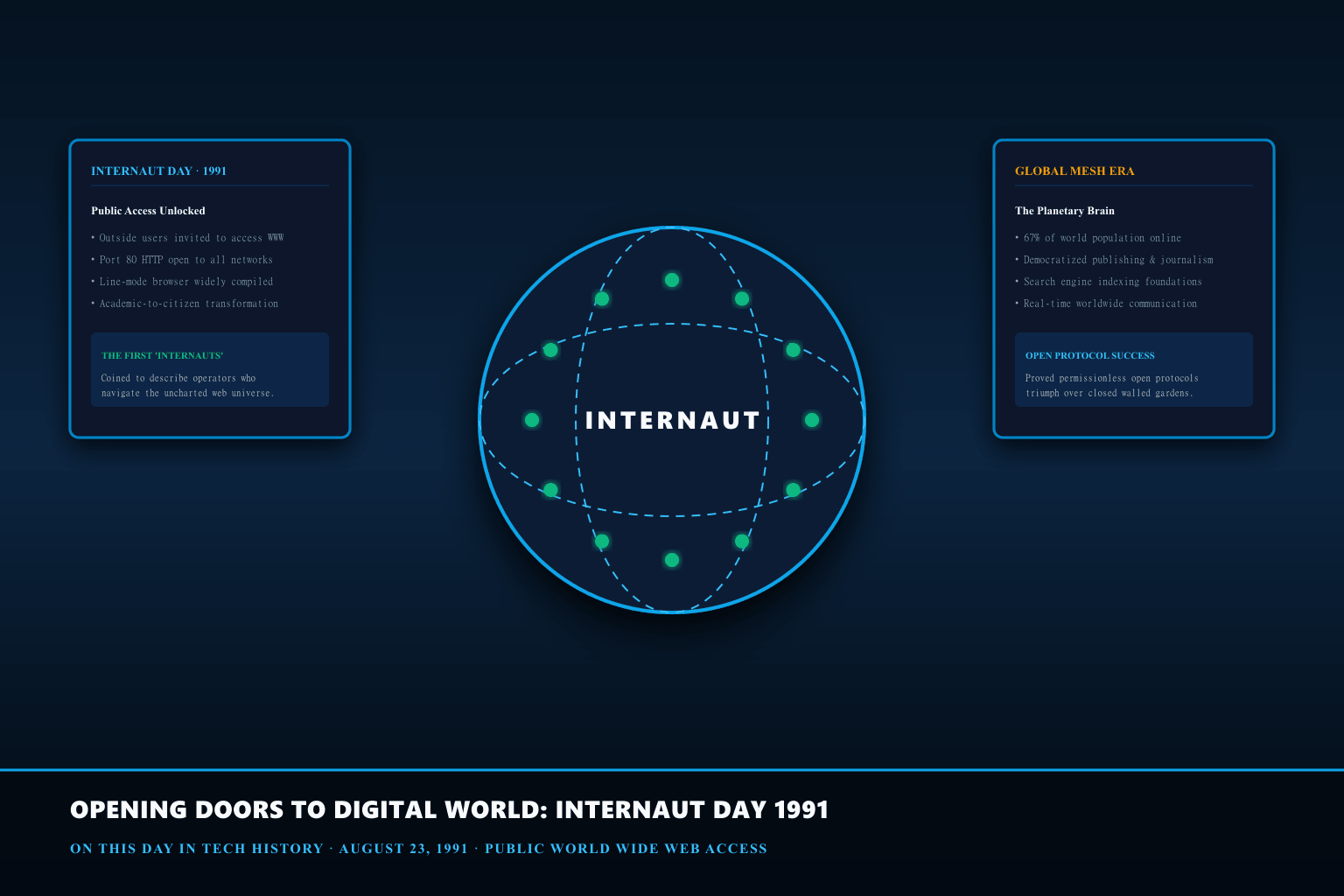
Breaking Out of the Academic Walled Garden
Between December 1990 and mid-1991, the World Wide Web functioned strictly as an internal CERN project running on NeXTSTEP workstations. Physicists used it to cross-reference experimental data from the Large Electron-Positron (LEP) collider and read internal documentation.
Tim Berners-Lee recognized that the web's transformative power depended on universal, permissionless network effects. If the web remained locked inside Swiss research institutes, proprietary commercial networks like CompuServe, AOL, and Prodigy would fragment digital information into closed corporate walled gardens.
The Line Mode Browser: Bringing Hypertext to Every Operating System
The major technical bottleneck preventing public adoption was hardware disparity: few outside CERN owned expensive NeXT computers. In response, student intern Nicola Pellow developed the Line Mode Browser (also known as www or libwww).
Written in standard portable ANSI C, the Line Mode Browser stripped away graphical dependencies, allowing users on MS-DOS, Unix, VMS, and Apple Macintosh terminals to fetch and read HTML documents over standard telnet connections. By navigating links using numeric brackets (e.g., typing '[1]' to follow the first link), anyone with a modem could access the World Wide Web on August 23, 1991.
The Birth of the Internaut and the Explosion of Nodes
Opening public access unleashed rapid organic growth. By late 1991, external web servers were online at SLAC (Stanford Linear Accelerator Center in California) and across Germany and the UK. Within five years, the number of web servers exploded from one to over 100,000.
The concept of the 'Internaut' symbolized an engaged digital citizenry empowered by open access to universal knowledge. The principles established in August 1991—open protocols, decentralized domain routing, and royalty-free access—remain the constitutional foundation of the modern internet.
What the evidence does not settle
While August 23 is widely celebrated on social media and technology forums as 'Internaut Day,' it represents a soft operational opening rather than a single formal ribbon-cutting ceremony, as public accessibility expanded steadily across August 1991 through successive Usenet postings.
PRODUCT IDEA 01
Where Wizards Stay Up Late: The Origins of the Internet — Katie Hafner & Matthew Lyon
The definitive narrative history of the brilliant scientists and visionary engineers who built ARPANET, packet switching, and the foundations of the global internet.
Buying limit: Available in trade paperback (Simon & Schuster) and digital formats. Copies typically retail between $12 and $20.
Original editorial illustration, not a retailer photograph. No exact Amazon offer passed our verification gate.PRODUCT IDEA 02
Vintage Retro Dial-Up Modem Audio Sound Keychain with LED Lights
A fun novelty audio keychain that plays the iconic 56k dial-up modem handshake sound sequence with glowing status LED activity indicators.
Buying limit: Look for durable ABS plastic with replaceable coin-cell batteries. Novelty tech keychains cost between $10 and $18.
Original editorial illustration, not a retailer photograph. No exact Amazon offer passed our verification gate.SOURCES, METHOD, AND LIMITS
Researched using primary CERN internet server logs, W3C historical timeline archives, and early Usenet discussion threads from comp.sys.next and alt.hypertext. No commercial products were physically tested.
- World Wide Web Consortium (W3C) — A History of the World Wide Web (1989-1995) — Official historical chronology recording the release of libwww, line-mode browser porting, and public access milestones.
- Computer History Museum — The Web at 30: The Open Internet and the First Internauts — Curated retrospective examining early server logs, SLAC installation records, and Nicola Pellow's portable C browser implementation.