ON THIS DAY · SEPTEMBER 10, 2008
Beams Beneath the Border: How CERN’s Large Hadron Collider Began Probing the Secrets of Physics
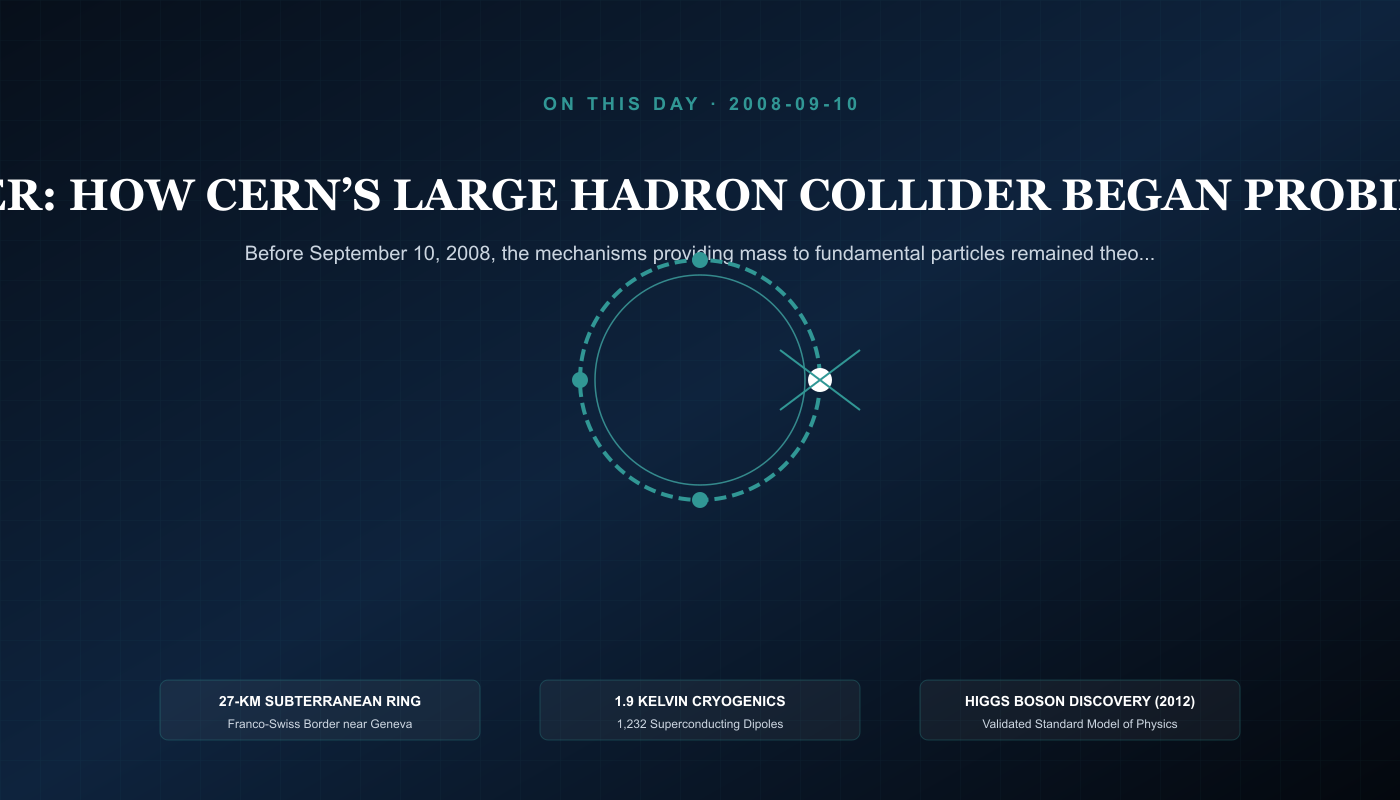
Before September 10, 2008, the mechanisms providing mass to fundamental particles remained theoretical conjecture. When CERN scientists successfully steered the first proton beam through the 27-kilometer subterranean cryogenic ring, they powered up the largest scientific instrument ever built.
Twenty-Five Years of Multinational Cryogenic Engineering
Conceived in the early 1980s and formally approved by CERN member states in 1994, the Large Hadron Collider was engineered inside the existing 26.7-kilometer circular tunnel originally excavated for the Large Electron-Positron Collider (LEP). The scale of the engineering challenge was unprecedented in human history.
To bend protons traveling at 99.9999991% the speed of light along the curved ring, engineers installed 1,232 15-meter niobium-titanium superconducting dipole magnets generating magnetic fields of 8.3 Tesla. To maintain superconductivity, 96 tonnes of superfluid liquid helium cooled the entire ring to 1.9 Kelvin (-271.3°C)—creating a cryogenic environment colder than the vacuum of deep outer space across 16 miles of underground tunnel.
September 10, 2008: Circulating the First Beam
In the CERN Main Control Center in Prévessin, France, Project Leader Lyn Evans monitored telemetry as a bunch of two billion protons was injected from the Super Proton Synchrotron (SPS) into the LHC beam pipe. Steering magnets guided the particles step-by-step through successive sectors.
At 08:28 UTC, two distinct bright white dots flashed on digital phosphor beam monitors in the control room, confirming that the proton beam had completed a full 27-kilometer revolution. The control room erupted in cheers as particle detectors ATLAS, CMS, ALICE, and LHCb detected secondary particles from beam collimator splashes.
The 2012 Higgs Discovery and the Future of Particle Physics
The operational success of the LHC culminated on July 4, 2012, when physicists from the ATLAS and CMS collaborations announced the discovery of the long-sought Higgs boson at a mass of approximately 125 GeV. The discovery confirmed the Brout-Englert-Higgs mechanism, explaining how fundamental particles acquired mass in the earliest fractions of a second following the Big Bang.
Beyond fundamental particle physics, the engineering breakthroughs developed to operate the LHC catalyzed major technological spin-offs, including grid computing networks, high-gradient beam radiotherapy for oncology, and advanced ultra-high vacuum cryogenic insulation techniques.
What the evidence does not settle
Popular media hysterical claims prior to 2008 that the LHC would create planet-devouring micro black holes were thoroughly disproven by independent safety reviews; high-energy cosmic rays strike Earth’s atmosphere with far higher collision energies continuously with zero catastrophic effects. Readers should note the LHC accelerates protons, not fundamental electrons.
PRODUCT IDEA 01
The Particle at the End of the Universe — Sean Carroll

Theoretical physicist Sean Carroll provides a lucid, thrilling insider narrative chronicling the multi-decade international hunt for the Higgs boson, the engineering of the LHC, and the future of cosmology.
Buying limit: Available in paperback (Dutton, ISBN 978-0142180303) and digital formats. Paperbacks typically sell between $14 and $20.
Original editorial illustration, not a retailer photograph. No exact Amazon offer passed our verification gate.PRODUCT IDEA 02
Desktop Crookes Radiometer & Solar Light-Mill Glass Vacuum Sphere

A precision hand-blown glass vacuum sphere with blackened and polished mica vanes that rotate under thermal and optical radiation, providing a captivating desktop demonstration of physics principles.
Buying limit: Look for optical borosilicate glass, low-friction needle bearings, and sturdy glass base. Quality radiometers range from $16 to $30.
Original editorial illustration, not a retailer photograph. No exact Amazon offer passed our verification gate.SOURCES, METHOD, AND LIMITS
Researched using primary CERN official press releases and technical design reports (CERN-2008-001 Large Hadron Collider Design Report), Nobel Prize in Physics 2013 scientific background documentation, and Sean Carroll’s The Particle at the End of the Universe. No commercial products were physically tested.
- CERN Document Server — The Large Hadron Collider Design Report (CERN-2008-001) — Comprehensive primary technical specification documenting the cryogenic cooling systems, superconducting dipole magnets, beam vacuum, and beam monitoring instrumentation.
- Nobel Prize in Physics 2013 — Scientific Background on the Brout-Englert-Higgs Mechanism — Official Nobel Committee scientific citation evaluating the experimental data from ATLAS and CMS that confirmed the Higgs scalar field at CERN.