ON THIS DAY · JULY 6, 1885
Taming the Invisible Killer: How Louis Pasteur's 1885 Rabies Inoculation Inaugurated Modern Immunology
In the summer of 1885, a rabies diagnosis was a 100% fatal death sentence. By drying infected spinal cords of rabbits in sterile flasks, French chemist Louis Pasteur created an attenuated vaccine that saved a dying 9-year-old boy and conquered rabies.
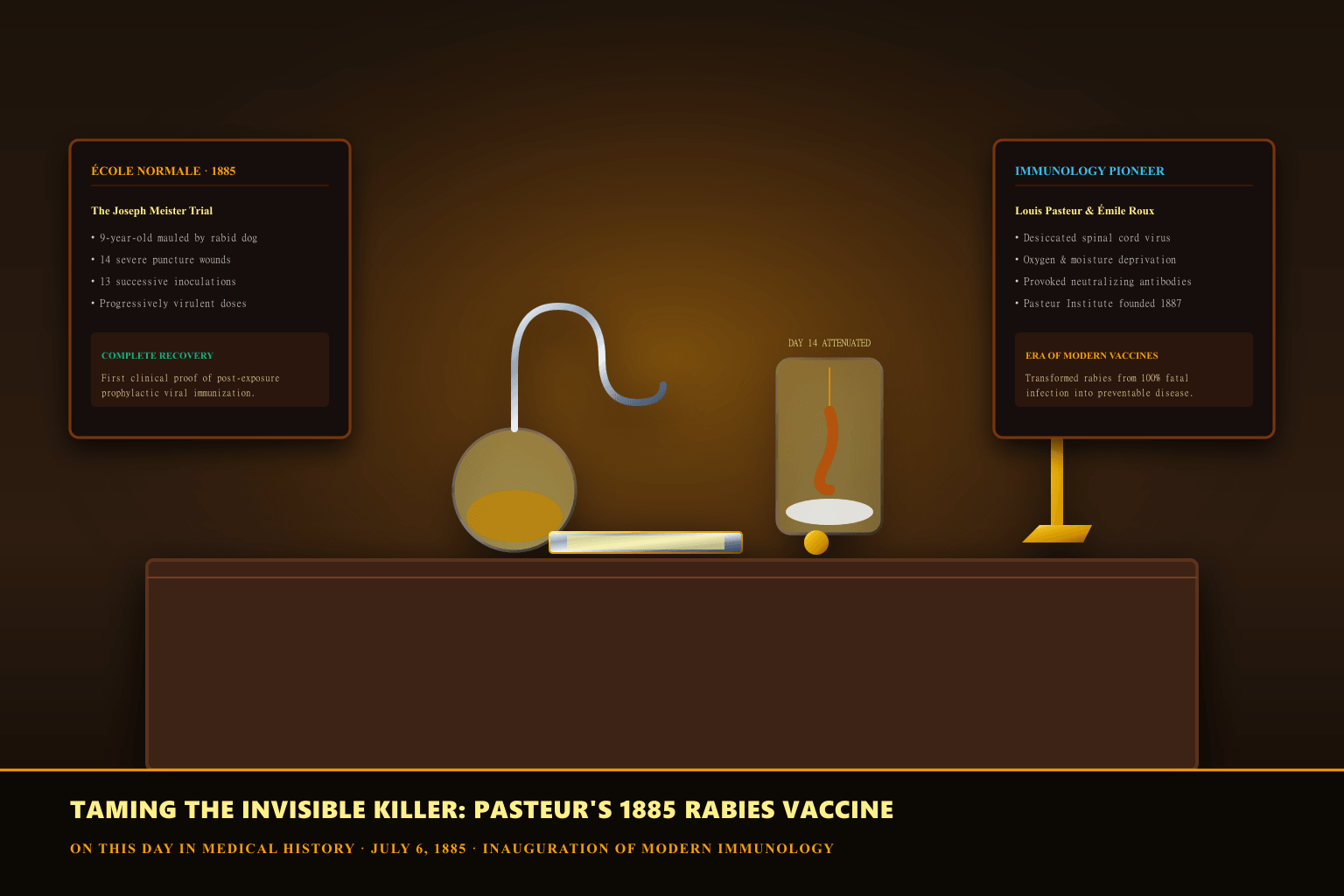
The 100% Fatal Curse of Rabies and the Invisible Pathogen
In the nineteenth century, rabies (hydrophobia) was one of the most terrifying diseases known to humanity. Transmitted through animal bites, the virus slowly traveled along peripheral nerves into the central nervous system, causing violent convulsions, fever, throat spasms, and inevitable death once symptoms appeared.
Optical microscopes of Pasteur's era could not resolve viruses, which are hundreds of times smaller than bacteria. Despite being unable to physically see the pathogen, Pasteur deduced its viral nature through meticulous transmission experiments in rabbits and dogs, isolating the infectious agent within the spinal cord and brain stem.
The Attenuation Technique: Desiccating Spinal Cords
Pasteur and Émile Roux devised an ingenious method to weaken (attenuate) the rabies pathogen. They extracted spinal cords from infected rabbits and suspended them in sterile glass flasks containing caustic potassium hydroxide flakes to absorb humidity.
By varying the drying time from fourteen days down to one day, they created a standardized spectrum of virulence: cords dried for fourteen days were completely non-virulent, while cords dried for one or two days remained highly lethal. By injecting an animal progressively from the weakest emulsion to the strongest, the host's immune system built neutralizing antibodies before the pathogen reached the brain.
The July 6 Decision and the Founding of the Pasteur Institute
On July 6, 1885, Marie-Angélique Meister brought her 9-year-old son Joseph to Pasteur's Paris laboratory with fourteen deep bite wounds. Because Pasteur was a chemist rather than a licensed medical doctor, physicians Jacques-Joseph Grancher and Alfred Vulpian examined the boy and confirmed he faced certain death without intervention, agreeing to supervise the injections.
Meister received thirteen injections over ten days, concluding with a fully virulent rabies dose that would have killed an untreated patient. Meister never developed symptoms and lived a long, healthy life, later serving as the gatekeeper of the Pasteur Institute in Paris, which was established in 1887 to provide free rabies treatments worldwide.
What the evidence does not settle
Because post-exposure rabies vaccination must be administered during the incubation window before the virus crosses the blood-brain barrier into the central nervous system, the treatment is ineffective once clinical neurological symptoms manifest.
PRODUCT IDEA 01
Louis Pasteur: Free Lance of Science — René J. Dubos
René Dubos's classic scientific biography detailing Pasteur's brilliant experimental methodology, from molecular chirality and fermentation to germ theory and rabies vaccination.
Buying limit: Available in trade paperback (Da Capo Press) and library hardcover editions. Copies typically retail between $16 and $28.
Original editorial illustration, not a retailer photograph. No exact Amazon offer passed our verification gate.PRODUCT IDEA 02
Vintage Amber Glass Apothecary Bottle & Dropper Decor Set
A set of thick amber glass laboratory bottles with ground glass stoppers and pipettes, adding 19th-century scientific elegance to bookshelves and desks.
Buying limit: Look for lead-free borosilicate amber glass with airtight ground-glass stoppers. Quality apothecary sets cost $18 to $35.
Original editorial illustration, not a retailer photograph. No exact Amazon offer passed our verification gate.SOURCES, METHOD, AND LIMITS
Researched using primary laboratory notebooks from the Archives de l'Institut Pasteur (Paris), Émile Roux's clinical retrospective papers, and historical monographs from the National Library of Medicine. No commercial products were physically tested.
- Institut Pasteur — Historical Archives: The Discovery of the Rabies Vaccine (1885) — Official historical archive detailing Louis Pasteur's desiccated rabbit spinal cord protocols, Joseph Meister's clinical treatment log, and the 1888 institute inauguration.
- National Library of Medicine (NIH) — Louis Pasteur and the Dawn of Modern Immunology — Peer-reviewed medical history analysis examining viral attenuation kinetics, antibody production, and 19th-century clinical ethics.