ON THIS DAY · SEPTEMBER 12, 1959
The First Metal on the Moon: How Soviet Luna 2 Crossed the Cislunar Void in 1959
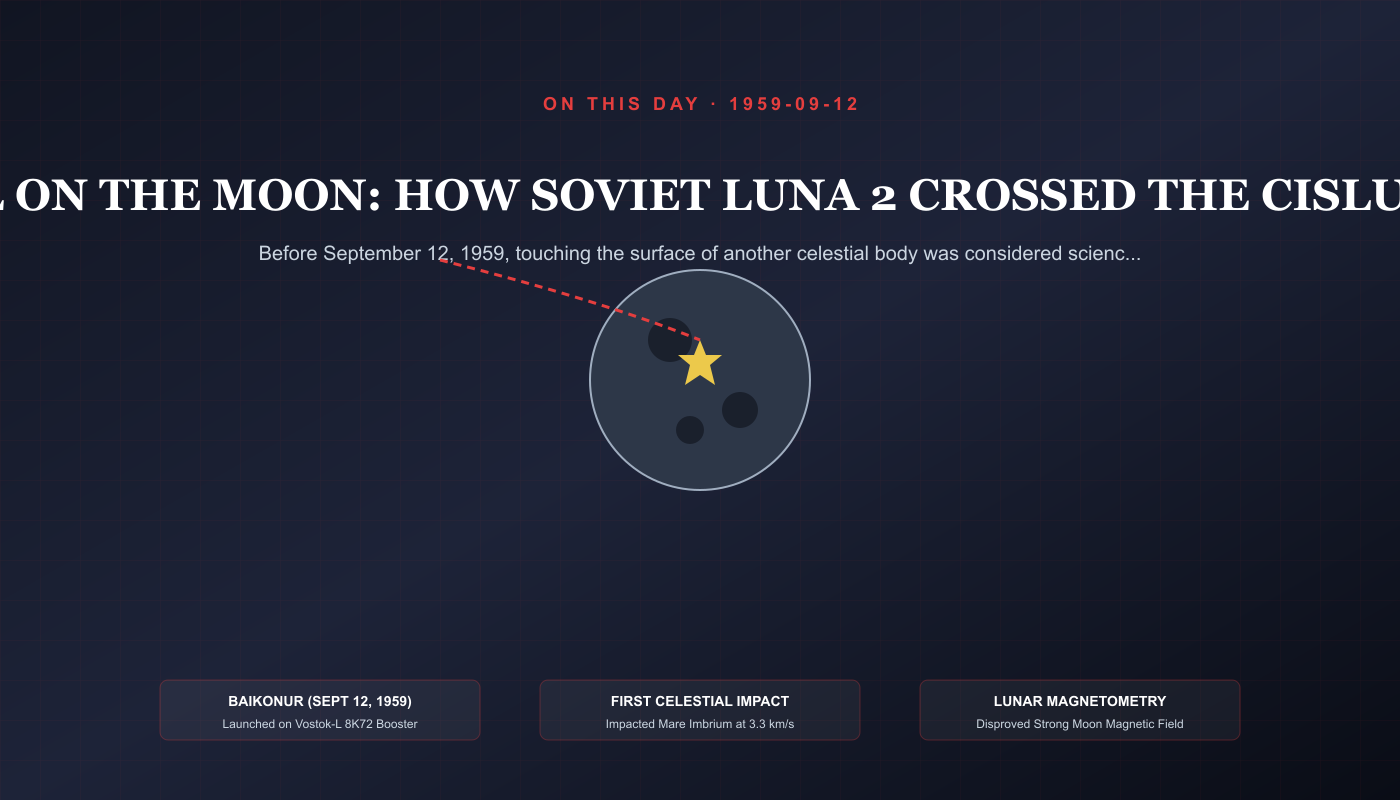
Before September 12, 1959, touching the surface of another celestial body was considered science fiction. When Soviet Chief Designer Sergei Korolev launched Luna 2 on an exact trans-lunar trajectory to Mare Imbrium, humanity made its first physical contact with the Moon.
The Trans-Lunar Navigation Challenge in 1959
Hitting a celestial target 384,000 kilometres away with a spacecraft lacking onboard mid-course correction thrusters was an extraordinary feat of celestial mechanics and ballistics. A trajectory error of just 0.1% in burnout velocity or one arcminute in launch azimuth would cause the probe to miss the Moon by thousands of miles.
Soviet Chief Designer Sergei Korolev and mathematician Mstislav Keldysh solved this through precise ignition timing of the Blok-E upper stage. To confirm the spacecraft’s location to optical astronomers worldwide, Luna 2 released a bright orange cloud of glowing sodium vapor in cislunar space on September 12, creating an artificial comet visible through ground-based telescopes.
September 14, 1959: Impacting Mare Imbrium
As Luna 2 hurtled toward the lunar surface at 3.3 kilometres per second, its onboard radio transmitters broadcast high-frequency telemetry on 19.993, 39.986, and 183.6 MHz directly to the Jodrell Bank Radio Telescope in England, where astronomer Bernard Lovell independently tracked the Doppler shift.
At 21:02:24 UTC, the radio signal abruptly ceased mid-transmission. Jodrell Bank confirmed that the silence matched the exact theoretical moment of impact. Luna 2 had excavated a fresh crater between the lunar craters Archimedes and Autolycus, scattering explosive-dispersed pentagonal steel medallions bearing the Cyrillic inscription "USSR September 1959".
Scientific Breakthroughs and Cold War Geopolitics
Scientific instruments aboard Luna 2, designed by physicist Sergey Vernov, delivered crucial discoveries prior to impact. Magnetometers proved that the Moon possessed no measurable dipole magnetic field (less than 1/10,000th of Earth’s) and detected no trapped radiation belts, fundamentally advancing lunar geology.
Geopolitically, the mission represented another stunning Soviet Cold War victory. When Premier Nikita Khrushchev arrived in Washington for a state visit with President Dwight D. Eisenhower forty-eight hours later, he presented Eisenhower with a replica of the Luna 2 impact pennant—demonstrating Soviet ballistic guidance superiority on the global stage.
What the evidence does not settle
Skeptics in 1959 initially alleged the impact was Soviet propaganda; however, the Jodrell Bank Radio Observatory in the UK independently tracked the Doppler frequency acceleration and confirmed lunar impact. Readers should note Luna 2 was a high-velocity impact probe, not a soft-landing lander like Luna 9 (1966) or Apollo 11 (1969).
PRODUCT IDEA 01
Challenge to Apollo: The Soviet Race to the Moon — Asif A. Siddiqi

The definitive 1,000-page scholarly history of the Soviet space program by historian Asif Siddiqi, utilizing declassified Soviet Politburo and OKB-1 archives to reconstruct the Luna, Vostok, and N1 missions.
Buying limit: Available in NASA SP series or university press editions. Paperback copies typically trade between $25 and $45.
Original editorial illustration, not a retailer photograph. No exact Amazon offer passed our verification gate.PRODUCT IDEA 02
High-Resolution 3D Relief Topographic Lunar Surface Desktop Globe

A precision desktop globe featuring accurate topographic elevation mapping of lunar maria, highlands, and historical landing sites from Luna 2 to Apollo.
Buying limit: Look for laser-etched surface details, stable weighted acrylic or metallic base, and clear crater labeling. Quality lunar globes range from $30 to $65.
Original editorial illustration, not a retailer photograph. No exact Amazon offer passed our verification gate.SOURCES, METHOD, AND LIMITS
Researched using primary NASA Space Science Data Coordinated Archive records (ID 1959-014A), Jodrell Bank Observatory historical archives, and Asif Siddiqi’s definitive history Challenge to Apollo: The Soviet Race to the Moon. No commercial products were physically tested.
- NASA Space Science Data Coordinated Archive — Luna 2 Master Catalog (ID 1959-014A) — Official NASA catalog detailing Luna 2 spacecraft dimensions, mass, instruments, and verified lunar impact coordinates at 29.1 N, 0.0 W in Mare Imbrium.
- NASA History Division — Soviet Lunar Probes and the Space Race — Comprehensive historical monograph evaluating Sergei Korolev’s E-1A spacecraft series, sodium cloud optics, and Jodrell Bank tracking confirmation.