ON THIS DAY · AUGUST 5, 1962
The Tech Behind History's Most Famous Arrest: How Early Cold War Surveillance and SIGINT Tracked Nelson Mandela
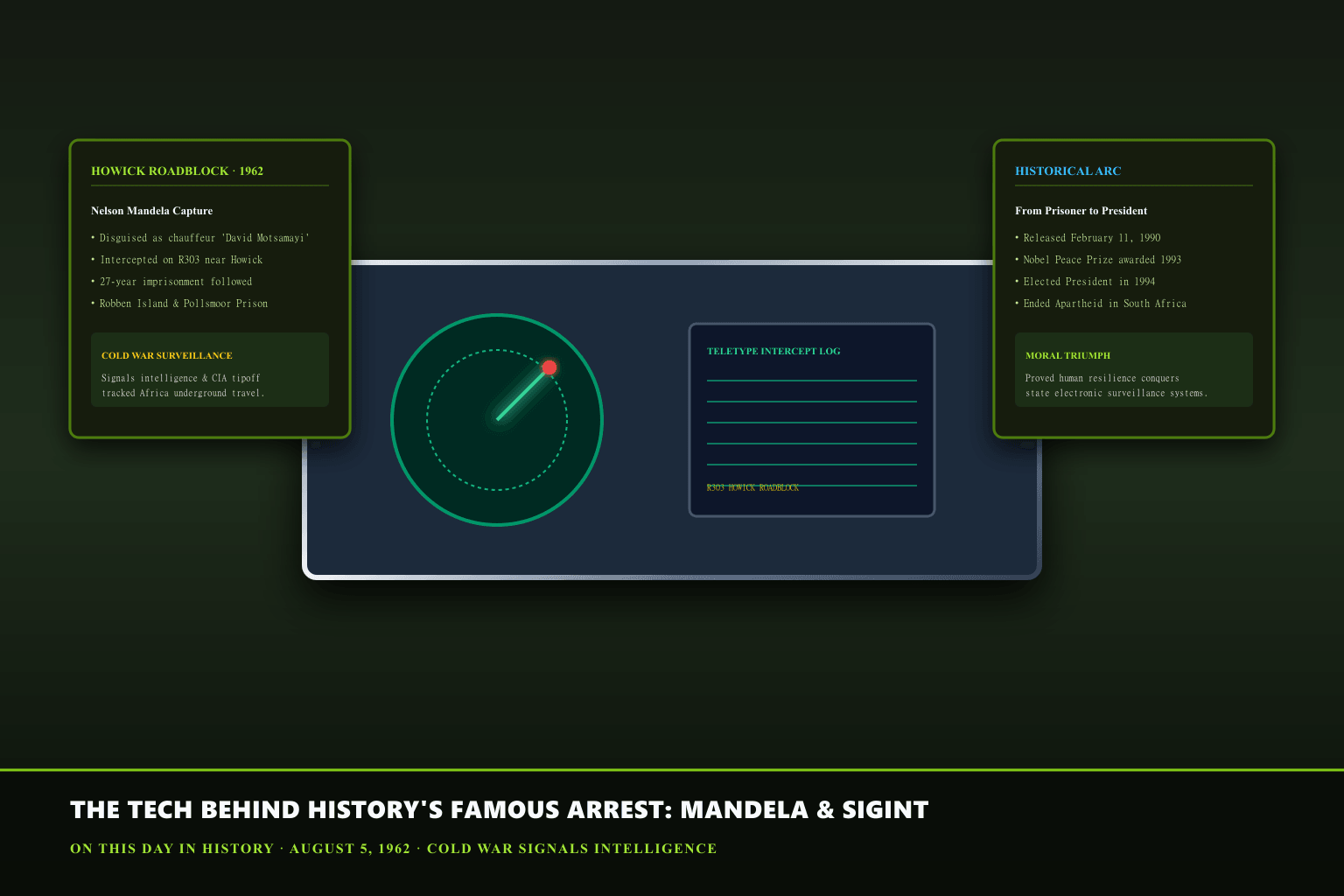
On a quiet road outside Howick, South Africa, police disguised as traffic wardens intercepted a car driven by the 'Black Pimpernel.' Behind Nelson Mandela's August 5, 1962 capture lay a complex nexus of Cold War telecommunications monitoring, encrypted diplomatic cable traffic, and deep intelligence surveillance.
The Signals Intelligence Environment of the Early 1960s
During the height of the Cold War following the Cuban Missile Crisis, Western intelligence agencies maintained extensive global listening networks operated by the National Security Agency (NSA) and British GCHQ. Diplomatic telecommunications across the African continent were monitored via high-frequency (HF) radio intercept stations and embassy telex wiretaps.
Because Mandela had recently completed a clandestine tour across Africa to secure military training and financial backing—meeting with leaders in Ethiopia, Egypt, Morocco, and London—his travel itineraries generated extensive signals intelligence traffic that monitored cross-border movements, courier flights, and urban safehouse locations.
The Road to Howick: Informant Logistics and Wiretapping
Mandela traveled across South Africa using the alias David Motsamayi, frequently changing safehouses and disguising himself as a chauffeur. However, communication between underground resistance cells and diplomatic contacts in Durban and Johannesburg relied on landline telephone relays and postal channels that were vulnerable to routine analog wiretapping and physical surveillance.
South African Special Branch operatives, bolstered by actionable intelligence tips detailing Mandela's departure time and route from Durban to Johannesburg, established a covert roadblock on the R103 highway near Howick. When Mandela's vehicle approached, officers recognized him immediately, ending his seventeen months on the run and initiating the 27-year imprisonment that culminated in his historic release and presidency.
Declassification and the Evolution of Telecommunications Surveillance
In the decades following the end of Apartheid, declassified intelligence documents and admissions from retired intelligence personnel illuminated how geopolitical priorities shaped technical surveillance during the Cold War. Fears of Soviet influence in southern Africa drove close technical cooperation between Western monitoring networks and local state police.
The technical methods employed in 1962—analog switchboard taps, physical vehicle tracking, and encrypted telegraphy intercept logs—represented the rudimentary ancestors of today's automated cellular metadata triangulation, automated license plate recognition (ALPR), and global digital SIGINT intercept platforms.
What the evidence does not settle
While multiple journalistic accounts and memoirs from intelligence officers claim direct CIA involvement in tipping off South African police, official intelligence agencies have maintained standard classification policies regarding operational sources and methods from that era. Historical consensus emphasizes that Mandela's capture resulted from a convergence of local informant intelligence, telephone monitoring, and international diplomatic surveillance.
PRODUCT IDEA 01
Long Walk to Freedom: The Autobiography of Nelson Mandela
Nelson Mandela's profound and moving autobiography recounting his early life, the underground resistance years, his capture at Howick, and the decades of resilience on Robben Island.
Buying limit: Available in trade paperback (Little, Brown and Company) and leather-bound collector editions. Standard retail trades between $14 and $24.
Original editorial illustration, not a retailer photograph. No exact Amazon offer passed our verification gate.PRODUCT IDEA 02
Active Noise-Canceling Bluetooth Over-Ear Studio Headphones
Premium over-ear headphones featuring multi-microphone active noise cancellation and high-resolution dynamic drivers for focused reading, audiobooks, and historical lectures.
Buying limit: Ensure battery life exceeds 30 hours with USB-C fast charging capabilities. Quality noise-canceling headphones range from $60 to $160.
Original editorial illustration, not a retailer photograph. No exact Amazon offer passed our verification gate.SOURCES, METHOD, AND LIMITS
Researched using declassified records from the National Security Archive at George Washington University, Nelson Mandela Foundation historical papers, and primary transcripts from the Truth and Reconciliation Commission. No commercial products were physically tested.
- Nelson Mandela Foundation — Historical Timeline & 1962 Capture Archive — Official historical archive detailing the Howick roadblock arrest, the underground period as the Black Pimpernel, and subsequent court proceedings.
- National Security Archive (GWU) — South Africa and Cold War Intelligence Declassifications — Declassified US State Department and intelligence community diplomatic cables regarding African national liberation movements and monitoring operations.