ON THIS DAY · AUGUST 3, 2004
The Journey to the Sun's Closest Neighbor: How NASA's MESSENGER Solved the Gravity Game to Orbit Mercury
Orbiting Mercury requires shedding immense orbital energy as a spacecraft falls toward the Sun's deep gravity well. On August 3, 2004, NASA's MESSENGER launched on an intricate 6.6-year celestial billiards trajectory, becoming the first spacecraft in history to enter orbit around the innermost planet.
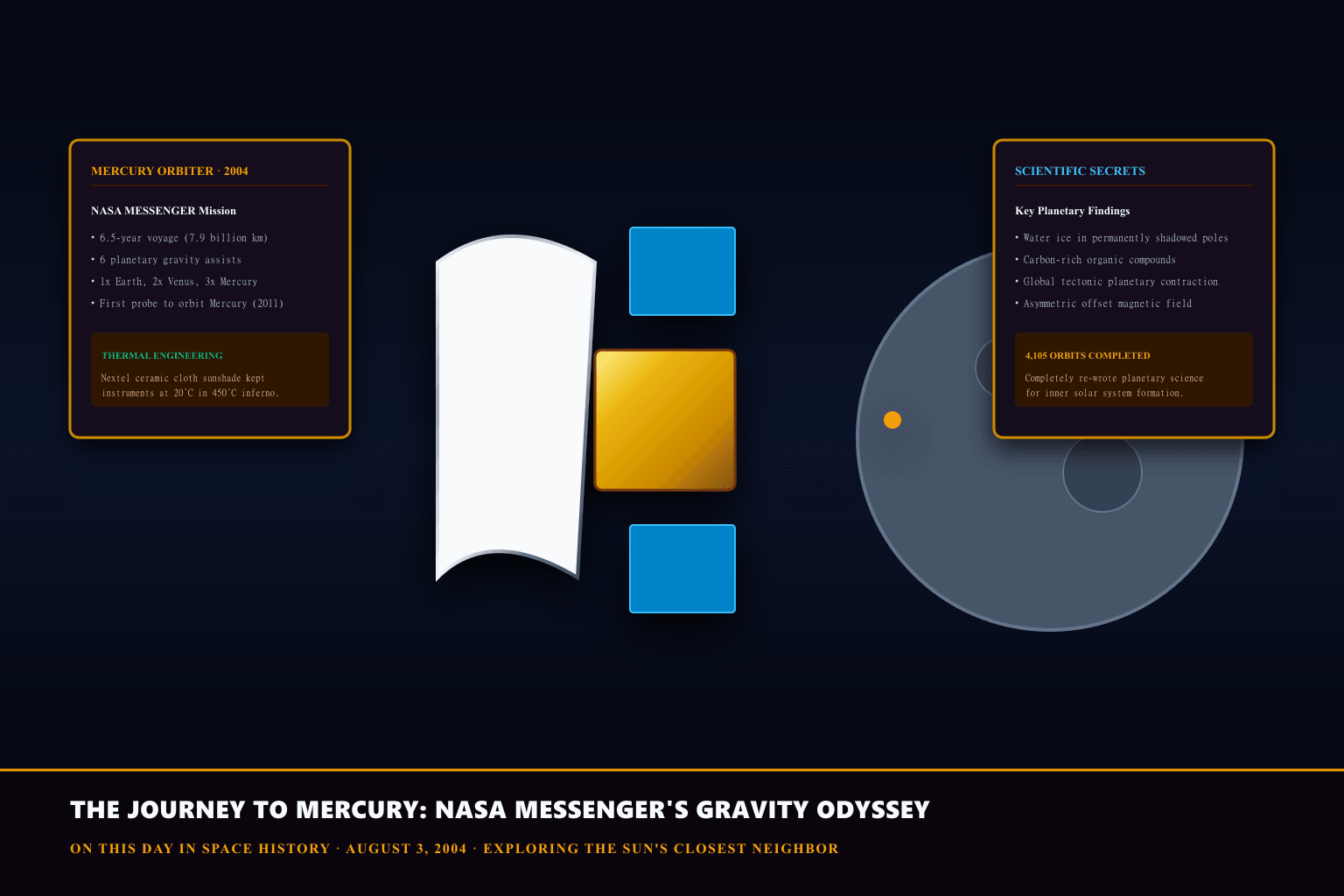
The Delta-V Dilemma: Falling Inward Toward the Sun
Reaching the outer solar system requires accelerating away from the Sun, but traveling to Mercury presents the opposite aerodynamic challenge: shedding excess orbital velocity. As a spacecraft drops toward the Sun, solar gravitational acceleration increases its speed dramatically. Entering orbit around Mercury directly would require more rocket propellant than the mass of the launch vehicle itself.
Mission orbital designers at the Johns Hopkins University Applied Physics Laboratory (JHU/APL) engineered a masterclass in interplanetary trajectory design. Over six and a half years, MESSENGER flew past Earth once, Venus twice, and Mercury three times. Each flyby exchanged angular momentum with the planets, progressively shrinking the probe's aphelion until its relative velocity matched Mercury's orbital speed on March 18, 2011.
Engineering for Extreme Thermal Environments: The Nextel Sunshade
At Mercury's perihelion, solar radiation is eleven times more intense than at Earth, heating exposed spacecraft surfaces to over 450°C (840°F)—hot enough to melt lead. Conversely, when the spacecraft dipped into the planet's shadow, temperatures plunged to minus 180°C. Standard multi-layer insulation would quickly vaporize under these punishing conditions.
Engineers designed a curved, semi-cylindrical sunshade measuring 2.5 by 2 meters, woven from proprietary Nextel ceramic cloth backed by layers of Kapton aluminized film. By keeping this lightweight, heat-reflective shield pointed continuously toward the Sun, the sensitive electronics, spectrometers, and magnetometers operating behind it remained at a comfortable room temperature of 20°C.
Scientific Discoveries: Water Ice and Volatile Composition
Before MESSENGER, prevailing planetary formation models held that Mercury was an airless, dried-out cinder stripped of volatile elements by early solar heat. MESSENGER's neutron spectrometer and laser altimeter disproved this assumption, confirming that deep, permanently shadowed impact craters at Mercury's poles harbor pure water ice and carbon-rich organic compounds shielded from direct sunlight.
The probe also discovered an offset dipole magnetic field, vast volcanic smooth plains indicating prolonged tectonic activity, and unique surface depressions dubbed 'hollows' formed by sublimating volatile minerals. On April 30, 2015, after expending its final hydrazine propellant reserves, MESSENGER completed its mission with a planned, high-speed impact on Mercury's northern plains.
What the evidence does not settle
While MESSENGER confirmed the presence of water ice at Mercury's poles, it could not directly land on the surface to sample isotopic ratios. The high orbital speeds and intense thermal conditions restricted detailed radar sounding to northern latitudes due to the eccentric nature of its orbit.
PRODUCT IDEA 01
Mechanical Brass Desktop Orrery Model of the Inner Solar System
A precision-geared mechanical desktop orrery demonstrating the real-time orbital resonance and planetary alignments of Mercury, Venus, Earth, and Mars around the Sun.
Buying limit: Look for solid brass gear trains and sturdy weighted oak bases. Collectible kinetic models typically retail from $65 to $140.
Original editorial illustration, not a retailer photograph. No exact Amazon offer passed our verification gate.PRODUCT IDEA 02
National Geographic Backyard Guide to the Night Sky & Planetary Astronomy
A beautifully illustrated stargazer's guide offering clear constellation charts, planetary transit tracking tips, and practical observation guides for amateur astronomers.
Buying limit: Available in flexibound field editions and digital formats. Field guides generally cost between $15 and $28.
Original editorial illustration, not a retailer photograph. No exact Amazon offer passed our verification gate.SOURCES, METHOD, AND LIMITS
Researched using mission summary reports from Johns Hopkins Applied Physics Laboratory (JHU/APL), NASA Solar System Exploration archives, and primary scientific papers published in Science and Nature. No commercial products were physically tested.
- NASA Planetary Data System — MESSENGER Mission Overview & Instrument Data — Official mission repository detailing spacecraft trajectory, neutron spectrometer calibration, and polar ice radar mapping.
- Johns Hopkins Applied Physics Laboratory — MESSENGER Engineering & Thermal Design Monograph — Technical publication documenting the ceramic Nextel sunshield construction, gravity assist milestones, and orbital insertion delta-v calculations.