ON THIS DAY · AUGUST 1, 1981
The Day Video Killed the Radio Star: How MTV's 1981 Launch Redefined Music, Cable Television, and Visual Culture
At 12:01 AM on August 1, 1981, a countdown of Apollo 11 rocket footage and a synthesized guitar riff inaugurated MTV. Armed with stereo simulcasting and 24-hour music video programming, a scrappy cable startup permanently transformed how the world consumed pop culture and visual arts.
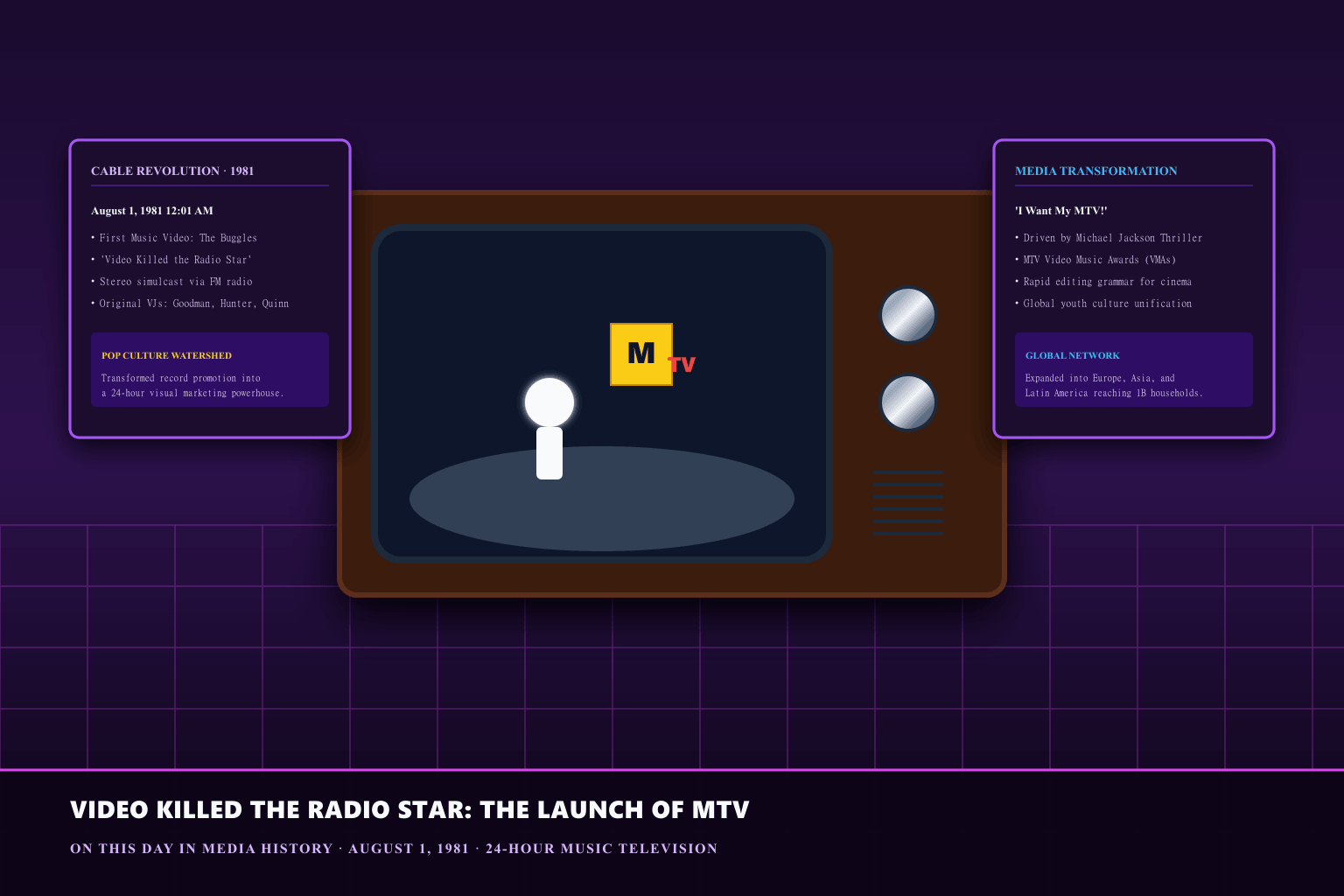
The FM Simulcast Breakthrough and Cable Architecture
In the early 1980s, standard television audio was delivered via low-fidelity, monophonic analog RF signals that sounded hollow compared to FM radio receivers. MTV co-founders Bob Pittman, John Lack, and Tom Freston recognized that rock and pop music fans demanded dynamic stereo sound. To bypass the physical limitations of analog CRT television speakers, MTV engineered an innovative dual-feed delivery system.
Cable operators received video over RCA Satcom I satellite transponders while simultaneous stereo audio tracks were modulated onto an unassigned FM frequency band. Subscribers connected a separate FM stereo splitter cable from their wall tap into their home Hi-Fi receivers. This technical architecture allowed MTV to deliver pristine stereo audio years before the Federal Communications Commission standardized Multi-channel Television Sound (MTS) broadcast television in 1984.
Curating a Visual Revolution: The Video Jockeys and Rotation Format
MTV adopted the programming philosophy of progressive AOR (Album-Oriented Rock) radio stations, replacing traditional disc jockeys with charismatic 'Video Jockeys' (VJs) including Martha Quinn, Nina Blackwood, Mark Goodman, Alan Hunter, and J.J. Jackson. Unlike rigid 30-minute sitcom slots, MTV was formatted as a continuous visual flow, encouraging ambient viewing and around-the-clock engagement.
In its first months, the channel had a library of fewer than 250 music clips, largely sourced from European record labels where promotional films were already common. The rotation of clips by artists like Duran Duran, Blondie, and Rod Stewart demonstrated an unprecedented promotional power: record stores in towns carrying MTV reported massive sellouts for artists receiving zero local radio airplay.
The Cultural Impact of the 'I Want My MTV' Campaign
Faced with resistance from conservative cable operators in major urban markets like Manhattan and Los Angeles, MTV launched its iconic 'I Want My MTV' guerrilla advertising campaign in 1982. Featuring rock icons like Mick Jagger, Pete Townshend, and Cyndi Lauper urging viewers to call their local cable providers, the campaign unleashed an avalanche of consumer demand that forced national cable expansion.
Within three years, MTV evolved from a niche experimental cable feed into a dominant global media empire. The channel fundamentally altered filmmaking techniques, accelerating editing tempos, elevating music video directors into Hollywood feature filmmakers, and cementing visual aesthetics as the defining dimension of global popular music.
What the evidence does not settle
While MTV is remembered as an instantaneous nationwide sensation, its initial August 1, 1981 broadcast was actually seen by only a few thousand households in parts of northern New Jersey due to limited satellite dish reception. Early programming was also criticized for an initial lack of diversity, a policy dramatically overturned in 1983 with the breakout rotation of Michael Jackson's 'Billie Jean.'
PRODUCT IDEA 01
Retro MTV Classic Logo Vintage Cotton Graphic Tee
An officially licensed vintage-washed cotton tee showcasing the iconic 1981 MTV block logo with spray-paint textures, celebrating the visual identity that defined early cable television.
Buying limit: Look for 100% ring-spun cotton with durable screen-printed graphics. Quality heritage apparel typically retails between $20 and $35.
Original editorial illustration, not a retailer photograph. No exact Amazon offer passed our verification gate.PRODUCT IDEA 02
Portable Bluetooth Boombox with Stereo Audio & FM Tuner
A retro-inspired portable boombox combining dual high-output stereo speakers, FM radio reception, and modern Bluetooth streaming to recreate the vibrant audio ambiance of the early 80s.
Buying limit: Select units with rechargeable lithium-ion battery packs and dedicated bass reflex radiators. Dependable retro stereos range from $45 to $85.
Original editorial illustration, not a retailer photograph. No exact Amazon offer passed our verification gate.SOURCES, METHOD, AND LIMITS
Researched using archival broadcast logs from MTV Networks, audio engineering documentation on early cable FM stereo simulcast modulation, and historical industry analysis from the Museum of Broadcast Communications. No commercial products were physically tested.
- Museum of Broadcast Communications — Music Television (MTV) Historical Archive — Archival retrospective documenting the founding team, Apollo 11 moon launch imagery branding, and the roll-out of 24-hour cable music programming.
- IEEE Broadcast Technology Society — Evolution of Television Stereo Audio & Cable Simulcast — Technical monograph analyzing FM subcarrier cable distribution and early multi-channel television sound modulation techniques.