ON THIS DAY · JULY 28, 1958
A Civilian Path to the Stars: How the National Aeronautics and Space Act Established NASA in 1958
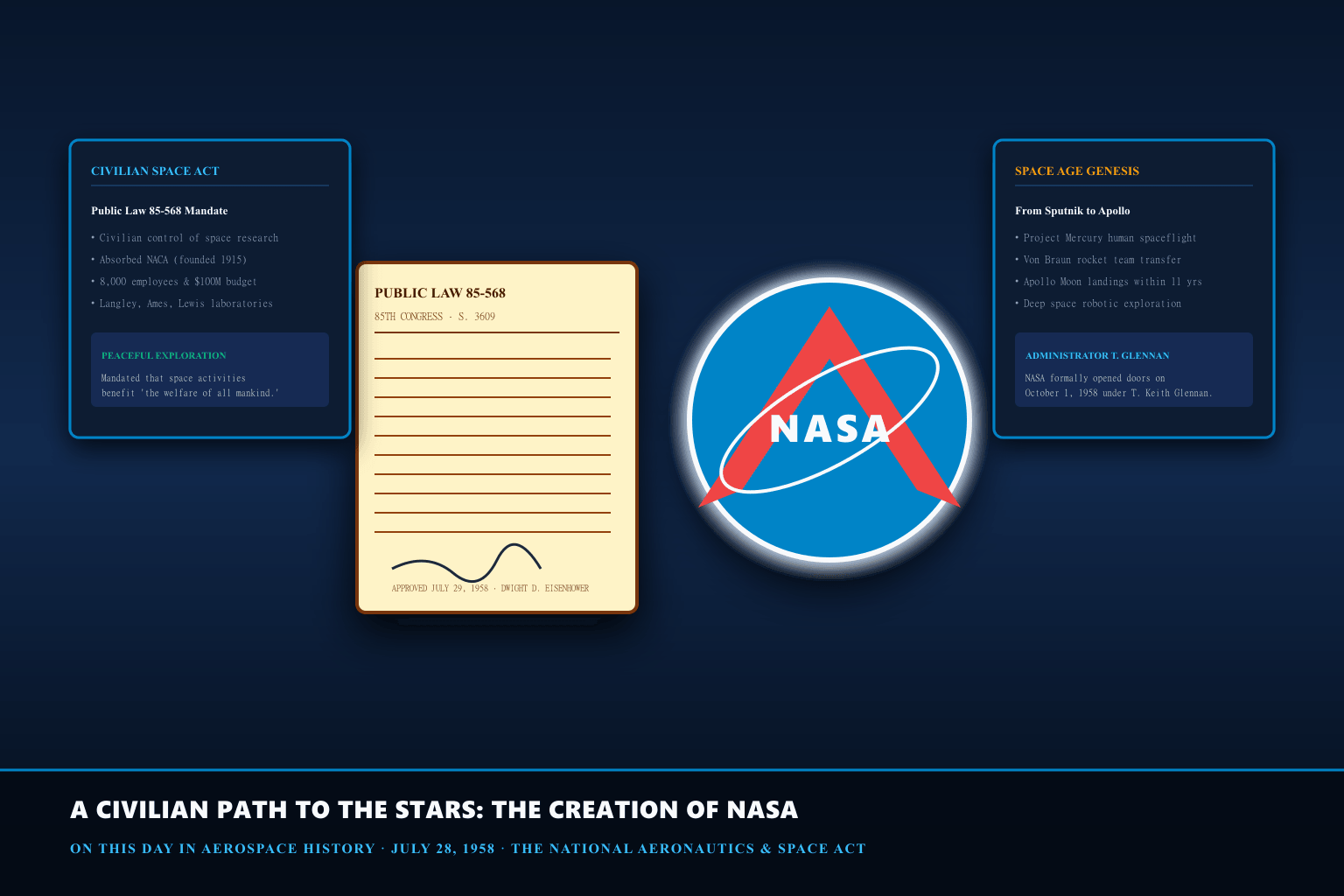
In the geopolitical panic following the Soviet launch of Sputnik, American military branches fought fierce turf wars for control of rocket programs. On July 28, 1958, President Dwight D. Eisenhower signed public law 85-568, establishing NASA as a civilian space agency dedicated to peaceful exploration for all humanity.
The Sputnik Crisis and the Military Turf War
When the Soviet Union launched Sputnik 1 in October 1957, the American public and Congress experienced a profound technological shock. In the months that followed, the US Army, Navy, and Air Force engaged in intense bureaucratic and budgetary warfare to control the future of spaceflight.
The Army Ballistic Missile Agency (ABMA) in Huntsville had Wernher von Braun's rocket team, the Navy had Project Vanguard, and the Air Force claimed jurisdiction over all ballistic missile operations. President Eisenhower recognized that dividing space efforts across three competing military branches would result in wasteful duplication, classified secrecy, and international accusations of space weaponization.
The Civilian Mandate: Science Over Militarism
Eisenhower and his science advisor, Dr. James Killian (president of MIT), insisted that space exploration should be administered by a civilian government agency open to international scientific cooperation. The Space Act codified nine fundamental objectives, prominently declaring:
"The Congress hereby declares that it is the policy of the United States that activities in space should be devoted to peaceful purposes for the benefit of all mankind."
Consolidating the NACA and the Birth of Modern Centers
On October 1, 1958, NASA officially began operations under its first Administrator, T. Keith Glennan. The agency absorbed the venerable NACA's world-class aerodynamics infrastructure: the Langley Aeronautical Laboratory in Virginia, the Ames Aeronautical Laboratory in California, and the Lewis Flight Propulsion Laboratory in Ohio.
Shortly thereafter, NASA acquired the Jet Propulsion Laboratory (JPL) from the US Army and transferred Wernher von Braun's rocket development team to form the Marshall Space Flight Center. This unified civilian command structure allowed the United States to mobilize industrial and academic resources, taking humanity from early suborbital flights to the surface of the Moon in just eleven years.
What the evidence does not settle
While the Space Act created a civilian agency for exploration, it established a parallel mechanism ensuring that military space reconnaissance and intercontinental ballistic missile programs remained under the direct operational purview of the Department of Defense (DoD).
PRODUCT IDEA 01
NASA Vintage Retro Meatball & Worm Logo Pullover Heavyweight Hoodie

A comfortable heavy-blend fleece pullover hoodie featuring authentic NASA retro chest emblems, honoring the golden age of American civilian space science.
Buying limit: Look for durable double-stitched seams and official NASA licensing tags. Quality space enthusiast hoodies retail from $35 to $65.
Original editorial illustration, not a retailer photograph. No exact Amazon offer passed our verification gate.PRODUCT IDEA 02
This New Ocean: A History of Project Mercury — Loyd S. Swenson Jr.

The definitive, comprehensive official NASA history chronicling the birth of NASA, the creation of the Space Task Group, and America's first human spaceflight missions.
Buying limit: Available in trade paperback (NASA History Series) and digital formats. Copies typically retail between $18 and $32.
Original editorial illustration, not a retailer photograph. No exact Amazon offer passed our verification gate.SOURCES, METHOD, AND LIMITS
Researched using primary legislative records from the US House of Representatives Committee on Science and Astronautics (85th Congress), the Dwight D. Eisenhower Presidential Library archives, and NASA History Series publications (NASA SP-4407). No commercial products were physically tested.
- NASA History Division — The National Aeronautics and Space Act of 1958 (Public Law 85-568) — Official statutory text of the 1958 Space Act, legislative declaration of policy, and NACA reorganization mandates.
- Dwight D. Eisenhower Presidential Library — The Creation of NASA Historical Files — Presidential executive correspondence detailing James Killian's advisory reports and the civilian agency doctrine.