ON THIS DAY · AUGUST 29, 1997
The Late Fee That Created Netflix: How Reed Hastings and Marc Randolph Pivoted from Red Envelopes to Global Streaming
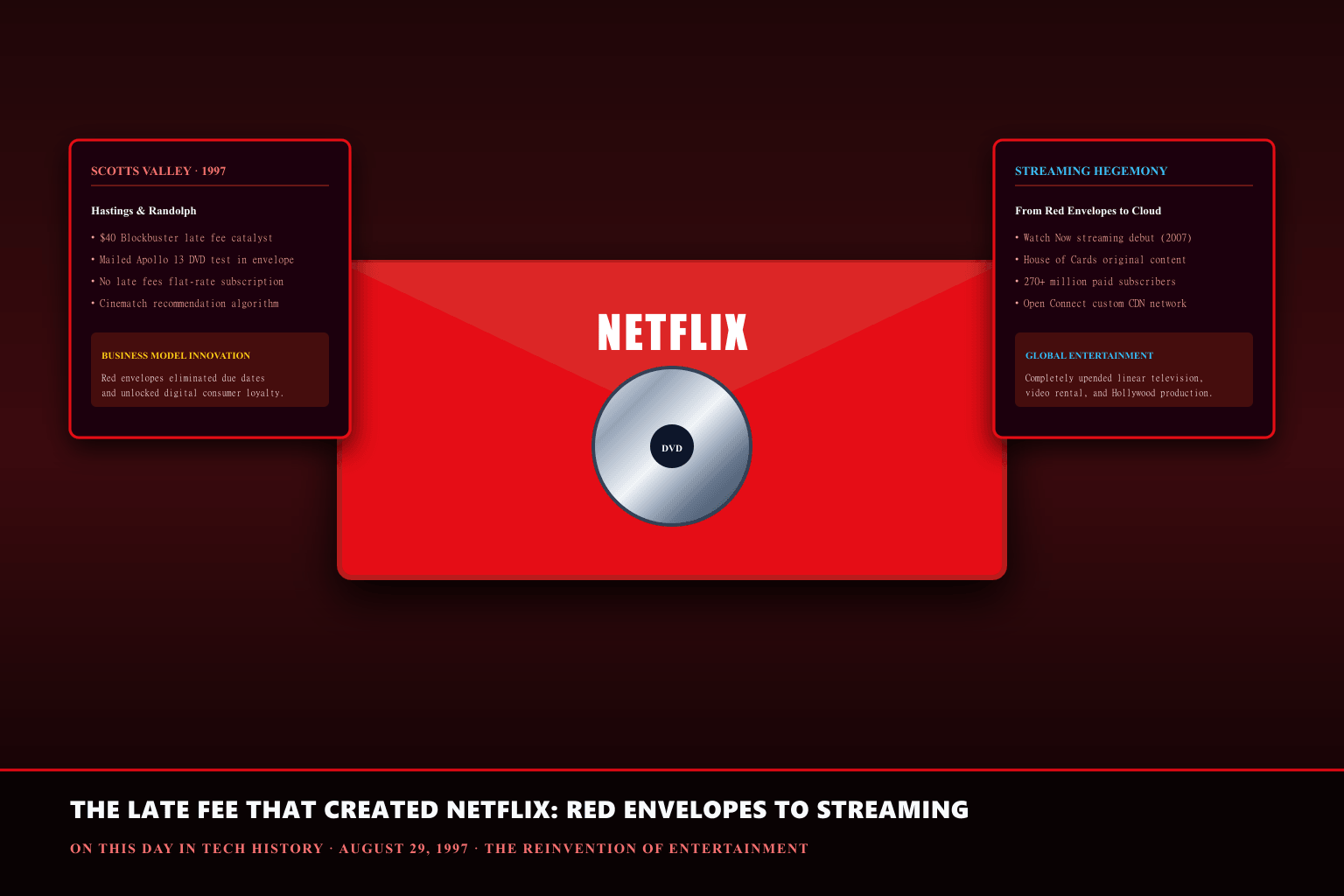
Frustrated by a $40 late fee on a rented VHS tape of Apollo 13, a software entrepreneur wondered why video rentals couldn't work like gym memberships with flat-rate subscriptions. On August 29, 1997, Netflix was founded, permanently upending entertainment technology.
The DVD Technological Breakthrough and the Postal Test
In 1997, the home video rental market was utterly dominated by Blockbuster's 9,000 brick-and-mortar stores renting bulky magnetic VHS tapes. VHS tapes were heavy, expensive to inventory, and suffered from mechanical wear. Simultaneously, electronics manufacturers introduced the Digital Versatile Disc (DVD)—a lightweight 5-inch optical disc that stored pristine digital video.
Randolph and Hastings realized that DVDs weighed less than an ounce and could be slipped into standard first-class postal envelopes for a fraction of the shipping cost of VHS. On a summer afternoon in Santa Cruz, they bought a music CD, slipped it into a greeting card envelope with a 32-cent postage stamp, and mailed it to Hastings' home address. When the disc arrived the next morning unbroken, they incorporated Netflix.
The Death of Late Fees and the Subscription Queue
When Netflix launched its website in April 1998, it operated on a traditional pay-per-rental model that struggled to compete with neighborhood video stores. In late 1999, Hastings introduced a radical business model innovation: the flat-rate monthly subscription with no due dates, no late fees, and an online 'Queue.'
Subscribers kept three DVDs at home for as long as they wanted. As soon as they returned a movie in the prepaid red return mailer, the next title in their Queue was automatically dispatched from a nationwide network of automated regional distribution hubs, delivering reliable next-day delivery.
Cinematch, Big Data, and the Pivot to Global Streaming
To keep customers engaged while waiting for popular Hollywood blockbusters, Netflix developed 'Cinematch'—an innovative collaborative filtering recommendation algorithm that predicted user movie tastes based on millions of user ratings.
In 2006, Netflix launched the legendary $1 million 'Netflix Prize' machine learning competition to improve Cinematch's accuracy by 10%, galvanizing global data science research. In 2007, leveraging decreasing cloud bandwidth costs, Netflix launched 'Watch Instantly,' transitioning from physical red envelopes to the cloud-native streaming platform that defines modern global television.
What the evidence does not settle
While the famous 'Apollo 13 late fee' anecdote was popularized by Reed Hastings as a convenient founding myth for marketing interviews, co-founder Marc Randolph has clarified that Netflix resulted from months of methodical market research exploring dozens of e-commerce business concepts.
PRODUCT IDEA 01
No Rules Rules: Netflix and the Culture of Reinvention — Reed Hastings & Erin Meyer
Netflix CEO Reed Hastings and INSEAD professor Erin Meyer reveal the radical corporate philosophy, talent density, and candid culture that drove Netflix's rise.
Buying limit: Available in trade paperback (Penguin Books) and unabridged audio. Copies typically retail between $14 and $24.
Original editorial illustration, not a retailer photograph. No exact Amazon offer passed our verification gate.PRODUCT IDEA 02
Ultra-Portable 1080p Mini Movie Projector with Wi-Fi & Bluetooth
A compact, lightweight 1080p home theater projector featuring HDMI/USB inputs, built-in stereo speakers, and smartphone screen mirroring for movie nights.
Buying limit: Look for true native resolution of at least 720p/1080p and high ANSI lumen brightness. Quality mini projectors cost $60 to $130.
Original editorial illustration, not a retailer photograph. No exact Amazon offer passed our verification gate.SOURCES, METHOD, AND LIMITS
Researched using California corporate registration filings, Marc Randolph's memoir That Will Never Work, Reed Hastings's No Rules Rules, and archival SEC Form 10-K regulatory reports. No commercial products were physically tested.
- SEC EDGAR Archives — Netflix Inc. Initial Public Offering Form S-1 Registration (2002) — Official financial regulatory filing detailing subscriber growth metrics, DVD distribution hub logistics, and Cinematch algorithms.
- Computer History Museum — The Architecture of Streaming: The Netflix Engineering Evolution — Technical retrospective documenting the transition from physical postal fulfillment to AWS cloud microservices and global Open Connect CDNs.