ON THIS DAY · AUGUST 4, 1995
The Day the Dot-Com Boom Began: How Netscape's 1995 IPO Ignited the Commercial Internet Economy
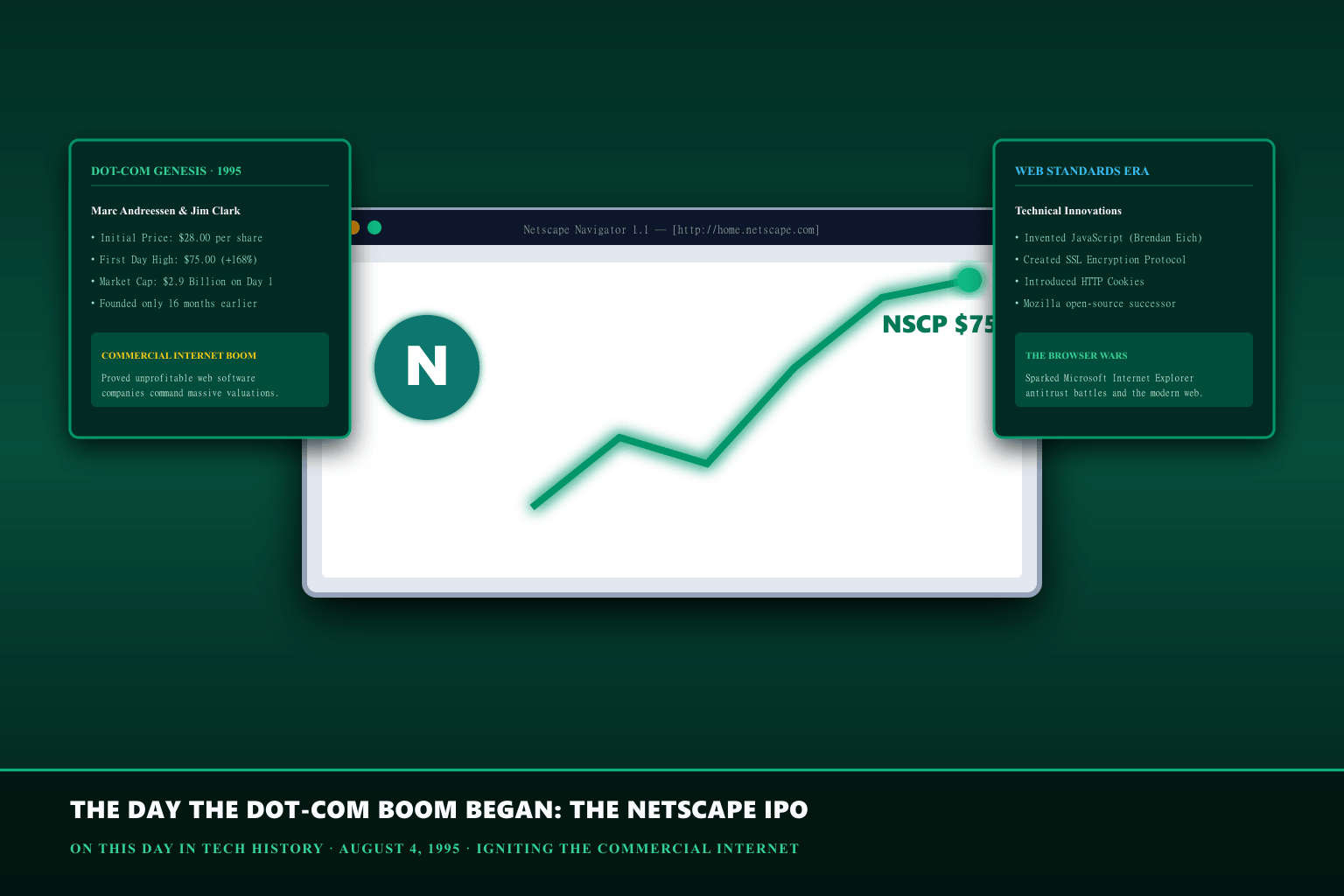
A sixteen-month-old startup with zero operating profit took Wall Street by storm on August 4, 1995. Netscape's public listing doubled share prices in minutes, minted the modern tech venture capital playbook, and convinced global markets that the World Wide Web was the commercial future of human civilization.
From Academic Mosaic to Netscape Navigator 1.0
In 1993, 22-year-old Marc Andreessen and Eric Bina developed NCSA Mosaic at the University of Illinois Urbana-Champaign, creating the first graphical web browser that displayed inline images alongside text. Recognizing the commercial potential of the nascent web, Silicon Graphics founder Jim Clark recruited Andreessen and key members of the original engineering team to Mountain View, California.
Incorporated originally as Electric Media and then Mosaic Communications, the team rebuilt the browser codebase from scratch to optimize performance on slow 14.4k dial-up modems. Netscape Navigator 1.0, released in late 1994, featured progressive JPEG rendering (loading blurry previews that gradually sharpened), cross-platform binary compatibility across Windows, Mac, and Unix, and aggressive network caching.
Inventing the Architecture of Modern Web Commerce: SSL and JavaScript
Beyond visual browsing, Netscape's engineering team invented the core protocols that enabled the modern digital economy. Under Kip Hickman and Taher Elgamal, Netscape created Secure Sockets Layer (SSL 2.0 and SSL 3.0), introducing asymmetric public-key cryptography to encrypt credit card transactions and protect confidential user sessions across open networks.
Simultaneously, engineer Brendan Eich was tasked with creating a lightweight scripting language embedded directly into HTML documents to make static pages dynamic. Developed in just ten days under the code name Mocha (and later LiveScript), the language was officially christened JavaScript in December 1995. Together with Lou Montulli's invention of the HTTP cookie for state management, Netscape created the fundamental tri-part architecture of modern e-commerce.
The Financial Earthquake and the Dawn of the Internet Era
Netscape's August 4 IPO defied traditional Wall Street orthodoxy, which traditionally required three to five consecutive years of documented profitability before taking a company public. Netscape had lost millions in its prior quarter, yet investors recognized that in network-effect software platforms, rapid distribution and market capture mattered far more than immediate quarterly margins.
The astonishing success of NSCP triggered a tidal wave of venture capital investment into Silicon Valley internet startups, sparking the dot-com era. It also famously provoked Microsoft CEO Bill Gates to publish his internal 'The Internet Tidal Wave' memo, shifting Microsoft's entire corporate focus to bundle Internet Explorer with Windows and initiating the fierce first browser war.
What the evidence does not settle
While Netscape proved the massive commercial appetite for web technologies, its initial market dominance was short-lived. Microsoft's aggressive bundling of Internet Explorer into Windows 95/98 eroded Netscape's market share by the late 1990s, ultimately leading to Netscape's acquisition by AOL in 1999 and the open-sourcing of its browser engine as the Mozilla Project (Firefox).
PRODUCT IDEA 01
The New New Thing: A Silicon Valley Story by Michael Lewis
Michael Lewis's bestselling journalistic masterpiece chronicles Jim Clark's visionary career, from founding Silicon Graphics and Netscape to funding Healtheon, capturing the intoxicating euphoria of the dot-com boom.
Buying limit: Available in paperback (W.W. Norton & Company) and unabridged audio. Standard retail trades between $12 and $20.
Original editorial illustration, not a retailer photograph. No exact Amazon offer passed our verification gate.PRODUCT IDEA 02
Retro 90s Dial-Up Modem & Vintage Tech Die-Cut Sticker Pack
A high-gloss waterproof vinyl sticker assortment featuring retro 90s tech emblems, CRT monitors, 3.5-inch floppy disks, and vintage browser icons perfect for laptop and water bottle personalization.
Buying limit: Opt for UV-laminated vinyl stickers that resist fading and peeling. Quality sticker multipacks retail from $8 to $16.
Original editorial illustration, not a retailer photograph. No exact Amazon offer passed our verification gate.SOURCES, METHOD, AND LIMITS
Researched using SEC S-1 registration filings from Netscape Communications Corp, historical market ticker data from NASDAQ archives, and primary interviews documented in the Computer History Museum oral histories. No commercial products were physically tested.
- Computer History Museum — The Netscape IPO and the Dawn of the Commercial Web — Institutional archive detailing Marc Andreessen and Jim Clark's founding strategy, browser architecture transitions, and Wall Street trading telemetry.
- SEC EDGAR Archives — Netscape Communications Corp Form S-1 Registration Statement (1995) — Primary financial regulatory filing containing Netscape's balance sheets, risk disclosures, initial share allocations, and institutional underwriters.