ON THIS DAY · AUGUST 26, 1920
The Unsung Pioneers of Early Computing: How the 19th Amendment Paved the Way for Grace Hopper and the ENIAC Programmers
When the 19th Amendment secured women's voting rights on August 26, 1920, it unlocked educational and institutional doors that transformed twentieth-century technology. Two decades later, women mathematically calculated ballistics trajectories, programmed the world's first electronic computer, and invented the compiler.
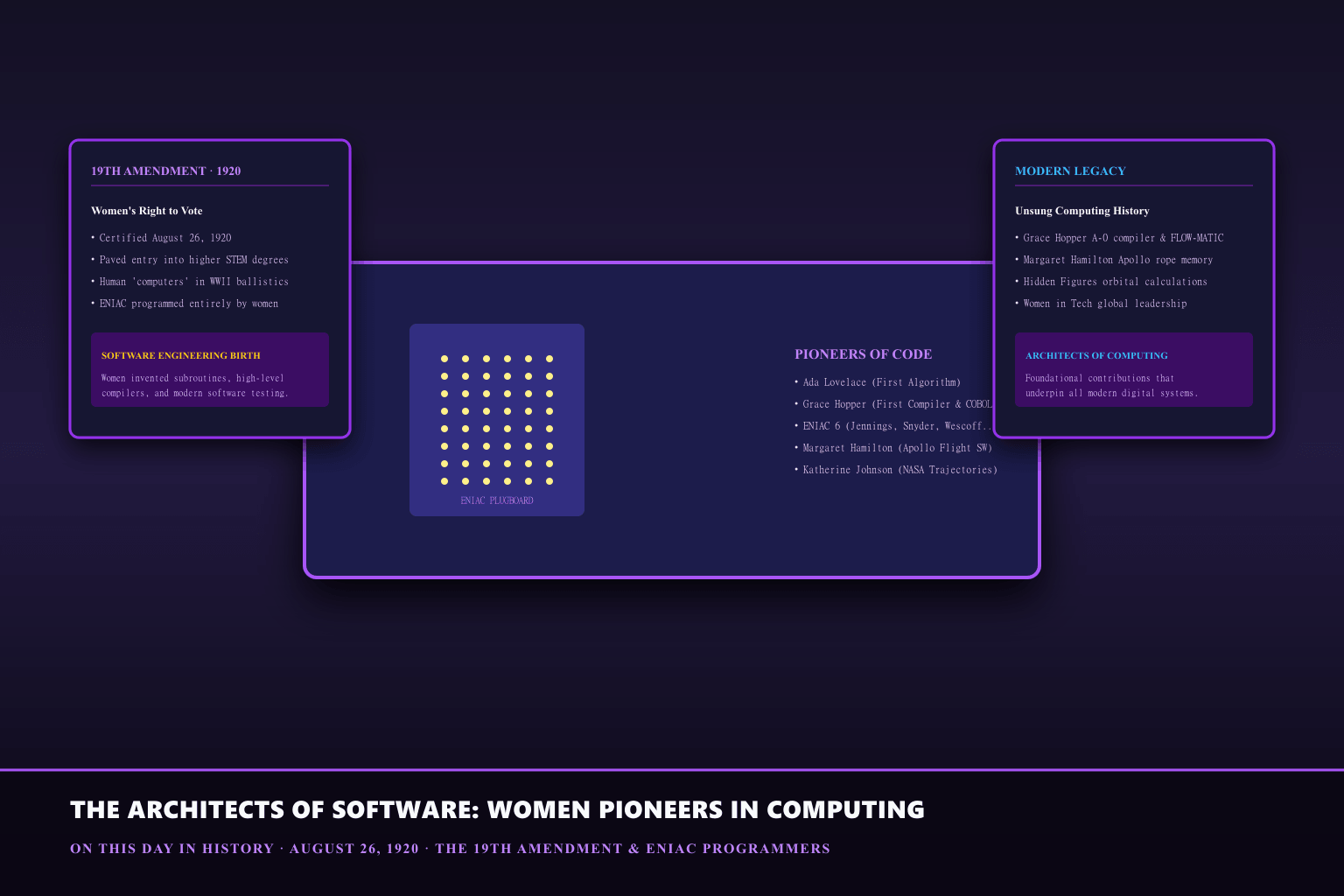
From Human 'Computers' to the ENIAC Six
Before electronic machines existed, the word 'computer' was a formal job title referring to human mathematicians—primarily women—who calculated complex mathematical tables by hand. During World War II, the US Army Ballistic Research Laboratory recruited dozens of female math graduates to calculate artillery firing tables using mechanical desktop calculators.
When the Moore School developed ENIAC (Electronic Numerical Integrator and Computer) in 1945, military leaders viewed building hardware as the 'man's job' and dismissed software programming as mere clerical wiring. Six brilliant female mathematicians—Betty Snyder Holberton, Jean Jennings Bartik, Kay McNulty, Marlyn Wescoff, Frances Bilas, and Ruth Lichterman—were tasked with making the 17,468 vacuum tube behemoth work without manuals, inventing flowcharts, subroutines, and programmatic debugging from scratch.
Grace Hopper and the Invention of the Compiler
Dr. Grace Hopper, who joined the US Navy during World War II and worked on the Harvard Mark I electromechanical computer under Howard Aiken, recognized that writing machine code in raw octal and binary numbers was inefficient and error-prone.
In 1952, working at Remington Rand on the UNIVAC system, Hopper created the A-0 System—the world's very first computer compiler—which translated human-readable mathematical symbols into machine code. Hopper argued that computers could be programmed in plain English words, pioneering FLOW-MATIC and laying the conceptual foundation for COBOL (Common Business-Oriented Language), which still runs billions of lines of global banking and government infrastructure today.
Recovering the Lost History of Software Engineering
Despite their foundational contributions, the ENIAC programmers were largely omitted from historical photographs and press coverage in 1946, frequently dismissed in archives as 'refrigerator models' posing next to the machine. It took decades of diligent historical research by scholars like Kathy Kleiman to restore their rightful place in technological history.
The legal and educational empowerment initiated by the 19th Amendment in 1920 created the intellectual pipeline that proved software was not an afterthought, but the primary intellectual engine driving digital civilization.
What the evidence does not settle
While the ratification of the 19th Amendment represented a historic milestone for women's suffrage, discriminatory state poll taxes and voter suppression laws continued to disenfranchise many women of color until the passage of the Voting Rights Act of 1965.
PRODUCT IDEA 01
Broad Band: The Untold Story of the Women Who Made the Internet — Claire L. Evans
Claire L. Evans's brilliant, deeply researched history celebrating the pioneering women who programmed early mainframes, built hypertext, and shaped the digital revolution.
Buying limit: Available in trade paperback (Portfolio/Penguin) and digital formats. Copies typically retail between $14 and $22.
Original editorial illustration, not a retailer photograph. No exact Amazon offer passed our verification gate.PRODUCT IDEA 02
Vintage Banker's Desk Lamp with Emerald Green Glass Shade
A timeless brass banker's desk lamp with an authentic emerald green glass shade and pull-chain switch, providing warm, glare-free illumination for research desks.
Buying limit: Look for heavy solid metal bases and hand-blown glass shades. Quality banker lamps range from $35 to $75.
Original editorial illustration, not a retailer photograph. No exact Amazon offer passed our verification gate.SOURCES, METHOD, AND LIMITS
Researched using primary records from the IEEE Women in Engineering historical collections, Harvard Mark I logbooks, the ENIAC Programmers Project archives, and Grace Hopper's oral histories at the Smithsonian. No commercial products were physically tested.
- IEEE Computer Society — The ENIAC Programmers: The Original Women of Computing — Historical technical profile documenting the software methodologies, patch-panel wiring, and mathematical subroutines created by the ENIAC Six.
- Smithsonian National Museum of American History — Grace Murray Hopper Collection & Compiler Patents — Curatorial archival collection containing Hopper's Harvard Mark I logbooks, A-0 compiler papers, and naval technical awards.