ON THIS DAY · AUGUST 14, 2003
When a Software Bug Turned Off the Lights for 50 Million People: The 2003 Northeast Blackout and Grid Architecture
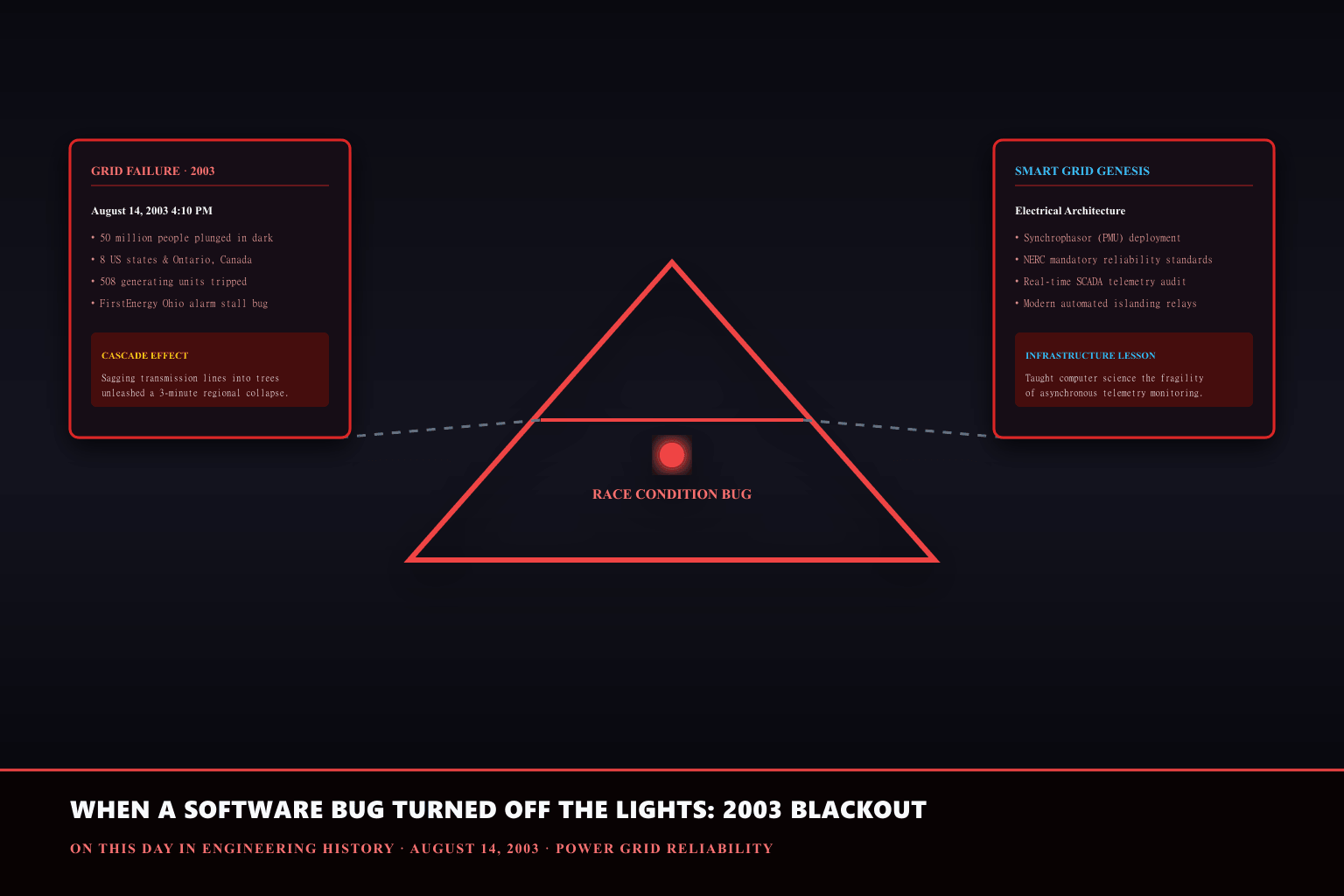
On a sweltering Thursday afternoon, a high-voltage transmission line in Ohio sagged into an overgrown tree branch. Behind the scenes, a silent software race condition crippled control room alarm monitors, triggering the largest cascading power blackout in North American history.
The Thermal Overload and the High-Voltage Line Sags
On August 14, high summer temperatures created severe air conditioning electricity demand across the Midwest. At 1:31 PM, FirstEnergy's Eastlake Unit 5 coal plant tripped offline. To meet the regional electrical deficit, neighboring 345-kilovolt transmission lines began carrying dangerously high current loads.
As electrical current flowed through the aluminum conductors, ohmic resistive heating caused the physical power lines to expand and sag downward. Between 3:05 PM and 3:41 PM, three critical 345-kV lines (Harding-Chamberlin, Hanna-Juniper, and Star-South Canton) sagged into overgrown brush and oak trees that had not been properly trimmed, short-circuiting to ground and tripping offline.
The Race Condition: How Software Froze Control Room Alarms
Under normal operational conditions, supervisory control and data acquisition (SCADA) systems alert grid dispatchers immediately when a high-voltage line trips, allowing operators to shed localized electrical loads to stabilize voltage. However, at 2:14 PM, the alarm processor inside FirstEnergy's XA/21 system encountered a classic computer science concurrency bug: a race condition.
Two separate software threads attempted to write into the same shared event data structure simultaneously without proper mutex locking. The alarm application crashed into an infinite processing loop. While the main telemetry display continued updating raw sensor values, the central alarm siren, warning banners, and audible chimes completely froze. For over ninety minutes, dispatchers sat unaware that their transmission network was failing around them.
The Cascading Collapse and Mandatory Grid Modernization
With three major transmission corridors severed, massive surges of electrical power surged unpredictably through lower-voltage 138-kV lines, overloading them sequentially like falling dominoes. At 4:05 PM, the surge destabilized the entire Lake Erie transmission loop, causing automatic protective relays to disconnect power plants across New York, Cleveland, Detroit, Toronto, and Ottawa to prevent physical turbine damage.
The blackout caused an estimated $6 billion in economic damages. In response, the US Congress passed the Energy Policy Act of 2005, transforming the voluntary North American Electric Reliability Council (NERC) into a regulatory body with legal power to enforce mandatory cybersecurity standards, vegetation management rules, and fail-safe SCADA software redundancy.
What the evidence does not settle
While the software race condition at FirstEnergy was the primary initiating catalyst, federal investigators emphasized that institutional communication failures between regional grid operators (MISO and PJM) and inadequate reactive power support contributed heavily to the continental-scale cascade.
PRODUCT IDEA 01
Emergency Hand-Crank Solar NOAA Weather Radio & Flashlight Power Bank
A rugged multi-powered emergency radio featuring AM/FM/NOAA emergency weather band reception, integrated solar panel, hand-crank dynamo generator, and USB phone charging port.
Buying limit: Look for durable water-resistant housings and internal batteries of at least 4,000 mAh. Quality emergency radios cost between $25 and $55.
Original editorial illustration, not a retailer photograph. No exact Amazon offer passed our verification gate.PRODUCT IDEA 02
Pure Sine Wave Uninterruptible Power Supply (UPS) Battery Backup
A 1500VA pure sine wave battery backup system with automatic voltage regulation (AVR) to protect computers, network routers, and sensitive electronics from blackouts and power surges.
Buying limit: Ensure the unit provides true pure sine wave AC output to protect delicate power supplies. Quality 1500VA UPS units retail from $160 to $260.
Original editorial illustration, not a retailer photograph. No exact Amazon offer passed our verification gate.SOURCES, METHOD, AND LIMITS
Researched using the official Final Report on the August 14, 2003 Blackout in the United States and Canada published by the US-Canada Power System Outage Task Force, IEEE Power & Energy Society engineering reviews, and NERC reliability standards documents. No commercial products were physically tested.
- US Department of Energy & Natural Resources Canada — Final Report on the August 14, 2003 Blackout — Comprehensive 228-page joint government investigation detailing root-cause telemetry logs, line-sag sequences, and software architecture failures.
- IEEE Power & Energy Magazine — Anatomy of the 2003 Northeast Blackout — Technical analysis examining transmission grid dynamics, SCADA alarm race conditions, and automatic relay protection mechanisms.