ON THIS DAY · TECHNOLOGY HISTORY
The Contaminated Dish That Changed Medicine: How Alexander Fleming Observed Penicillin in a Messy London Lab
Before Alexander Fleming noticed a halo of dissolved staphylococci around a stray fungal colony in a St. Mary's laboratory, bacterial infections were lethal sentences. Here is the verified history behind the 1928 discovery, the Oxford purification breakthrough, and what really happened.
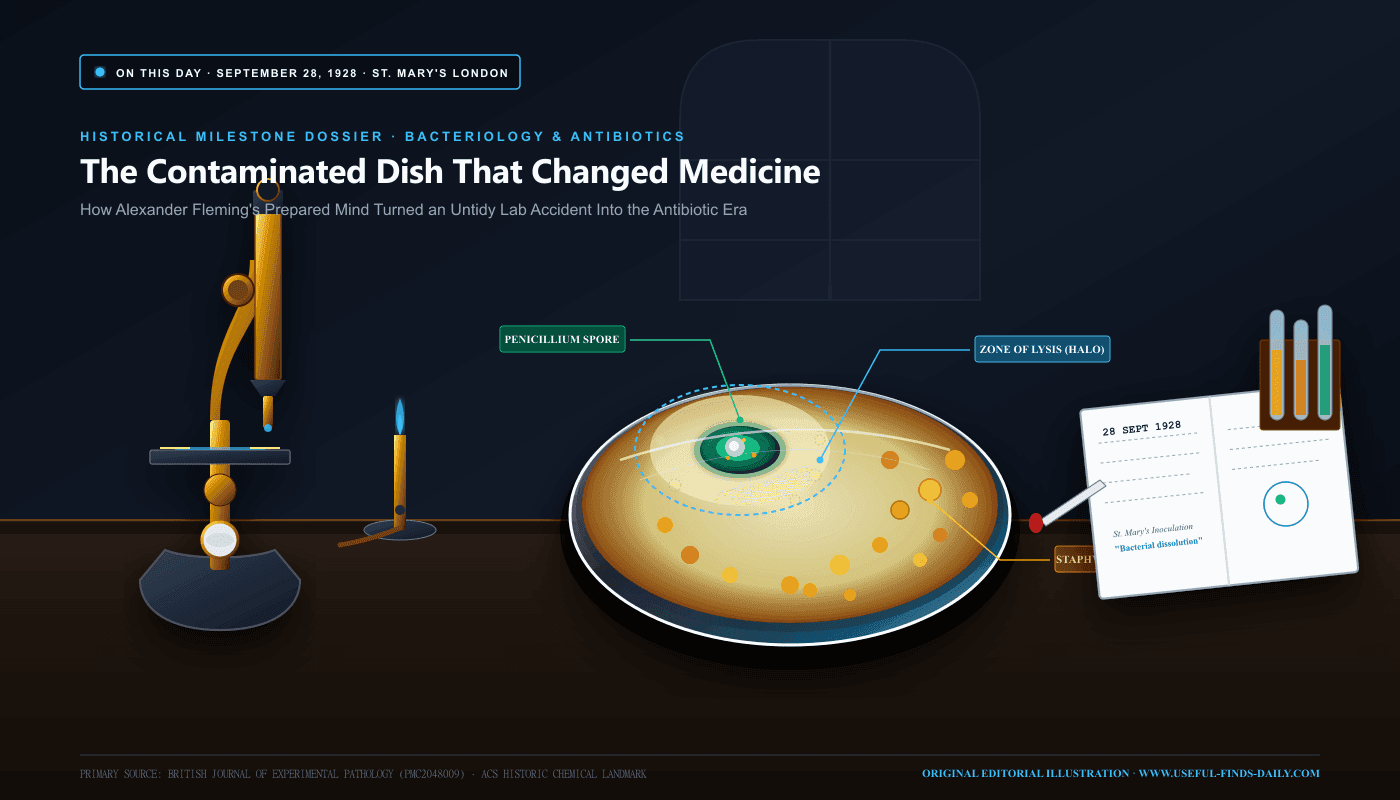
The St. Mary's Lab: A Prepared Mind and an Untidy Bench
In late September 1928, Dr. Alexander Fleming returned to his second-floor laboratory at St. Mary's Hospital Medical School in London after a month-long holiday in Suffolk with his wife and young son. Fleming was a 47-year-old Scottish bacteriologist respected for his meticulous scientific curiosity, but widely notorious among colleagues for maintaining an extraordinarily cluttered workstation. Prior to leaving for holiday, Fleming had inoculated dozens of circular glass petri dishes with Staphylococcus aureus—a common bacterium responsible for boils, abscesses, wound sepsis, and often fatal bloodstream infections. Rather than submerging the finished culture plates in trays of Lysol disinfectant, Fleming had simply stacked them in a corner of his wooden workbench near a draughty, open window overlooking Praed Street.
Upon his return, Fleming began sorting through the towering stacks of culture dishes with his former assistant, D. Merlin Pryce. Picking up a plate from the top of the pile, Fleming noticed that an airborne fungal spore had drifted in and germinated into a velvety blue-green mold colony. In ordinary circumstances, any standard bacteriologist would have cursed the contamination, discarded the spoiled agar plate, and scrubbed the glass dish. But as Fleming closely inspected the plate under the window's natural grey London light, he observed something astonishing: across the wide surface of the agar, colonies of staphylococci were growing densely, except in a wide, pristine circular ring surrounding the mold colony. In that immediate perimeter—a clear halo roughly an inch wide—the once-opaque bacterial colonies had completely stopped growing and were visibly undergoing lysis, dissolving into translucent, ghostly fluid shadows.
Fleming famously uttered a dry, understated reaction: 'That's funny.' But his ability to recognize the profound significance of that halo was neither luck nor coincidence. Louis Pasteur's famous dictum—'chance favors only the prepared mind'—applied precisely to Fleming. Seven years earlier, in 1921, Fleming had discovered lysozyme, a natural antibacterial enzyme found in tears, nasal mucus, and saliva, after accidentally allowing a droplet of his own nasal secretion to fall onto a bacterial culture plate. Because he had spent the preceding decade studying enzymatic bacterial lysis, Fleming was uniquely primed to realize that this stray mold was actively secreting a powerful, diffusible antibacterial substance that was destroying cell walls.
The 1929 Paper and the Unstable 'Mold Juice'
Fleming immediately preserved the contaminated culture plate and subcultured the mold in liquid meat nutrient broth. Working with his young lab assistants, Stuart Craddock and Frederick Ridley, Fleming observed that the liquid broth—which turned a bright golden yellow as the mold matured on its surface—retained lethal bactericidal properties even when diluted 1:800. The mold was identified as a member of the genus Penicillium (originally classified as Penicillium notatum, later recognized by modern molecular phylogenetics as Penicillium rubens). In his laboratory notes, Fleming initially referred to the yellow broth as 'mold juice,' but by early 1929 he formally coined the name 'penicillin' to designate the active antibacterial filtrate.
In June 1929, Fleming published his landmark paper in the British Journal of Experimental Pathology, entitled 'On the Antibacterial Action of Cultures of a Penicillium, with Special Reference to their Use in the Isolation of B. influenzae.' The paper methodically demonstrated that penicillin was extraordinarily potent against Gram-positive pathogens—including staphylococci, streptococci, pneumococci, and the diphtheria bacillus—while leaving Gram-negative bacteria such as the typhoid bacillus, E. coli, and Bacillus influenzae unaffected. Crucially, Fleming injected the crude broth into rabbits and mice and applied it to human white blood cells, discovering that unlike harsh chemical antiseptics of the era (such as carbolic acid or iodine, which destroyed leukocytes faster than bacteria), penicillin was non-toxic to living tissue.
Despite this astonishing therapeutic potential, penicillin hit a chemical dead end in Fleming's laboratory. Fleming was a bacteriologist, not a bio-organic chemist. Penicillin was an exceptionally labile beta-lactam compound: it broke down and lost its antibacterial potency within hours when exposed to mild heat, light, shifts in pH, or ordinary evaporation. Ridley and Craddock attempted to concentrate the substance by vacuum distillation, but the unstable active principle repeatedly decomposed into an inert residue. Discouraged by the impossibility of isolating or stabilizing the pure compound, Fleming concluded that penicillin was too fragile for systemic human medicine, suggesting instead that its primary practical value was as a selective differential agent in laboratory petri dishes to suppress unwanted bacteria while isolating B. influenzae.
The Oxford Breakthrough: Florey, Chain, and Heatley's Bedpans
For nearly a decade, penicillin remained a forgotten academic curiosity cited in textbook footnotes. The turning point arrived in 1938 at the Sir William Dunn School of Pathology at Oxford University. Australian-born experimental pathologist Howard Florey and brilliant German-Jewish biochemist Ernst Boris Chain, who had fled Nazi Germany, were conducting a systematic academic survey of natural antibacterial substances. While reviewing bacteriological literature, Chain stumbled upon Fleming's 1929 paper. Convinced that penicillin's mechanism of action represented an extraordinary biochemical puzzle, Florey and Chain assembled a multidisciplinary research team, recruiting talented biophysicist Norman Heatley.
Working under wartime austerity and strict blackout regulations in 1939 and 1940, the Oxford team faced a staggering engineering challenge: the Penicillium mold produced only trace fractions of penicillin (roughly one part per million in surface culture), requiring thousands of liters of liquid broth just to produce a few milligrams of brown active powder. Heatley demonstrated boundless mechanical genius. Because laboratory glass was severely rationed during the Blitz, Heatley scoured local suppliers, hospitals, and dairies, converting hundreds of ceramic hospital bedpans, metal biscuit tins, milk churns, and surgical rubber tubing into a continuous automated surface fermentation apparatus. Heatley developed a delicate multi-stage back-extraction technique: lowering the broth's pH to extract penicillin into cold amyl acetate, then rapidly shifting the pH back with an aqueous alkaline buffer to capture the delicate antibiotic before it decomposed.
In May 1940, Florey conducted the decisive animal experiment: eight mice were injected with lethal doses of virulent hemolytic streptococci; four received injections of purified penicillin every few hours, while four were left untreated. By morning, all four untreated control mice were dead, while all four penicillin-treated mice were alive and thriving. In February 1941, the team administered penicillin to the first human patient: Albert Alexander, a 43-year-old Oxford police constable dying of terminal staphylococcal and streptococcal sepsis following a scratched rose thorn that had turned gangrenous. Within days of intravenous penicillin treatment, Alexander's fever dropped dramatically, his appetite returned, and his severe facial abscesses began healing. Tragically, the Oxford laboratory's tiny handmade supply ran out—despite the team desperately recovering un-metabolized penicillin from the patient's urine—and Alexander suffered a fatal relapse. The heartbreaking trial proved two undeniable facts: penicillin was a miracle cure of unparalleled potency, and saving human lives would require an industrial scale of production that war-torn Britain could not provide.
Peoria, Cantaloupes, and Wartime Deep-Tank Fermentation
With British chemical and manufacturing infrastructure completely consumed by the Battle of Britain and relentless German bombing, Howard Florey and Norman Heatley flew across the Atlantic in July 1941 with the support of the Rockefeller Foundation to seek American industrial assistance. They traveled to the U.S. Department of Agriculture's Northern Regional Research Laboratory (NRRL) in Peoria, Illinois. Peoria was the capital of the American brewing and corn-processing industries, possessing world-class expertise in large-scale agricultural fermentation. The collaboration between British biological insight and American biochemical engineering would permanently alter world history.
Scientists at the Peoria laboratory, led by Robert Coghill, made three monumental breakthroughs that escalated penicillin yields by thousands of times. First, Dr. Andrew Moyer discovered that replacing standard sucrose nutrient medium with corn steep liquor—a concentrated, inexpensive byproduct of industrial cornstarch wet-milling—combined with milk sugar (lactose), multiplied penicillin production twentyfold. Second, the Peoria team initiated a global search for hyper-productive fungal strains. While pilots and military couriers sent soil samples from around the world, the holy grail was found locally in Peoria: laboratory worker Mary Hunt ('Moldy Mary') brought in an overripe, moldy cantaloupe from a neighborhood grocery market. The golden-green mold on the melon was Penicillium chrysogenum, which naturally produced more than two hundred times the penicillin yield of Fleming's original London strain.
Third, American chemical engineering giants—most notably Pfizer, Merck, E.R. Squibb & Sons, and Abbott Laboratories—pioneered deep-tank submerged fermentation. Instead of growing thin mold mats on the surface of thousands of fragile glass bottles, deep-tank fermentation involved pumping thousands of cubic feet of sterile compressed air through gigantic, steam-sterilized 10,000-gallon stainless steel agitated vats. By the time Allied forces landed on the beaches of Normandy on D-Day (June 6, 1944), American factories had manufactured 2.3 million doses of sterile penicillin. For the first time in military history, the majority of bacterial wound infections, amputations, and post-operative gangrene were completely conquered, transforming medicine from a passive observational discipline into a proactive curative science.
What the evidence does not settle
While popular accounts celebrate Alexander Fleming as the lone discoverer who created a miracle cure overnight, the historical and archival record demonstrates that Fleming discovered only the antibacterial phenomenon and could not chemically purify, stabilize, or systemically administer penicillin. Transforming penicillin from an unstable laboratory curiosity into a life-saving pharmaceutical required more than a decade of additional biochemical breakthroughs by Howard Florey, Ernst Chain, and Norman Heatley at Oxford, alongside American industrial scale-up at the USDA Peoria laboratory and wartime pharmaceutical consortia.
PRODUCT IDEA 01
The Mold in Dr. Florey's Coat: The Story of the Penicillin Miracle by Eric Lax
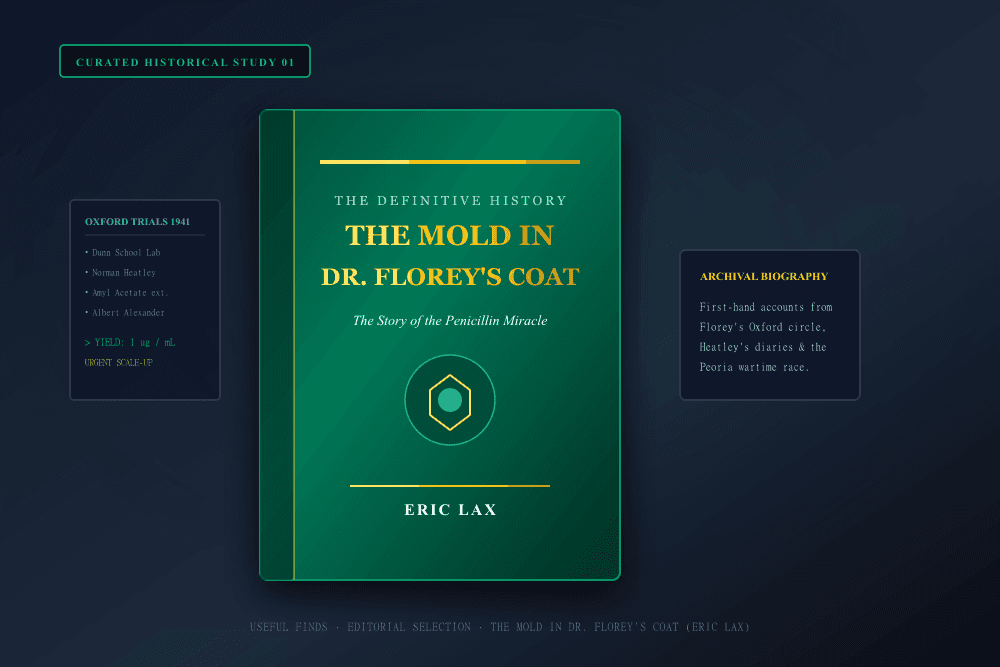
Eric Lax's masterfully researched book restores the crucial contributions of Howard Florey, Ernst Chain, and Norman Heatley to their rightful place alongside Alexander Fleming. Drawing from private letters, laboratory diaries, and first-person interviews with surviving Oxford researchers, Lax chronicles the clandestine wartime race to purify the fragile mold juice, the makeshift hospital bedpan extraction setups, and the dramatic transatlantic voyage to Illinois that ultimately scaled mass production in time for the Allied invasion of Europe.
Buying limit: Available in standard trade paperback and digital e-book formats. When purchasing copies online, readers should verify whether they are ordering the complete unabridged edition rather than shortened excerpt summaries. Because secondhand listings occasionally list ex-library copies with damaged dust jackets at collectible prices, verify seller condition ratings before purchase.
Original editorial illustration, not a retailer photograph. No exact Amazon offer passed our verification gate.PRODUCT IDEA 02
Compound Optical Monocular & Digital Student Microscope Kits
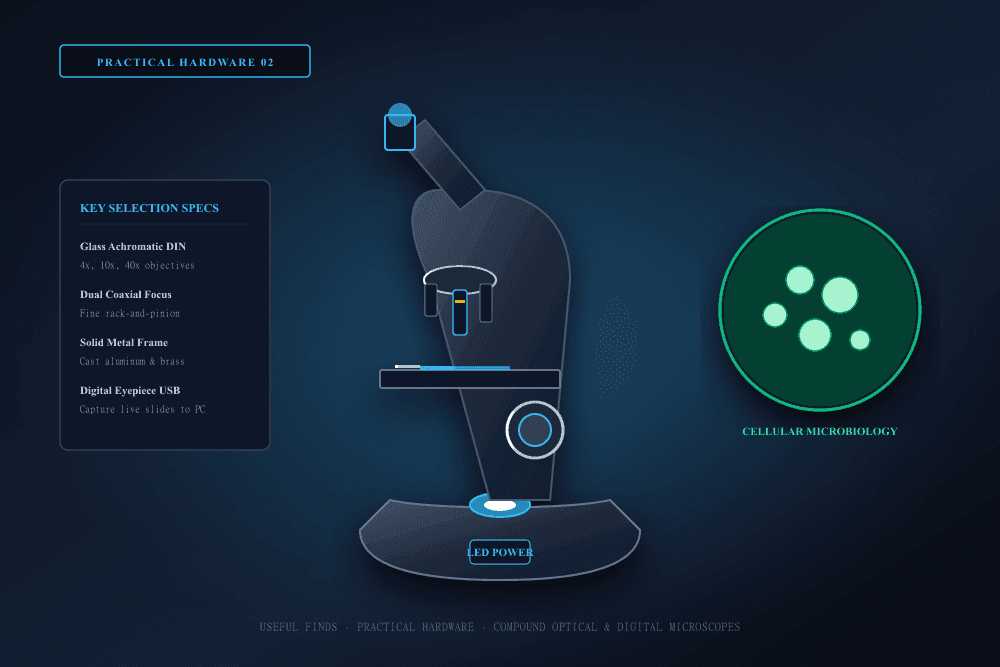
For aspiring scientists, students, and home biology enthusiasts, modern compound microscopes make the cellular world Fleming observed directly accessible. High-grade student and hobbyist models featuring all-metal frames, achromatic glass objectives (40x to 1000x magnification), coaxial coarse and fine focusing knobs, and integrated digital camera eyepieces allow users to examine prepared bacterial smears, fungal spore morphology, and protozoa with remarkable clarity.
Buying limit: Carefully avoid low-cost all-plastic toy microscopes that lack glass optics and rack-and-pinion focusing, as chromatic distortion and loose focus mechanisms quickly frustrate beginner observation. Look for models with standard DIN achromatic lenses and dual LED top/bottom illumination. No specific merchant or brand sponsorship has been accepted for this recommendation.
Original editorial illustration, not a retailer photograph. No exact Amazon offer passed our verification gate.SOURCES, METHOD, AND LIMITS
We investigated the discovery of penicillin by examining primary medical literature, starting with Alexander Fleming's original June 1929 paper in the British Journal of Experimental Pathology (PMC2048009) and his 1945 Nobel Lecture. We cross-referenced institutional archives from the American Chemical Society National Historic Chemical Landmarks program, the Science History Institute, and the Alexander Fleming Laboratory Museum at St. Mary's Hospital. We evaluated the mycological taxonomy (Penicillium notatum vs. Penicillium rubens), fermentation chemistry, and Oxford clinical trials to distinguish verifiable historical milestones from romanticized folklore. No commercial product was physically evaluated for this historical analysis.
- British Journal of Experimental Pathology: Fleming's Original 1929 Penicillin Report (PMC2048009) — Alexander Fleming's landmark primary paper detailing the discovery of bacterial lysis, the antibacterial properties of Penicillium broth, and its initial laboratory application for isolating B. influenzae.
- American Chemical Society: Discovery and Development of Penicillin Historic Landmark — Institutional history documenting the Oxford University biochemical purification, USDA Peoria corn steep liquor fermentation advances, and wartime pharmaceutical mass production.
- Nobel Prize Organization: Alexander Fleming Nobel Lecture (1945) — Official primary Nobel lecture delivering Fleming's first-hand account of the September 1928 observation, early clinical observations, and his prophetic warning regarding bacterial drug resistance.