ON THIS DAY · AUGUST 24, 2006
The Day Pluto Lost Its Planethood: How the IAU Redefined Solar System Science, Kuiper Belt Objects, and Planetary Physics
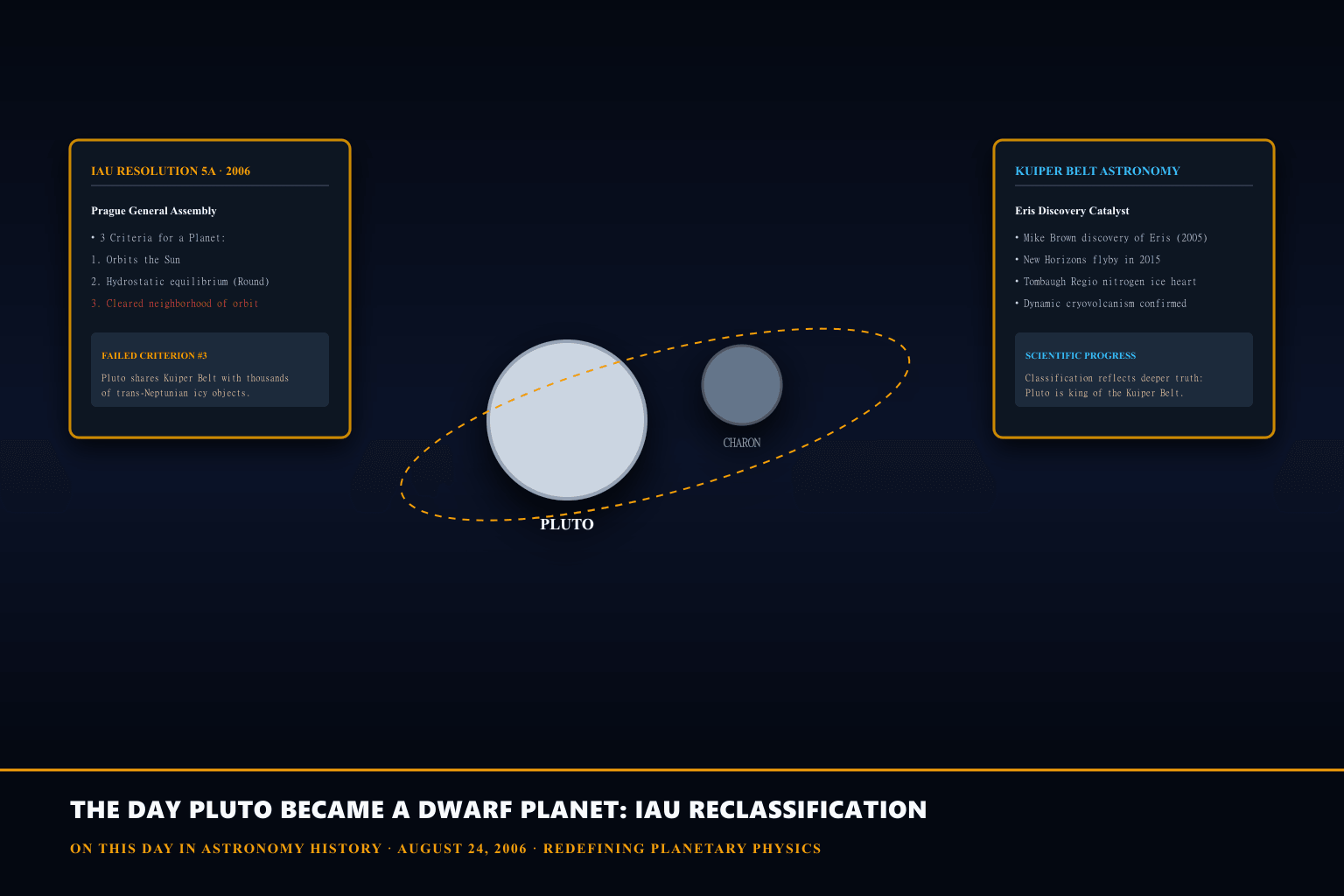
Discovered in 1930 by Clyde Tombaugh, Pluto reigned for seventy-six years as our solar system's beloved ninth planet. On August 24, 2006, a contentious vote by global astronomers demoted Pluto, creating the new category of 'dwarf planets' and rewriting science textbooks worldwide.
The Discovery of the Kuiper Belt and the Eris Dilemma
When Clyde Tombaugh discovered Pluto at Lowell Observatory in 1930, astronomers initially believed it was as massive as Earth. However, decades of photometric measurements and the 1978 discovery of its moon Charon revealed that Pluto was tiny—possessing just 0.2% of Earth's mass and smaller than Earth's Moon.
In the 1990s and early 2000s, astronomers led by Mike Brown at Caltech discovered that Pluto was not an isolated lonely world, but merely the largest member of a vast swarm of icy bodies orbiting beyond Neptune known as the Kuiper Belt. In 2005, Brown discovered Eris, a distant trans-Neptunian object roughly the same size as Pluto. The IAU was forced to make a decisive choice: either expand the solar system to dozens or hundreds of planets, or create a rigorous, physically grounded definition of planethood.
IAU Resolution B5: The Three Criteria of a Planet
During the tense closing session of the Prague conference on August 24, 2006, voting members approved Resolution B5, defining a true planet as a celestial body that: (1) is in orbit around the Sun; (2) has sufficient mass for its self-gravity to overcome rigid body forces so that it assumes a hydrostatic equilibrium (nearly round) shape; and (3) has cleared the neighborhood around its orbit.
The term 'cleared the neighborhood' means that a planet has accumulated sufficient gravitational dominance to either absorb, eject, or gravitationally capture smaller asteroids and planetesimals in its orbital path. Because Pluto's mass is only a tiny fraction of the total mass of objects in its orbital zone, it was assigned to the newly created category of 'dwarf planet,' alongside Ceres and Eris.
New Horizons and Pluto's Geological Complexity
The decision provoked passionate debate across the scientific community and the general public. Critics like New Horizons principal investigator Alan Stern argued that the dynamical definition unfairly penalized objects located far from the Sun where orbital volumes are immense.
In July 2015, NASA's New Horizons spacecraft completed its historic flyby of Pluto, revealing a world of astonishing geological vitality: towering 3-kilometer-high water-ice mountains, floating nitrogen glaciers at Sputnik Planitia, a blue-haze atmosphere, and evidence of a subsurface liquid water ocean. While no longer officially designated the ninth planet, Pluto remains one of the most scientifically complex and fascinating bodies in the outer solar system.
What the evidence does not settle
The IAU voting process was criticized because only 424 astronomers (less than 5% of the global IAU membership) remained in Prague to cast ballots on the final day of the two-week conference. Several prominent planetary scientists advocate for a geophysical definition of a planet based purely on intrinsic mass and geology rather than orbital clearing.
PRODUCT IDEA 01
How I Killed Pluto and Why It Had It Coming — Mike Brown
Caltech astronomer Mike Brown's captivating, witty first-hand account of discovering Eris, the Kuiper Belt revolution, and the contentious IAU planetary definition debates.
Buying limit: Available in trade paperback (Spiegel & Grau) and digital formats. Copies typically retail between $12 and $20.
Original editorial illustration, not a retailer photograph. No exact Amazon offer passed our verification gate.PRODUCT IDEA 02
Refractor Astronomical Beginner Telescope with Tripod & Smartphone Adapter
A 70mm aperture portable refractor telescope with fully coated optical glass, adjustable aluminum tripod, and phone mount for photographing the Moon and bright planets.
Buying limit: Look for focal lengths of 400mm to 700mm with Barlow lenses included. Quality beginner telescopes cost $70 to $130.
Original editorial illustration, not a retailer photograph. No exact Amazon offer passed our verification gate.SOURCES, METHOD, AND LIMITS
Researched using primary voting transcripts and resolution texts from the International Astronomical Union (IAU GA XXVI), New Horizons mission science releases from NASA/JPL, and Mike Brown's memoir How I Killed Pluto and Why It Had It Coming. No commercial products were physically tested.
- International Astronomical Union (IAU) — Resolution B5: Definition of a Planet in the Solar System — Official scientific resolution text codifying the three criteria for planetary classification and dwarf planet status.
- NASA Solar System Exploration — Pluto In-Depth & New Horizons Mission Science — Comprehensive planetary geology summary documenting Sputnik Planitia nitrogen glaciers, atmospheric haze layers, and Charon orbital dynamics.