ON THIS DAY · JULY 8, 2011
The Final Ascent: How Space Shuttle Atlantis and STS-135 Concluded Thirty Years of Shuttle History
At 11:29 AM on July 8, 2011, nearly a million spectators gathered along the Florida coast to watch four astronauts ride a thunderous column of smoke through the clouds. Mission STS-135 marked the 135th and final launch of NASA's Space Shuttle Program.
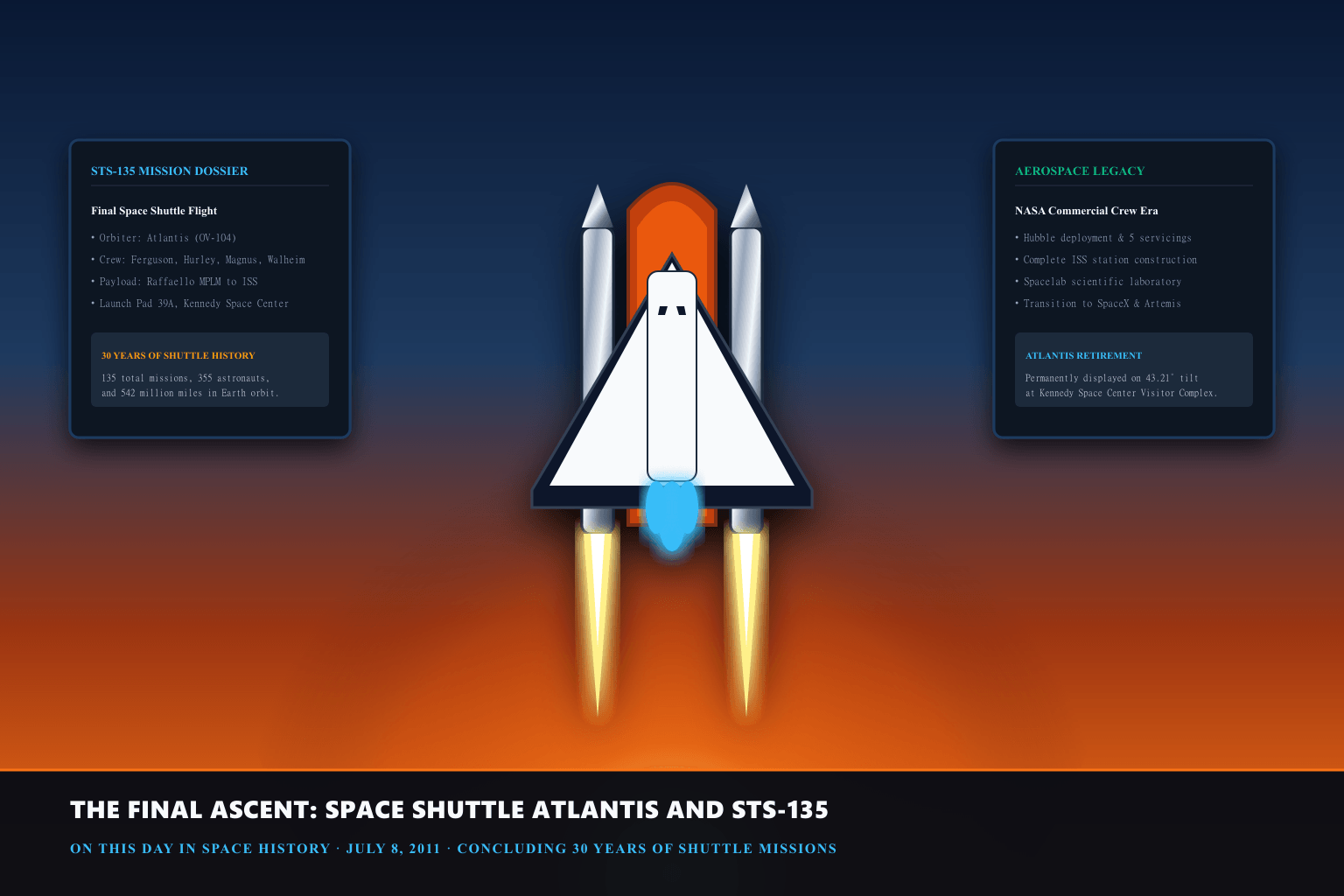
The Minimalist Crew and the High-Stakes Rescue Plan
Unlike typical space shuttle missions that carried six or seven astronauts, STS-135 flew with a lean crew of only four. Because Atlantis was the absolute last shuttle flight, there was no backup shuttle standing by on a neighboring pad for a launch-on-need rescue mission (STS-335) if Atlantis suffered thermal tile damage during ascent.
If the thermal protection system was compromised, the four astronauts would have taken refuge on the International Space Station as a 'safe haven,' returning to Earth one by one over a year aboard Russian Soyuz spacecraft. The reduced crew size ensured that Soyuz life-support logistics remained viable in an emergency.
Stocking the Station: The Raffaello Logistics Cargo
With the retirement of the shuttle fleet, NASA faced a multi-year gap in heavy domestic cargo launch capacity until commercial providers matured. STS-135's primary objective was packing the ISS with critical supplies.
Atlantis delivered the 21-foot Italian-built Raffaello module containing food, clothing, scientific experiment racks, and heavy mechanical spares—including the Robotic Refueling Mission (RRM) payload to test satellite propellant transfer in orbit—providing the station with a multi-year operational supply cushion.
The Historic Handover: The Flag for Commercial Crew
During the mission, Commander Chris Ferguson presented the ISS crew with an American flag that had flown on the very first space shuttle mission (STS-1 Columbia in April 1981). The flag was mounted to the hatch of the Harmony module with the instruction that it would remain on the ISS until the next American spacecraft launched from US soil retrieved it.
Nine years later, on May 31, 2020, STS-135 pilot Doug Hurley flew back to the station as commander of SpaceX's Demo-2 Crew Dragon flight alongside Bob Behnken, fulfilling the shuttle's legacy and inaugurating the modern commercial human spaceflight era. Atlantis is proudly displayed today at the Kennedy Space Center Visitor Complex.
What the evidence does not settle
The retirement of the shuttle fleet left the United States without domestic crew launch capability for nine years (2011–2020), requiring NASA to purchase seats aboard Russian Soyuz spacecraft at costs rising to over $80 million per seat.
PRODUCT IDEA 01
NASA Space Shuttle Atlantis STS-135 3D Laser-Cut Metal Model Kit
A precision laser-cut sheet steel model kit of Space Shuttle Atlantis with solid rocket boosters and external fuel tank, requiring no glue or solder for assembly.
Buying limit: Look for high-grade Japanese steel sheets with pre-bent tabs. Quality metal model kits cost $16 to $30.
Original editorial illustration, not a retailer photograph. No exact Amazon offer passed our verification gate.PRODUCT IDEA 02
Commemorative NASA STS-135 Final Mission Emblem Ceramic Coffee Mug
A premium 15-ounce ceramic coffee mug featuring the official NASA STS-135 mission patch and the final flight mission dates (1981–2011).
Buying limit: Ensure microwave and dishwasher-safe ceramic glaze. Quality space mugs retail between $14 and $24.
Original editorial illustration, not a retailer photograph. No exact Amazon offer passed our verification gate.SOURCES, METHOD, AND LIMITS
Researched using official NASA flight documentation for STS-135, Kennedy Space Center launch telemetry logs, and Smithsonian National Air and Space Museum historical collections. No commercial products were physically tested.
- NASA History Division — STS-135 Mission Overview & Space Shuttle Program Final Report — Official NASA mission archive detailing launch countdown, Raffaello cargo manifests, and wheelstop landing telemetry.
- Kennedy Space Center — Space Shuttle Atlantis OV-104 Permanent Exhibition — Curatorial technical record documenting Atlantis's 33 spaceflights, payload bay configurations, and transition to the national exhibition.