ON THIS DAY · AUGUST 30, 1984
The Workhorse of America's Space Fleet: Space Shuttle Discovery STS-41-D Maiden Flight and Solar Array Innovation
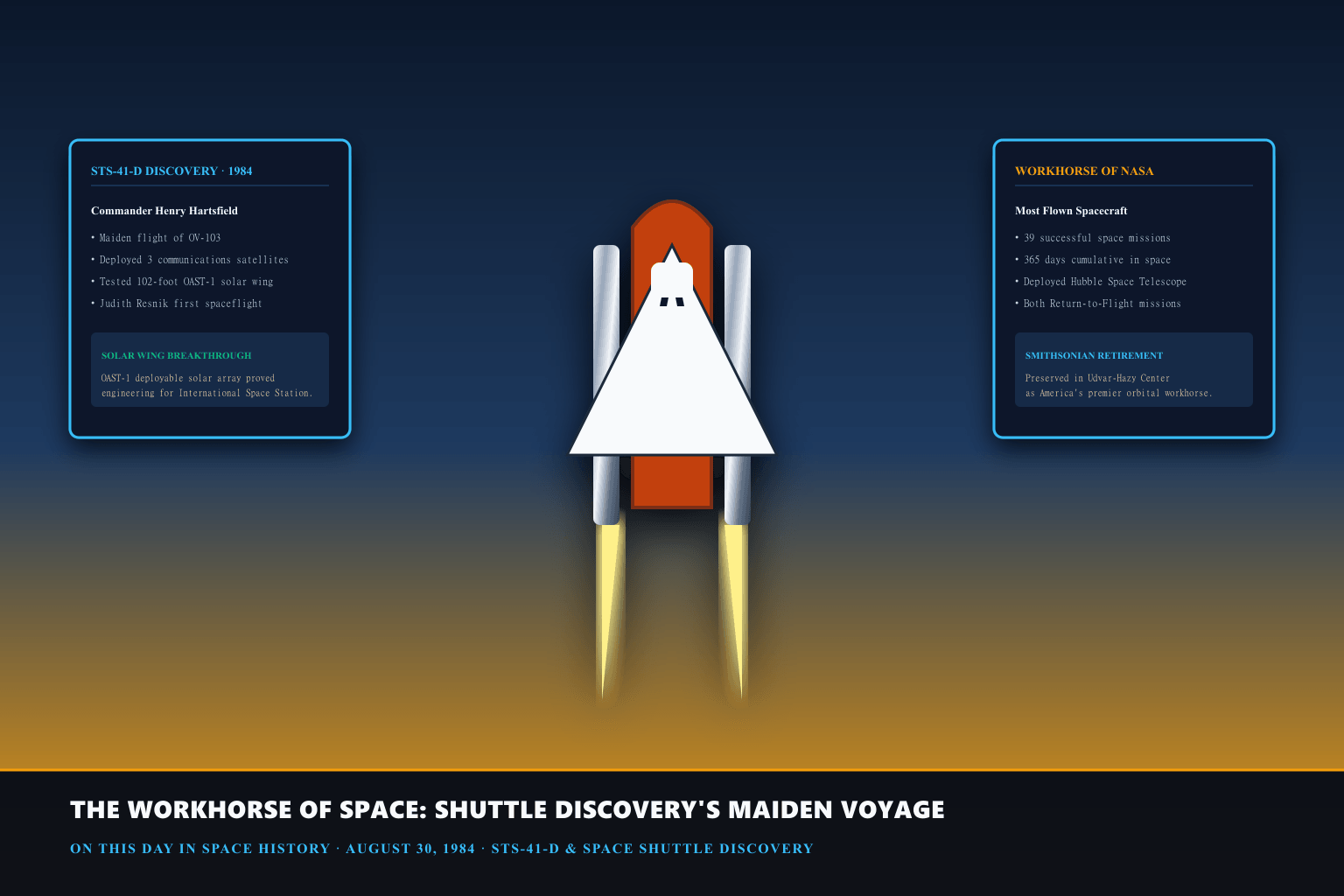
Rising on a pillar of fire from Launch Pad 39A after three grueling launch scrubs, Orbiter Vehicle 103 took flight on August 30, 1984. Space Shuttle Discovery would go on to fly thirty-nine missions, deploy the Hubble Space Telescope, and become NASA's most accomplished spaceship.
Building Orbiter 103: Weight Reduction and Thermal Upgrades
Discovery was the third operational space shuttle orbiter built by Rockwell International in Palmdale, California, following Columbia (OV-102) and Challenger (OV-099). Drawing from operational flight data from Columbia's early orbital tests, engineers made hundreds of structural refinements to reduce empty vehicle weight.
Discovery was nearly 3,100 kilograms (6,870 pounds) lighter than Columbia, utilizing advanced graphite epoxy structural components in the payload bay doors and replacing heavy high-temperature thermal tiles with lightweight Advanced Flexible Reusable Insulation (AFRI) thermal blankets on the upper fuselage.
The Drama of the Pad Abort and the STS-41-D Flight
Discovery's maiden voyage was delayed by one of the most dramatic launch aborts in early shuttle history. On June 26, 1984, with just four seconds remaining on the countdown clock, the Space Shuttle Main Engines ignited and then abruptly shut down automatically when computers detected a stuck fuel valve on Engine 3, triggering pad water deluge systems to extinguish a hydrogen flame.
Following engine replacement and comprehensive recertification, Discovery lifted off flawlessly on August 30. During the six-day mission, the six-person crew deployed three satellites and unfurled the 102-foot-long OAST-1 folding solar array from the cargo bay, validating flexible solar wing dynamics that directly enabled the future design of the International Space Station's massive solar arrays.
The Historic Legacy of NASA's Most Trusted Spaceship
Over its legendary 27-year operational career, Discovery was entrusted with NASA's highest-stakes space missions. In April 1990, Discovery launched the Hubble Space Telescope (STS-31), opening humanity's eye to deep cosmic history. In 1998, it carried Mercury astronaut John Glenn back into space at age 77.
Discovery flew both critical 'Return to Flight' missions—STS-26 in 1988 following Challenger, and STS-114 in 2005 following Columbia—safely restoring America's human spaceflight program. When Discovery touched down for the final time on March 9, 2011, it had traveled 238 million kilometers (148 million miles) across 5,830 orbits, and is preserved today at the Smithsonian's National Air and Space Museum.
What the evidence does not settle
While the Space Shuttle system was originally conceived as a reusable transport that would fly every two weeks at low cost, thermal protection tile refurbishment, complex main engine rebuilds, and strict safety requirements resulted in average launch costs exceeding $500 million per flight.
PRODUCT IDEA 01
LEGO Icons NASA Space Shuttle Discovery (10283) Model Kit
An extraordinarily detailed 2,354-piece LEGO replica of Space Shuttle Discovery featuring working payload bay doors, functional landing gear, elevons, and a scale Hubble Space Telescope.
Buying limit: Look for complete sealed collector boxes with metallic silver drum-lacquered telescope parts. Collector kits retail between $180 and $220.
Original editorial illustration, not a retailer photograph. No exact Amazon offer passed our verification gate.PRODUCT IDEA 02
NASA Space Shuttle Discovery STS-41-D Embroidered Mission Patch
An authentic full-sized embroidered reproduction of the 1984 STS-41-D maiden flight mission patch, featuring vibrant threading and iron-on backing.
Buying limit: Opt for official licensed NASA mission patches with heat-sealed borders. Collectible patches trade between $8 and $16.
Original editorial illustration, not a retailer photograph. No exact Amazon offer passed our verification gate.SOURCES, METHOD, AND LIMITS
Researched using official NASA Space Shuttle mission chronologies (NASA SP-407), Rockwell International Orbiter OV-103 manufacturing records, and the Smithsonian National Air and Space Museum curatorial archives. No commercial products were physically tested.
- NASA History Division — STS-41-D Mission Summary & Space Shuttle Discovery Archives — Official NASA flight summary recording the June 1984 pad abort, OAST-1 solar array deployment, and satellite orbital injection data.
- Smithsonian National Air and Space Museum — Space Shuttle Discovery OV-103 Curatorial Record — Curatorial technical review detailing Discovery's 39 missions, structural weight reductions, and induction into the National Collection.