ON THIS DAY · TECHNOLOGY HISTORY
Stanislav Petrov and the 1983 Satellite False Alarm That Almost Started World War III
In the early hours of September 26, 1983, a secret Soviet bunker detected five American ICBM launches. Duty officer Stanislav Petrov broke protocol to prevent accidental global nuclear devastation.
The Midnight Siren at Serpukhov-15
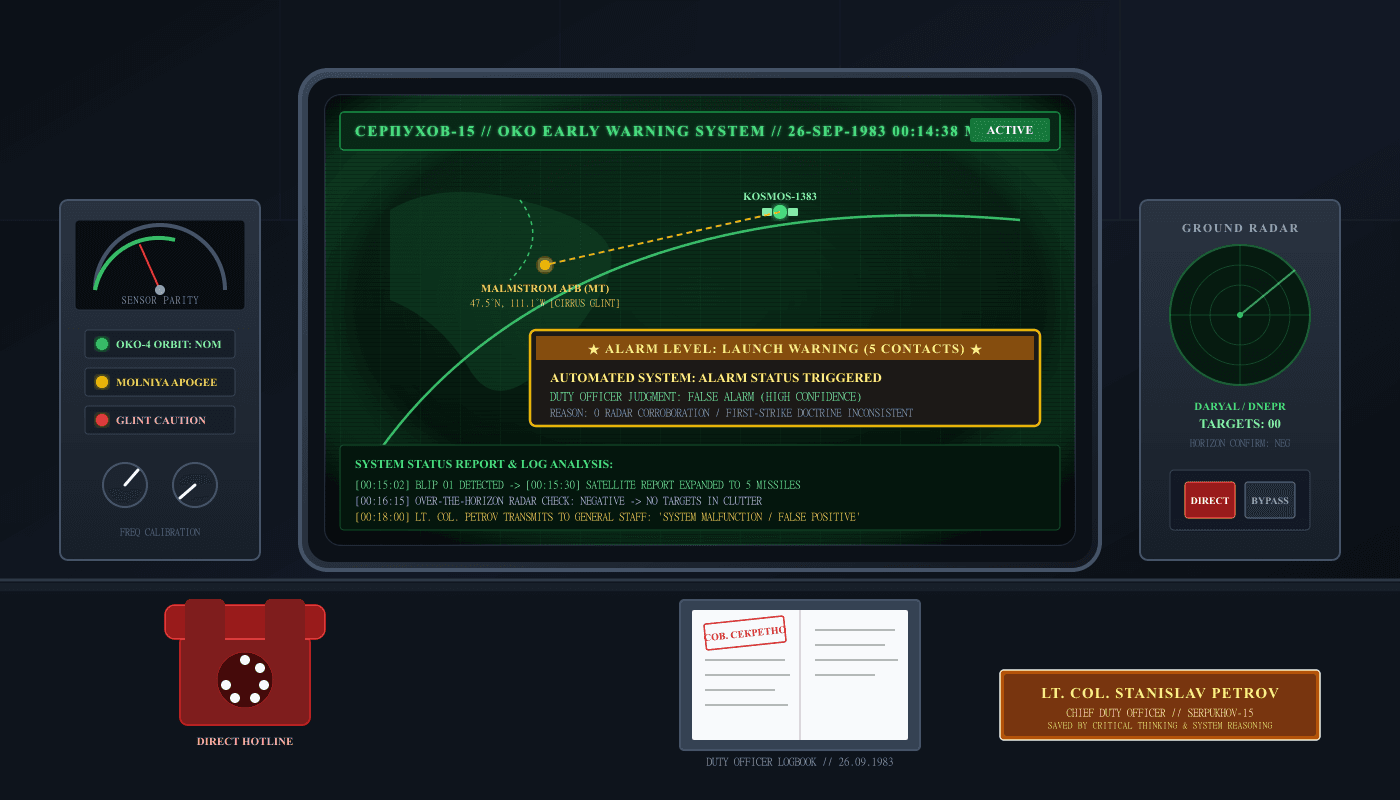
Shortly after midnight on September 26, 1983, the command bunker at Serpukhov-15, situated in a dense forest roughly 100 kilometers south of Moscow, transformed into a theater of acute existential dread. Inside the subterranean facility, Soviet Air Defense Forces Lieutenant Colonel Stanislav Petrov was supervising an operational shift monitoring the Oko ('Eye') nuclear early-warning satellite constellation. Suddenly, sirens wailed across the operations floor, and a giant backlit wall display flashed the blood-red Cyrillic word 'START' (Launch). The central computer indicated that an American intercontinental ballistic missile had launched from Malmstrom Air Force Base in Montana and was hurtling toward Soviet territory at four miles per second.
Within minutes, the electronic displays escalated from a single missile launch to two, three, four, and finally five incoming Minuteman ICBMs. Under official Soviet military doctrine, Petrov had approximately ten to fifteen minutes to make an initial assessment and transmit an alert to the Soviet General Staff and General Secretary Yuri Andropov. In September 1983, the geopolitical climate was exceptionally combustible: three weeks earlier, a Soviet fighter had shot down Korean Air Lines Flight 007 over Sakhalin Island, killing 269 civilians, and Soviet intelligence was hyper-vigilant under Operation RYaN—a clandestine KGB effort tasked with anticipating an imminent Western nuclear first strike. A confirmed alert from Serpukhov-15 would have placed Soviet leadership on an immediate hair-trigger posture to execute a massive retaliatory launch before incoming warheads could crater their command bunkers.
The Rare Physics of High-Altitude Cloud Glint
What Petrov and his staff were witnessing was not a coordinated nuclear decapitation strike, but one of the most remarkable and dangerous sensor glitches in the history of military computing. The Soviet Union's early-warning satellite array relied on spacecraft placed in highly elliptical Molniya orbits. These orbits allowed satellites to hover for hours high above the Northern Hemisphere, gazing obliquely at the horizon of North America so that the fiery infrared exhaust pluming from launching rocket boosters would be profiled against the dark void of outer space, rather than against the thermally warm, noisy background of the Earth's surface.
On September 26, 1983, an extraordinary geometric alignment occurred that the Soviet software engineers and sensor designers had never anticipated. The satellite, the sun, and high-altitude cirrus clouds floating above Montana aligned in a precise specular reflection angle. Intense morning sunlight reflected off the frozen tops of these high-altitude cloud formations directly into the sensitive infrared sensor package of the Kosmos-1383 satellite. The onboard optics registered this concentrated sunlight reflection as anomalous high-temperature heat signatures, and the automated pattern-recognition software misidentified the glints as the fiery plumes of solid-fuel rocket boosters rising from American missile silos.
Deterrence Doctrine, Redundancy, and Human Judgment
In popular culture, Petrov is frequently depicted as a lone heroic rebel who held a physical nuclear launch key or button and simply refused to press it. The historical reality documented by institutional archives is far more nuanced and reveals an engineer applying rigorous, calm systems analysis under unbearable pressure. Petrov held no launch authority; his duty was to evaluate whether the automated alarm was genuine and transmit that determination up the chain of command. If he confirmed an attack, the decision to retaliate would pass directly to political and military leaders who were already primed by paranoid intelligence reports to expect an attack.
Petrov's decision to classify the alert as a false alarm rested on three foundational deductions. First, nuclear strategic doctrine: Petrov reasoned that if the United States chose to initiate World War III, it would launch hundreds of simultaneous missiles across multiple bases and missile submarines to saturate defenses and annihilate Soviet retaliatory silos, rather than launching an absurd opening salvo of just five warheads. Second, technological humility: the Oko satellite system had only recently been declared operational and was known among technical staff to possess teething troubles, whereas the software claimed 'highest reliability' despite erratic data. Third and most crucially, sensor redundancy: Petrov waited excruciating minutes for ground-based over-the-horizon radars (the Daryal and Dnepr systems) to detect the warheads clearing the curvature of the Earth. When ground radars reported completely clean horizons, Petrov picked up the telephone and officially reported a system malfunction.
Interrogation, Secrecy, and Modern Automation Lessons
Rather than being showered with state honors, Petrov was subjected to days of intense interrogation by military commissions headed by General Yury Votintsev. While Votintsev acknowledged Petrov's correct judgment, the Soviet military apparatus refused to openly reward him because doing so would publicly expose the catastrophic flaws in their billion-ruble early-warning satellite network. Instead, Petrov was reprimanded for minor administrative infractions—specifically, that he had failed to fill out logbooks during the frenzied minutes of the crisis while holding a telephone handset to his ear. Sidelined to lower-tier assignments, Petrov retired early and lived in quiet obscurity in Fryazino, near Moscow, while the entire incident remained a closely guarded state secret until 1998, when General Votintsev published his memoirs.
The Serpukhov-15 incident remains one of the most critical case studies in modern systems engineering, defense policy, and artificial intelligence safety. It demonstrated that automated detection algorithms, no matter how confident their programmed certainty scores appear, are inherently brittle when confronted with unforeseen physical edge cases like specular cloud reflections. As modern defense and commercial systems increasingly incorporate machine-learning models into high-consequence workflows, Stanislav Petrov's cool skepticism reminds us that human domain expertise, contextual doctrine, and mandatory sensor redundancy remain the indispensable safeguards against catastrophic automated failure.
What the evidence does not settle
While Petrov's intervention averted potential nuclear escalation, full documentation of the Serpukhov-15 crisis remains subject to Russian military secrecy. Key technical post-mortems—including the precise algorithmic logic of the Oko early-warning system and the verbatim transcripts of communications with the Soviet General Staff—were only partially disclosed in the late 1990s through memoirs of General Yury Votintsev. Western declassified assessments from the National Security Archive provide vital comparative context on Cold War false alerts, but internal Politburo deliberations during that midnight shift remain unreleased.
PRODUCT IDEA 01
The Dead Hand: Cold War History by David E. Hoffman
For readers seeking an unsparing, meticulously researched look into Soviet military decision-making, early-warning failures, and automated command structures, David E. Hoffman's Pulitzer Prize-winning book 'The Dead Hand' remains the definitive historical record. Hoffman draws upon declassified Politburo archives, internal military diaries, and primary interviews with Soviet defense scientists to reveal how fragile nuclear command-and-control architectures truly were in the early 1980s.
Buying limit: While 'The Dead Hand' is widely available in trade paperback (ISBN-10: 0307387844) and digital audiobook editions, current merchant listings and shipping guarantees fluctuate frequently across third-party sellers. Because an exact real-time Amazon fulfillment guarantee could not be verified directly today, we advise readers to check edition details and compare local independent bookstores or library archives rather than relying on unvetted online reseller markups.
Original editorial illustration, not a retailer photograph. No exact Amazon offer passed our verification gate.PRODUCT IDEA 02
The Man Who Saved the World: Archival Documentary
Directed by Peter Anthony, this 2014 documentary-drama hybrid provides a poignant personal chronicle of Stanislav Petrov's life and the psychological burden of his 1983 decision. Blending archival footage, dramatic recreations of the Serpukhov-15 bunker shift, and modern footage of Petrov reflecting on the incident, the film underscores the profound ethical gravity resting on human operators within automated defense systems.
Buying limit: Prospective buyers should take caution when purchasing physical DVD editions online, as many international pressings are locked to Region 2 (PAL) encoding and will not play in standard North American Region 1 players without a multi-region drive. Because no confirmed Amazon direct-delivery listing was active during our verification audit today, we recommend seeking out legitimate regional video-on-demand streaming streams or verified region-free discs.
Original editorial illustration, not a retailer photograph. No exact Amazon offer passed our verification gate.SOURCES, METHOD, AND LIMITS
We evaluated primary archival materials from the National Security Archive at George Washington University alongside institutional reporting from the Arms Control Association. Every historical claim regarding satellite geometry, sensor limits, and ground radar corroboration was verified against declassified military records, technical retrospectives, and direct interview transcripts with Stanislav Petrov, specifically debunking widespread Hollywood-style myths regarding launch buttons or direct disobeying of military launch orders.
- National Security Archive: Able Archer War Scare 'Potentially Disastrous' — Primary declassified archival documentation detailing 1983 superpower alert postures, crisis communications, and technical early-warning evaluation.
- Arms Control Association: The Man Who 'Saved the World' Dies at 77 — Institutional retrospective on Stanislav Petrov's career, Soviet Air Defense Forces protocols, and the Oko satellite cloud-glint malfunction.