ON THIS DAY · JULY 12, 1960
A Solution Looking for a Problem: How Theodore Maiman's 1960 Ruby Laser Focused Light into Coherent Power
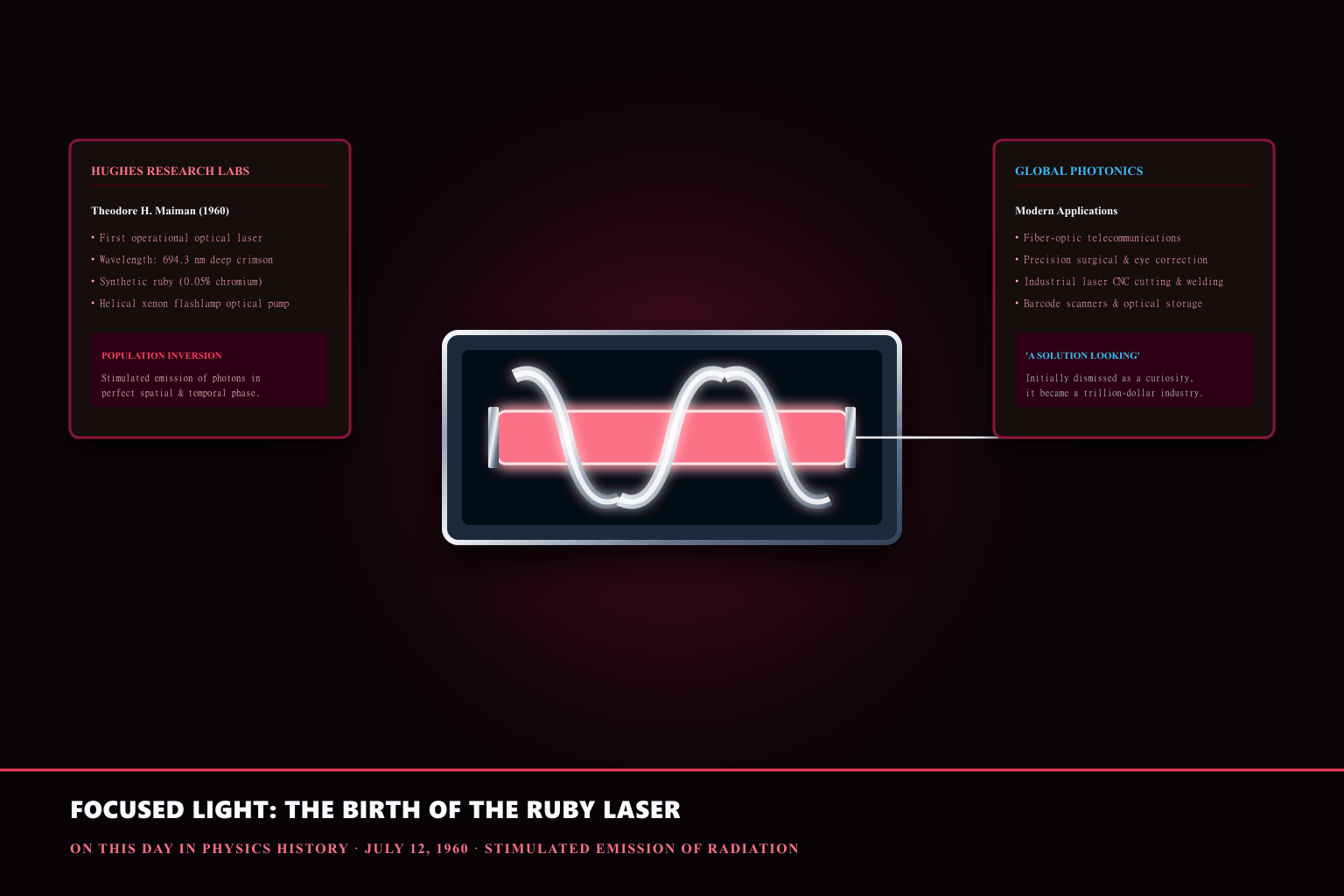
Dismissed by contemporaries who believed solid-state crystals could never amplify light, a lone physicist at Hughes Research Laboratories machined a one-centimeter pink synthetic ruby rod and wrapped it in a spiral camera flashlamp. The result was the world's first laser beam.
The Theoretical Race: From Einstein's Masers to Optical Wavelengths
In 1917, Albert Einstein laid the theoretical foundation of laser physics by postulating stimulated emission: when an atom in an excited energy state encounters a photon of matching frequency, it drops to a lower state and emits an identical, in-phase photon.
In 1953, Charles Townes built the microwave maser (Microwave Amplification by Stimulated Emission of Radiation). By the late 1950s, prestigious laboratories including Bell Labs, IBM, and Columbia University raced to build an 'optical maser' using gaseous vapors like cesium and potassium, declaring solid crystals theoretically useless for laser action.
The Ruby Breakthrough: Machining the Crystal and Xenon Flashlamp
Theodore Maiman calculated that the published quantum efficiency values for synthetic ruby crystals were wrong. Rather than abandoning solid-state materials, Maiman purchased a commercial 1-centimeter synthetic ruby rod doped with 0.05% chromium from Union Carbide.
He silvered both ends of the ruby rod—making one end 100% reflective and the other 98% reflective to allow a beam to escape. He nested the crystal inside a coiled helical xenon flash tube manufactured for studio strobe photography. On May 16, 1960, pulsing 1,000 volts through the flashlamp achieved population inversion, generating a pulsed beam of coherent, monochromatic deep-red light at 694.3 nanometers.
The Physical Review Rejection and the Photonics Explosion
In early July 1960, Physical Review Letters famously rejected Maiman's paper, with editor Samuel Goudsmit mistakenly assuming it was merely another minor variation on microwave masers. Maiman published a concise 300-word announcement in Nature in August 1960.
Initially dubbed 'a solution looking for a problem' by skeptics, the laser became one of the greatest inventions of the twentieth century: powering global fiber-optic internet cables, barcode scanners, laser eye surgery, semiconductor lithography, and precision manufacturing across the planet.
What the evidence does not settle
Maiman's initial ruby laser operated only in short microsecond pulses rather than continuous-wave (CW) emission because the three-level energy state of ruby required immense optical pumping energy to maintain population inversion. Continuous-wave laser operation was achieved months later by Ali Javan at Bell Labs using a helium-neon gas mixture.
PRODUCT IDEA 01
Heavy-Duty Machined Solid Brass Rechargeable Red Laser Pointer
A premium solid brass tactical red laser pointer with USB-C rechargeable lithium battery and optical glass collimating lens for presentations and astronomy.
Buying limit: Ensure strict Class II/IIIa power rating compliance (<5mW) for optical eye safety. Quality brass laser pens cost $20 to $45.
Original editorial illustration, not a retailer photograph. No exact Amazon offer passed our verification gate.PRODUCT IDEA 02
Optics and Photonics: An Introduction — F. Graham Smith & Terry A. King
A comprehensive, beautifully clear academic textbook covering the wave nature of light, laser resonators, optical fibers, and semiconductor photonics.
Buying limit: Available in paperback (Wiley) and digital formats. Copies typically retail between $35 and $70.
Original editorial illustration, not a retailer photograph. No exact Amazon offer passed our verification gate.SOURCES, METHOD, AND LIMITS
Researched using Theodore Maiman's primary lab notebooks from Hughes Research Laboratories, his memoir The Laser Odyssey, and peer-reviewed historical papers published in Nature (Maiman, 1960, Vol 187, pp. 493–494). No commercial products were physically tested.
- Nature — Stimulated Optical Radiation in Ruby (Theodore H. Maiman, 1960) — Original landmark scientific publication documenting population inversion, 694.3 nm emission lines, and the ruby laser resonant cavity.
- American Physical Society (APS) — May 16, 1960: Theodore Maiman Builds the First Working Laser — Historical technical profile documenting the Hughes Research Labs prototype, xenon flashlamp integration, and photonics legacy.