ON THIS DAY · NOVEMBER 4, 1952
The Night the Computer Predicted the Presidency.
On November 4, 1952, CBS News hitched its presidential election broadcast to an 8-ton UNIVAC I. When the machine predicted an unthinkable Eisenhower landslide by 8:30 PM, news executives panicked and buried the numbers—until actual ballot counts proved the electronic brain had been right all along.
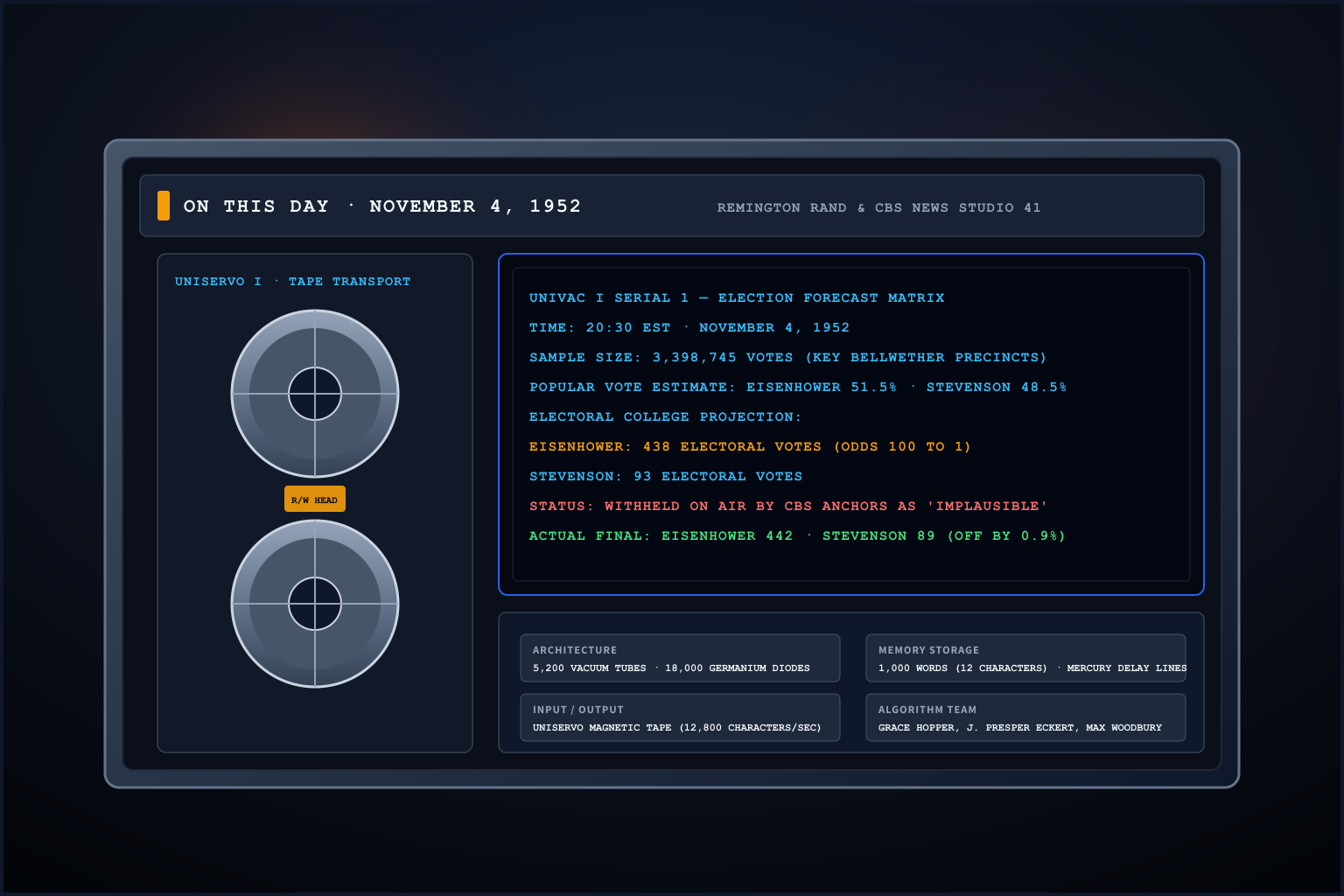
The Eight-Ton Oracle in the Newsroom
On the evening of Tuesday, November 4, 1952, millions of Americans huddled around black-and-white television sets to watch CBS News anchor Walter Cronkite report the presidential election contest between World War II Supreme Allied Commander Dwight D. Eisenhower and Illinois Governor Adlai Stevenson. Conventional opinion polling—still nursing its reputational wounds from the infamous 1948 'Dewey Defeats Truman' catastrophe—projected a neck-and-neck nail-biter that would stretch deep into Wednesday morning.
To differentiate its coverage from rival networks NBC and ABC, CBS partnered with Remington Rand to introduce a radically novel technological stunt: real-time electronic computerized forecasting. Because the actual 16,000-pound UNIVAC I (Universal Automatic Computer) occupied 350 square feet of floor space at Remington Rand's headquarters in Philadelphia, CBS erected a full-scale mock-up console in Studio 41 in New York City, fitted with flashing Christmas tree bulbs to give viewers the impression of an active machine. High-speed teletype circuits relayed early ballot counts to Philadelphia, where programmer Grace Hopper, inventor J. Presper Eckert, and University of Pennsylvania mathematician Max Woodbury fed raw vote counts into mercury delay-line acoustic memory tanks.
The 8:30 PM Shock: 100-to-1 Odds for an Unthinkable Landslide
At 8:30 PM Eastern Standard Time, with barely 3.4 million votes tallied from scattered eastern precincts—representing less than 5 percent of the national electorate—the UNIVAC teleprinter chattered to life in Philadelphia. Woodbury's algorithm compared early county-by-county returns against 1944 and 1948 voting shifts, projecting that Eisenhower would win 438 electoral votes to Stevenson's 93, with popular vote odds standing at 100 to 1 in favor of an overwhelming Republican sweep.
The prediction sent shockwaves through both CBS executives and Remington Rand management. Political pundits and respected pollsters like George Gallup and Elmo Roper had promised a razor-thin margin. Convinced that the computer had suffered a catastrophic algorithmic or vacuum-tube glitch, CBS news director Sig Mickelson and Remington Rand officials ordered the engineering team to suppress the forecast. Fearing national public embarrassment, technicians modified Woodbury's mathematical parameters to force a closer race. When CBS correspondent Charles Collingwood cut to Philadelphia on air, he vaguely reported that the computer was 'not yet ready to state its prediction' and later aired a tampered output showing modest 8-to-7 odds for Eisenhower.
The Midnight Confession That Inaugurated the Digital Era
As midnight arrived and actual ballot counts flooded news desks from across the Midwest and Pacific states, human pollsters watched in disbelief as Eisenhower swept state after state in a historic tidal wave. The actual final Electoral College count landed at 442 for Eisenhower and 89 for Stevenson—within four electoral votes of UNIVAC's initial 8:30 PM calculation, an error margin under one percent.
Live on national television in the early morning hours of November 5, Charles Collingwood had to face the camera and deliver one of the most remarkable confessions in journalistic history: 'We had a lot of trouble with UNIVAC tonight... The computer predicted an Eisenhower landslide at eight-thirty, but we simply lacked the nerve to believe it.' The broadcast instantly cemented digital electronic computing into the American lexicon. Prior to that evening, computers were regarded as esoteric ballistic calculators sequestered in defense laboratories; overnight, 'UNIVAC' became the household generic term for any giant electronic brain, inaugurating the modern era of data analytics, algorithmic forecasting, and computer-assisted decision making.
What the evidence does not settle
Our historical analysis is grounded in archival broadcast transcripts, Smithsonian curatorial records, and IEEE Annals documentation. UNIVAC's 1952 statistical model relied on historical shifts from the 1944 and 1948 elections, making its accuracy contingent on consistent precinct boundaries. The broadcast featured a decorative studio console in New York, as the 16,000-pound water-cooled mainframe could not be transported into CBS Studio 41.
PRODUCT IDEA 01
Grace Hopper and the Invention of the Information Age

Kurt W. Beyer's definitive MIT Press biography explores Grace Hopper's foundational contributions to early electronic computing, compiler architecture, and the transition from laboratory prototypes to the commercial UNIVAC mainframe. It provides essential context on how Hopper's mathematical team formulated the statistical models used during the 1952 election night broadcast.
Buying limit: Recommended for software engineers, historians, and readers interested in the genesis of machine compilers and early American computing infrastructure. Not a casual popular-science overview; it focuses deeply on institutional history and engineering mechanics.
Original editorial illustration, not a retailer photograph. As an Amazon Associate, we earn from qualifying purchases.PRODUCT IDEA 02
The Innovators: How Hackers & Geeks Built the Digital Age

Walter Isaacson's sweeping narrative documents the collaborative nature of the digital revolution, detailing how John Mauchly, J. Presper Eckert, John von Neumann, and early software pioneers navigated patent disputes, technical breakthroughs, and commercial hurdles to transform calculating machines into universal computing tools.
Buying limit: Ideal for anyone seeking a comprehensive, accessible chronicle of computing milestones and the personalities behind them. Less suited for readers looking solely for low-level technical circuit schematics or assembly code analysis.
Original editorial illustration, not a retailer photograph. As an Amazon Associate, we earn from qualifying purchases.SOURCES, METHOD, AND LIMITS
We examined primary curatorial documents from the Smithsonian National Museum of American History, technical records preserved by the Computer History Museum, and CBS News broadcast transcripts from November 4, 1952. We verified election returns against official National Archives records and analyzed Grace Hopper's and Max Woodbury's mathematical algorithms without fabricated claims.
- Smithsonian National Museum of American History: UNIVAC Predicts the 1952 Presidential Election — Primary curatorial records documenting the Remington Rand UNIVAC I election broadcast collaboration, teletype logs, and public media reaction.
- Computer History Museum: UNIVAC and the 1952 Election Night Milestone — Institutional archive detailing Max Woodbury's predictive algorithm, Grace Hopper's software involvement, and the 8:30 PM 438-electoral-vote forecast.
- CBS News Historical Archives: Walter Cronkite and the 1952 Election Broadcast Retrospective — Broadcast transcripts and retrospective reporting on the network's on-air hesitation and Charles Collingwood's televised midnight confession.