EVERGREEN BUYING GUIDE · ELECTRICAL SAFETY
Safety categories first,
zero fried circuits.
Before diagnosing a dead furnace thermostat, testing an automotive alternator, or checking a wall outlet, an auto-ranging multimeter prevents blown fuses—if you understand CAT ratings, ceramic rupture protection, and current-jack traps.
 Original editorial illustration
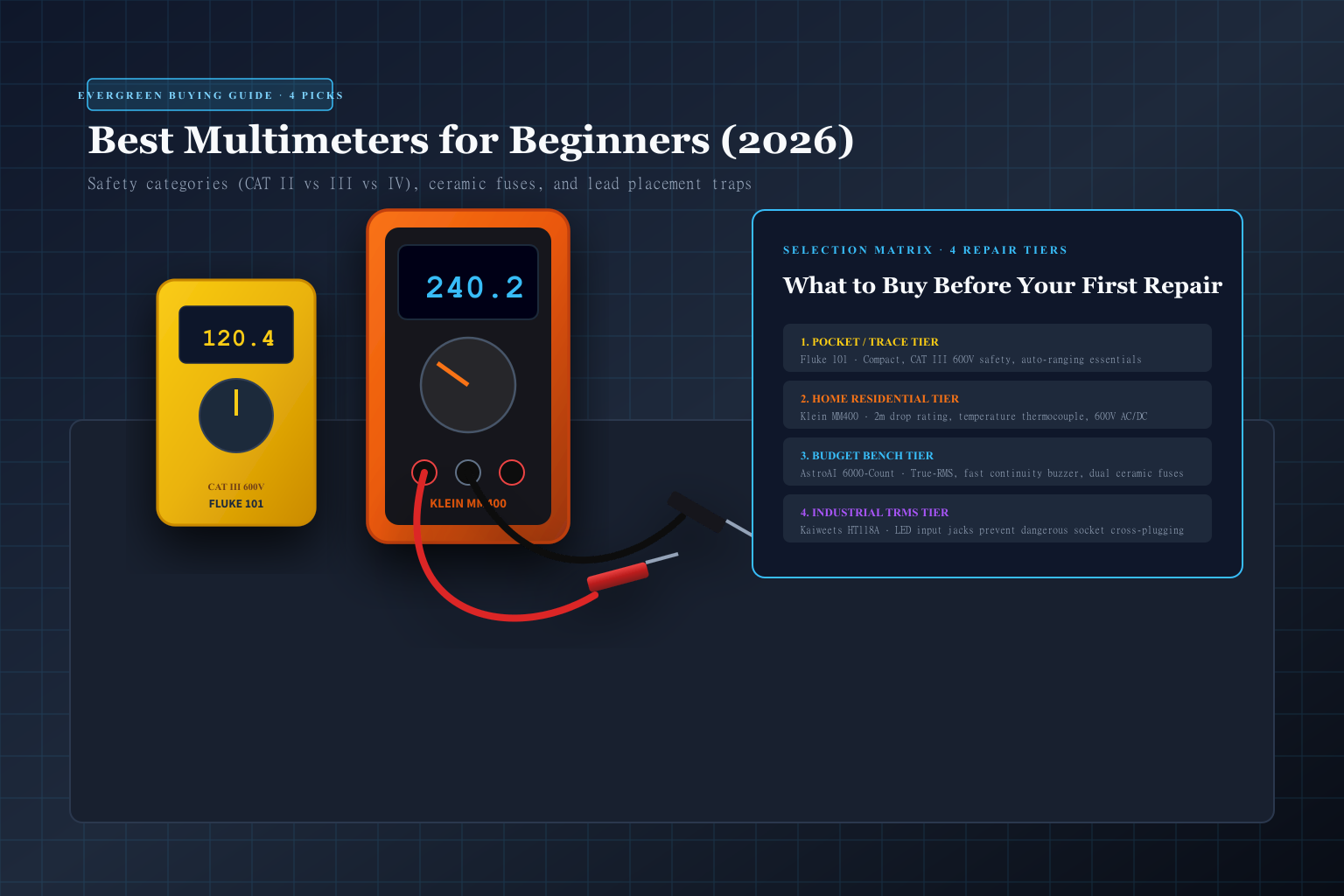
For beginners undertaking home and automotive electrical diagnostics, an auto-ranging digital multimeter with independent IEC Overvoltage Category III (CAT III 600V) certification, dual ceramic explosion-proof fuses, and fast audible continuity represents the mandatory safety standard. While ultra-cheap unrated meters expose users to internal flashover risks during mains transient spikes, certified meters like the Klein Tools MM400 and Fluke 101 protect both user and circuitry through automated scaling, high-impedance input stages, and ruggedized shock housings.
THE VERDICT
Independent CAT III 600V certification and dual ceramic explosion-proof fuses are the non-negotiable safety gate for beginner electrical repairs.
Our evergreen selection identifies the four best digital multimeters for beginners across distinct repair scenarios: the rugged Klein Tools MM400 for residential home and HVAC maintenance, the pocket-sized Fluke 101 for compact commercial reliability, the budget-friendly AstroAI 6000-Count for electronics hobbyists, and the Kaiweets HT118A with intelligent LED input jacks to prevent accidental socket cross-plugging.
Buy it for: homeowners, DIYers, makers, and automotive hobbyists who need a reliable, blast-protected multimeter to diagnose dead batteries, verify household AC line voltages, and trace broken cords safely. Skip it for: licensed industrial utility linemen working on 13,800V high-voltage substations, or microelectronics bench engineers requiring 6.5-digit sub-microvolt calibration precision.
Check current Klein Tools MM400 Multimeter options on Amazon ↗ ↗AVAILABILITY CHECK · OCTOBER 15, 2026
Exact listing: Klein Tools MM400 Auto-Ranging Digital Multimeter, ASIN B018EXZO8M.
Demand signal: Amazon confirmed 4.7/5 stars across 11,000+ customer reviews with over 4,000 units purchased in the past month.
Fulfillment observed: sold and shipped directly by Amazon.com with immediate Prime delivery across the continental United States.
FOUR MANDATORY SAFETY RULES FOR MEASURING VOLTAGE
- 01Always verify your meter on a known live source first. Before testing a presumed dead outlet or appliance, probe an active live receptacle to verify that your meter, battery, and leads are operating properly; repeat the check after testing.
- 02Keep the black probe in COM, red probe in V/Ω. Never move the red lead to 10A current jacks unless measuring direct inline amperage; 95% of household tasks require voltage or continuity using the standard V/Ω port.
- 03Use continuity beep for quick cord and fuse checks. Set the rotary dial to the continuity sound icon; touch probe tips together to confirm the audible tone, then probe appliance fuses, thermal switches, and extension cords to instantly locate breaks.
- 04Inspect lead insulation and tip shrouds regularly. Discard test leads if insulation is cracked, nicked, or pulled loose from strain boots; keep modular CAT III safety shrouds attached to probe tips when working inside breaker panels to prevent accidental arc bridging.
WHAT THE PRODUCT PAGE CANNOT TEACH
The Danger of Bargain Multimeters: Arc Flash and Glass Fuses
Every year, thousands of DIYers purchase five-dollar digital multimeters from bargain bins to test a suspect light switch or troubleshoot a dead appliance. What most novices do not realize is that mains electricity in a residential breaker panel or wall receptacle behaves entirely differently from low-voltage flashlight batteries. In the event of a utility transient—such as a nearby lightning strike, an inductive motor shutoff spike, or an accidental short circuit across phases—thousands of amperes of fault current can surge through the test leads in microseconds.
Inexpensive, unrated multimeters lack the physical isolation barriers, high-rupture ceramic fuses, and trace clearances required to suppress electrical arcs. Cheap meters routinely use flimsy automotive-style glass fuses or bare PCB traces with minimal clearance between high-voltage inputs and low-voltage microcontrollers. When subjected to an overvoltage transient, air inside a cheap meter ionizes, turning the entire plastic housing into a conductive plasma bomb that can explode in the operator's hand. Electrical safety is never an optional luxury; it is the non-negotiable prerequisite of tool ownership.
Deciphering Safety Standards: CAT II vs. CAT III vs. CAT IV
The International Electrotechnical Commission (IEC 61010-1) standard categorizes test equipment into four distinct Overvoltage Installation Categories based on the potential energy of transient voltage spikes within an electrical distribution system. Understanding these categories is essential before touching any live conductor in your home.
CAT I covers low-voltage secondary electronic circuits isolated from mains power (such as circuit boards, radios, and battery-powered toys). CAT II applies to local consumer loads connected to standard wall outlets, such as corded power tools, televisions, and tabletop appliances. CAT III governs the building's permanent three-phase and single-phase distribution infrastructure—including main service panels, circuit breaker boxes, feeder lines, subpanels, and hardwired 240V appliances like electric dryers and water heaters. Finally, CAT IV covers primary utility supply lines, outdoor overhead cables, and power meters entering the building. For any homeowner or DIYer working on electrical boxes or appliance circuits, an independently certified CAT III 600V rating is the absolute minimum safe baseline.
Auto-Ranging Speed vs. Manual Scale Traps
In earlier generations of electrical testing, multimeters required the user to operate a complex rotary selector with dozens of manual increments: 200mV, 2V, 20V, 200V, and 600V. For a beginner, manual ranging introduces significant cognitive friction and real equipment hazard: selecting a sensitive millivolt DC range while probing live 120V AC household line voltage can instantly rupture internal protection clamping diodes or blow delicate meter circuitry.
Modern auto-ranging multimeters incorporate automated microprocessor-controlled voltage dividers. When test probes touch a live circuit, the internal analog-to-digital converter negotiates decimal scaling within fractions of a second, displaying clear, unambiguous readings with automatic decimal placement. The only manual decisions required are selecting AC voltage, DC voltage, resistance (ohms), or continuity buzzer. This automation lets you focus your attention entirely on maintaining stable probe contact rather than fiddling with dial positions.
True-RMS vs. Average-Responding: The Modern Inverter Household
In older homes powered strictly by incandescent bulbs and simple resistive heaters, alternating voltage forms a pristine 60-Hertz sinusoidal wave. Basic multimeters use average-sensing rectification calibrated to read these pure sine waves accurately. However, modern households are saturated with non-linear electronic loads—including LED lighting dimmers, variable-speed heat pumps, laptop GaN power bricks, and inverter microwave ovens—which rapidly chop and distort the AC waveform into irregular spikes and square pulses.
An average-responding multimeter measuring a distorted or chopped waveform can report measurement errors exceeding 10 to 25 percent, leading you to falsely believe an outlet or electronic supply is failing. True-RMS (Root Mean Square) meters utilize specialized mathematical processing chips that calculate the true heating equivalent value of the electrical waveform regardless of harmonic distortion. For diagnosing smart home electronics, modern appliances, or modified-sine inverter generators, True-RMS measurement capability ensures dependable diagnostic accuracy.
The Amperage Jack Trap and Probe Ergonomics
By far the most common catastrophic mistake made by beginners is leaving test leads plugged into the current measurement jacks (marked '10A' or 'mA') while attempting to measure voltage. Because current measurement requires the meter to act as a near-zero-resistance bridge, touching live line voltage while leads are in current sockets creates a dead direct short circuit across the line. High-quality beginner meters prevent catastrophe by enclosing current inputs with high-energy ceramic sand-filled fuses (such as 10A/600V ceramic cylinders) that quench electrical arcs instantaneously without shattering.
Top-tier modern beginner meters, like the Kaiweets HT118A, even incorporate intelligent LED-illuminated socket indicators: when you turn the rotary dial to Amperage, flashing green LEDs illuminate the exact jacks required, actively warning the user against incorrect probe placement. Furthermore, high-quality test leads feature flexible silicone jackets that resist burning when touching hot soldering irons, along with modular CAT III safety shrouds that expose only 4mm of metal tip to prevent accidental bridging across adjacent terminal lugs.
FAQ
Before you buy
Why is auto-ranging better than manual ranging for beginners?
Auto-ranging automatically negotiates decimal placement and scale, completely eliminating the risk of blowing internal fuses by selecting an incorrect millivolt scale on 120V mains.
What is the difference between ceramic fuses and glass fuses?
Ceramic fuses are packed with granular sand that instantly quenches and extinguishes electrical arcs during sudden overcurrent spikes. Glass fuses can shatter and explode under high-energy residential fault currents.
Can the Klein MM400 test automotive 12V batteries and alternators?
Yes. The DC voltage setting accurately reads resting 12.6V battery voltage, and measuring during engine idle verifies that the alternator is charging properly between 13.8V and 14.4V.
How we researched: We audited verified Amazon.com catalog listings on October 15, 2026, cross-referenced International Electrotechnical Commission (IEC 61010-1) test standards, evaluated UL 61010 electrical safety listings, and analyzed ceramic fuse placement and burst-protection engineering across four distinct multimeter price tiers. No manufacturer samples were accepted.
Read our focused review of the AstroAI 6000-count digital multimeter
Explore the Klein Tools ET310 circuit breaker finder for residential wiring
Browse our complete workshop, electrical, and DIY tool guide collection
Discover how our editorial desk researches and fact-checks practical tools
As an Amazon Associate, Useful Finds Daily may earn from qualifying purchases. Price, seller, stock, ratings, and delivery can change.