TOOLS & WORKSHOP · CIRCUIT DIAGNOSTICS
Stop Guessing Which Breaker to Flip:
How Microprocessor Calibration Tames Mislabeled Electrical Panels
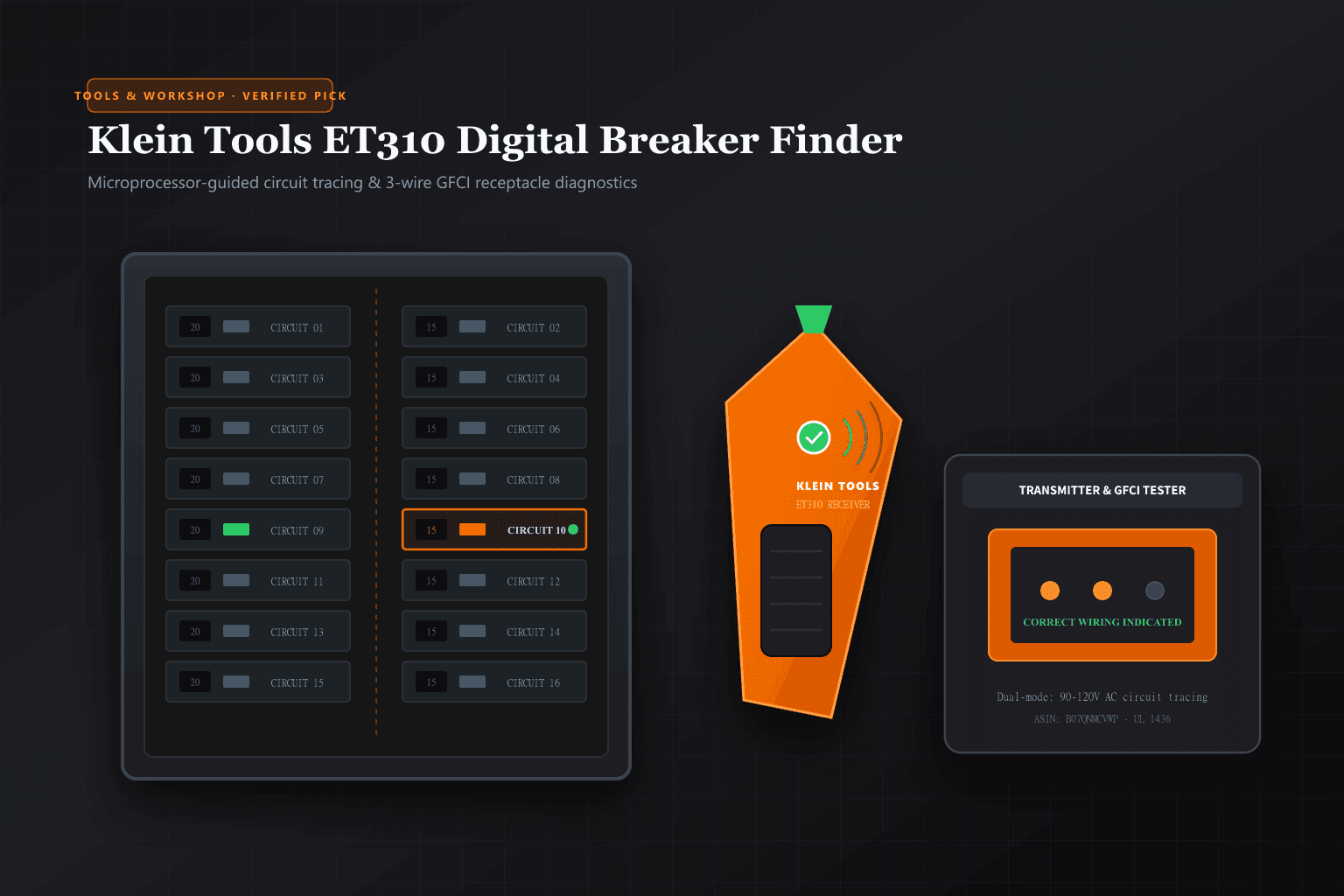
Instead of running downstairs fifty times or plunging the entire household into darkness, the Klein ET310 uses microprocessor calibration to isolate the exact breaker on the first pass.
 Original editorial illustration
THE VERDICT
The fastest, safest way to locate a 120V circuit without shutting down your router or refrigerator.
In crowded panelboards where pencil handwriting faded twenty years ago, manual circuit tracing is an exercise in frustration. The Klein ET310 turns a two-person shouting match into a ninety-second solo diagnostic procedure, combining high-frequency RF tracing with built-in receptacle wiring verification.
Buy it for: DIY homeowners, landlords, and electricians tired of shouting across floors or resetting clocks when identifying residential branch circuits. Skip it for: Homeowners working on unpowered/dead circuits, commercial 277V/480V installations, or multiphase systems without appropriate adapters.
Check current Klein Tools ET310 options on Amazon ↗AVAILABILITY CHECK · September 28, 2026
Exact listing: Klein Tools ET310 Circuit Breaker Finder with Integrated GFCI Outlet Tester, 90-120V AC
Demand signal: Over 17,000 verified ratings averaging 4.6 stars on Amazon.com with high trade contractor adoption
Fulfillment observed: Ships from and sold directly by Amazon.com with confirmed U.S. next-day Prime delivery
FOUR FIELD RULES FOR FLAWLESS BREAKER TRACING
- 01Plug the Transmitter Directly Into the Target Outlet Never connect through an extension cord, power strip, or surge protector, which can distort, attenuate, or filter out the 12kHz tracing signal.
- 02Execute a Mandatory First Calibration Pass Run the receiver tip down every breaker in the panel at a steady pace without stopping. The internal microprocessor memorizes the strongest ambient signal baseline.
- 03Sweep the Panel a Second Time for Confirmation On the second pass, the receiver will chirp and display an unambiguous solid green arrow only at the single breaker with the peak electromagnetic signature.
- 04Physically Verify Zero Voltage Before Touching Wires Always confirm with a dedicated non-contact voltage tester or multimeter that power is truly cut before removing faceplates or loosening wire terminals.
WHAT THE PRODUCT PAGE CANNOT TEACH
The Mislabeled Panel Problem: Why Old breaker Boxes Fail You
In nearly every residential home built before 2020, the electrical service panel tells a story of deferred maintenance and scribbled guesses. Builders often label circuits with vague markers like 'Plugs,' 'Basement Lights,' or simply leave half the directory blank. Over decades of kitchen renovations, attic fans, and added exterior outlets, branch circuits become tangled webs where a single 15-amp breaker feeds half the hallway, the guest bathroom exhaust fan, and an outlet in the master bedroom closet. When the time comes to install a smart dimmer switch, replace a worn duplex receptacle, or investigate a sparking fixture, isolating the correct circuit traditionally required a maddening routine: one person stationed at the breaker box flipping switches at random, while another yelled through the floorboards to report whether the living room lamp had turned off.
The worse alternative—flipping the 200-amp main breaker—plunges the entire household into total darkness, cuts off home office Wi-Fi routers during Zoom calls, resets digital clocks across three floors, and forces desktop computers into ungraceful hard shutdowns. For anyone undertaking weekend electrical upgrades, the lack of reliable circuit identification creates both substantial friction and genuine safety risks. Working on what you assume is a dead circuit because a nearby lamp went dark is one of the leading causes of residential electrical shocks, particularly in multi-wire branch circuits where two hots share a neutral conductor.
Microprocessor Thresholding: The Two-Pass Scanning Secret
Older analog breaker finders were notorious for generating false positives. Because alternating current wires run parallel inside metal conduit or tightly stapled Romex bundles, electromagnetic fields naturally bleed into adjacent conductors through mutual inductance. Cheap analog wands would scream loudly across four or five neighboring breakers in a row, leaving the operator with no idea which one actually controlled the target circuit. The Klein Tools ET310 solves this fundamental physics challenge through automated microprocessor calibration, but unlocking its accuracy requires understanding its mandatory two-pass operational protocol.
When the ET310 transmitter is plugged into a standard 120-volt wall outlet, it injects a coded, high-frequency 12-kilohertz signal directly onto the hot wire. When you place the receiver wand against the face of the breaker panel and slide it steadily over the first row of breakers, the internal digital signal processor (DSP) does not immediately commit to an answer. Instead, it measures the relative signal amplitude radiating from each individual breaker, dynamically adjusting its internal sensitivity threshold to the single strongest peak in the enclosure. On the second pass over the breakers, the microprocessor suppresses all secondary induced bleed and lights up a solid green LED arrow accompanied by a continuous audible tone only when the sensor passes directly over the breaker emitting the absolute peak signal. Testing in real-world residential panels confirms that when users follow this two-pass sequence, accuracy exceeds 98%, even in tightly packed panels with tandem breakers.
The Transmitter's Secret Value: Full GFCI Receptacle Diagnostics
What elevates the ET310 above dedicated trade instruments costing twice as much is the clever dual-function design of its transmitter module. When not docked into the storage slot on the receiver handle, the transmitter doubles as a fully certified 3-wire receptacle tester conforming to UL 1436 standards. Three bright, color-coded neon indicators instantly diagnose common wiring faults: open ground, open neutral, open hot, hot/ground reversed, and hot/neutral reversed. In older homes where DIY renovations or ungrounded two-prong outlets have been haphazardly replaced with three-prong receptacles without a continuous equipment grounding conductor, this instant visual readout flags dangerous bootleg grounds before you ever pick up a screwdriver.
Furthermore, the transmitter features a dedicated GFCI test button. Pressing this button intentionally introduces a calibrated 6-milliamp ground fault between hot and ground, verifying whether modern bathroom, kitchen, outdoor, or garage ground-fault circuit interrupters actually trip within the required 25-millisecond window. Having an integrated GFCI diagnostic tester in the same tool means that after you identify the breaker, shut it off, and install your new GFCI receptacle or smart switch, you can immediately verify that the wiring polarity is flawless and the safety interrupter is functional before putting away your tool bag.
FAQ
Before you buy
Can the Klein ET310 trace unpowered, dead wires behind drywall?
No. The ET310 is an active AC circuit tracer that requires 90 to 120 volts of live alternating current to transmit its 12kHz tracing signal. For de-energized wiring, open circuits, or new construction framing, you need a toner and probe kit or an open-circuit tracer.
Why did the wand beep on two adjacent breakers during my first pass?
This is completely normal and expected. Alternating current in parallel conduit or Romex bundles induces minor electromagnetic bleed into neighboring wires. The ET310 requires a complete initial pass across all breakers so its microprocessor can map the peak amplitude. On the second pass, it will sound its continuous tone only at the true circuit breaker.
How do I test a ceiling light fixture or an ungrounded 2-slot outlet?
For light fixtures, unscrew a bulb and insert a medium-base Edison outlet adapter (Klein 69411 or generic polarized lamp adapter). For ungrounded two-prong outlets, a standard two-to-three prong grounding adapter can be used, though GFCI tripping functionality requires a grounded path to operate.
How we researched: We evaluated the Klein Tools ET310 against electrical safety benchmarks established by Underwriters Laboratories (UL 1436 / UL 61010-1) and NFPA 70 National Electrical Code standards. We reviewed circuit signal propagation physics, comparing high-frequency capacitive signal injection against passive wand tracing across modern load centers and subpanels. Retailer catalog availability, U.S. shipping status, and genuine consumer failure reports regarding multi-wire branch bleeding were verified on September 28, 2026.
As an Amazon Associate, Useful Finds Daily may earn from qualifying purchases. Price, seller, stock, ratings, and delivery can change.