ON THIS DAY · AUGUST 20, 1977
The Longest Journey in Human History: How Voyager 2 Departed Earth on a Billion-Year Grand Tour of the Outer Planets
Before Voyager 2 lifted off on August 20, 1977, the ice giants of the outer solar system were mysterious, blurry dots in ground telescopes. Over four decades later, Voyager 2 remains the only spacecraft to visit Uranus and Neptune, still transmitting from interstellar space.
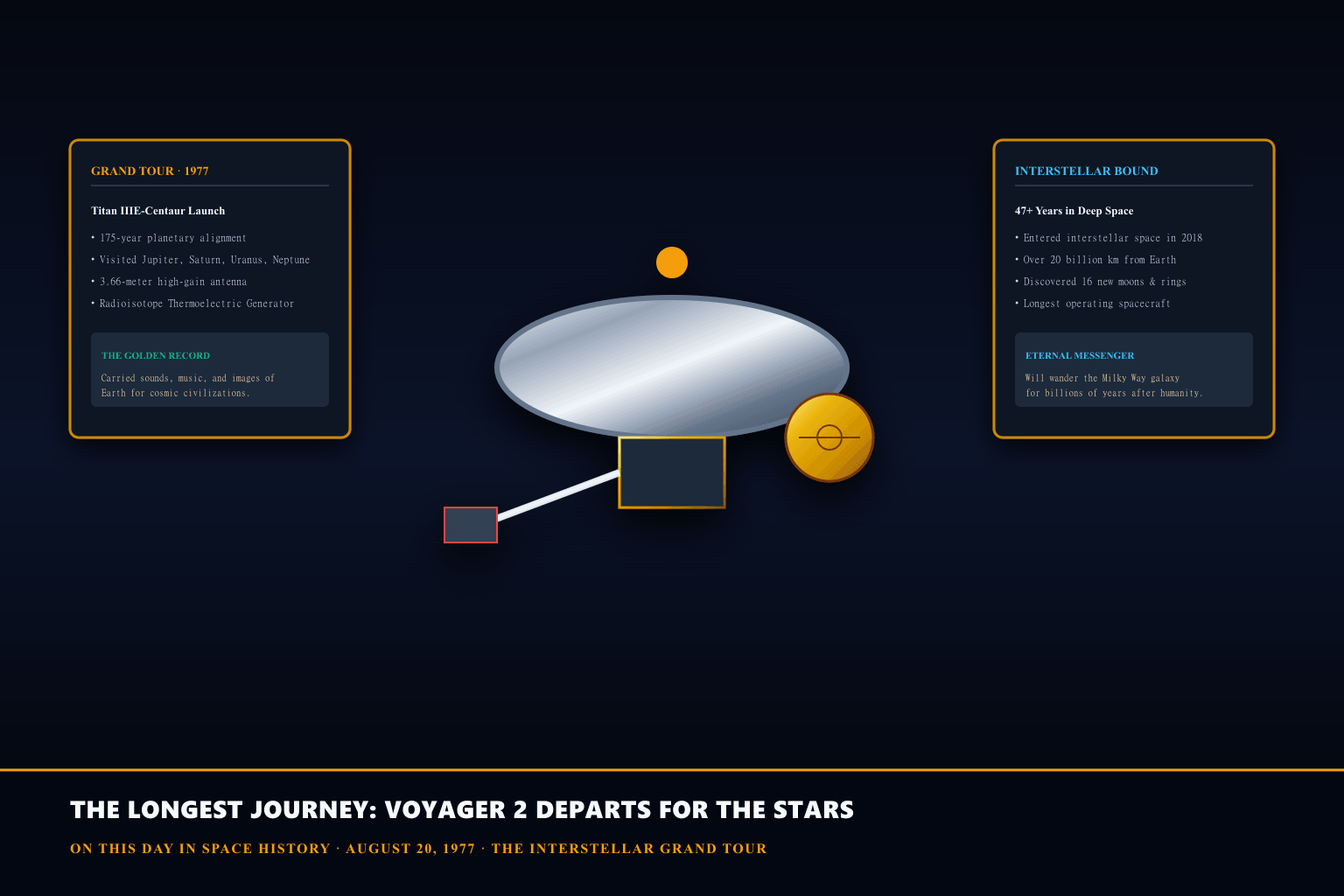
The Orbital Geometry of the 175-Year Grand Tour
In the 1960s, Gary Flandro, an aerospace graduate student at Caltech working for NASA's Jet Propulsion Laboratory (JPL), calculated that during the late 1970s, Jupiter, Saturn, Uranus, and Neptune would align in a sweeping orbital arc. This alignment allowed a single probe to use gravity assists to slingshot from one planet to the next, slashing transit times from forty years to twelve.
While Voyager 1 was placed on a faster trajectory optimized for a close flyby of Saturn's hydrocarbon-shrouded moon Titan (which deflected it northward out of the ecliptic plane), Voyager 2 was steered on a more flexible trajectory that preserved the option to continue onward to Uranus and Neptune.
Imaging the Ice Giants: Voyager 2's Unrivaled Solo Journey
In January 1986, Voyager 2 conducted humanity's first and only close flyby of Uranus, discovering ten new moons, two new rings, and measuring an extreme magnetic field tilted 59 degrees from its rotational axis. In August 1989, it encountered Neptune, revealing the Great Dark Spot, supersonic winds exceeding 2,100 km/h, and active cryogenic nitrogen geysers erupting on moon Triton.
To photograph these dimly lit outer worlds where sunlight is 900 times weaker than at Earth, JPL flight software engineers reprogrammed the onboard computers mid-flight. They implemented sub-pixel attitude thruster pulsing to prevent camera motion blur during long, multi-second exposures—an astonishing feat of remote software engineering.
Crossing the Heliopause: The Interstellar Ocean
On November 5, 2018, at a distance of 119 Astronomical Units (17.8 billion kilometers) from the Sun, Voyager 2's working Plasma Science Experiment (PLS) recorded a steep drop in solar wind particles and a simultaneous surge in high-energy interstellar cosmic rays.
Unlike Voyager 1 (whose plasma sensor had failed in 1980), Voyager 2 delivered humanity's first direct in-situ measurements of the interstellar plasma medium. Both Voyager probes will wander the Milky Way galaxy for billions of years, carrying humanity's music, greetings, and mathematical knowledge across the cosmos.
What the evidence does not settle
Because Voyager 2's plutonium-238 power supply decays by approximately 4 watts of electrical power per year, NASA flight controllers must progressively power down scientific instruments and heater systems to conserve electricity, with final telemetry operations expected to conclude around 2026-2030.
PRODUCT IDEA 01
NASA Voyager Golden Record Replica Metallic Foil Poster Print
A metallic gold-foil stamped art print illustrating the iconic Voyager Golden Record cover diagram, detailing binary pulsar coordinates and hydrogen atom decoding keys.
Buying limit: Look for heavy 300gsm black matte cardstock with embossed metallic gold foil stamping. Quality art prints trade between $20 and $45.
Original editorial illustration, not a retailer photograph. No exact Amazon offer passed our verification gate.PRODUCT IDEA 02
High-Powered Astronomical Stargazing Binoculars (10x50)
Rugged 10x50 multi-coated optical binoculars with BaK-4 prisms, providing crisp wide-field planetary observation of Jupiter's Galilean moons and the Milky Way.
Buying limit: Select models with rubber armor and tripod mounting threads. Quality stargazing binoculars cost between $40 and $95.
Original editorial illustration, not a retailer photograph. No exact Amazon offer passed our verification gate.SOURCES, METHOD, AND LIMITS
Researched using official mission documentation from NASA Jet Propulsion Laboratory (JPL Voyager Interstellar Mission), trajectory and telemetry catalogs from the National Space Science Data Center (NSSDC ID 1977-076A), and Carl Sagan's Murmurs of Earth. No commercial products were physically tested.
- NASA Jet Propulsion Laboratory — Voyager 2 Official Mission Overview & Interstellar Data — Primary mission archive detailing spacecraft instruments, Uranus and Neptune flyby chronologies, and real-time interstellar distance tracking.
- NASA History Division — Voyager: The Grand Tour of the Outer Planets (NASA SP-460) — Official historical publication documenting the Titan IIIE launch vehicle parameters, planetary encounters, and golden phonograph record assembly.