ON THIS DAY · JULY 17, 1902
Controlling Climate on Demand: How Willis Carrier's 1902 Psychrometric Apparatus Invented Modern Air Conditioning
Waiting for a train on a foggy Pittsburgh railway platform in 1902, a 25-year-old engineer watched swirling mist and realized that cooling air below its dew point could wring moisture out like a sponge. Willis Carrier's insight invented modern air conditioning.
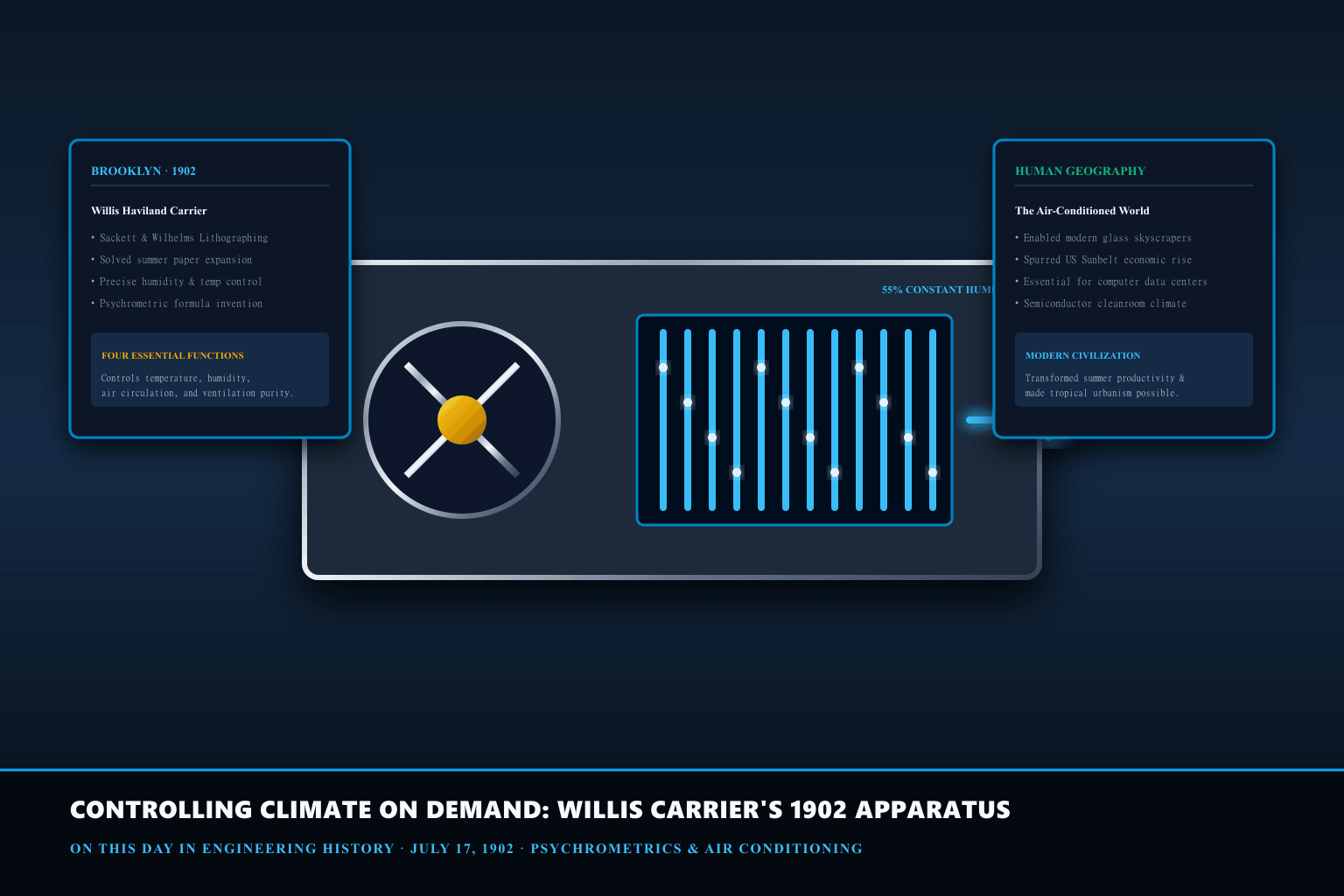
The Printing Plant Crisis: Warped Paper and Smudged Color
In the summer of 1902, high humidity inside the Sackett & Wilhelms printing plant in Brooklyn caused severe industrial disruption. When printing multi-color lithographic magazines like Judge, sheets of paper absorbed moisture from the muggy summer air, expanding unevenly between printing runs.
When the paper passed through four consecutive printing presses for yellow, red, blue, and black inks, the colors failed to align, producing smeared, unreadable images and thousands of dollars in ruined paper. Frustrated plant managers reached out to the Buffalo Forge Company for a mechanical solution.
The Railway Platform Insight: Psychrometrics and Dew Point Control
While standing on a foggy train platform in Pittsburgh in the autumn of 1902, Carrier watched clouds of mist drift past gas lamps. He realized that fog was simply saturated air that had cooled below its dew point, causing excess water vapor to condense into droplets.
Carrier reasoned that instead of attempting to dry air with chemical desiccant powders, he could pass humid air through a cold water spray or over chilled pipes. By cooling the air down to an exact dew point, the apparatus forced moisture to condense out; when the air was subsequently reheated, its relative humidity dropped to an exact, stable percentage (55%), regardless of outside weather conditions.
The Four Principles of Air Conditioning and Global Transformation
On July 17, 1902, Carrier submitted complete fabrication blueprints for a 30-ton cooling coil system connected to an ammonia compressor. In 1911, Carrier presented his seminal 'Rational Psychrometric Formulae' to the American Society of Mechanical Engineers (ASME), providing the foundational thermodynamic equations that still govern modern HVAC engineering.
Carrier's invention reshaped human geography: it made previously uninhabitable deserts and tropical regions economically vibrant, enabled the construction of sealed glass architectural skyscrapers, and created the climate-controlled environments required for pharmaceutical manufacturing and modern internet data centers.
What the evidence does not settle
Early industrial air conditioning systems relied on toxic and flammable refrigerants such as ammonia (NH3) and sulfur dioxide (SO2), restricting installations to industrial factories until Carrier invented the safer centrifugal chiller using non-toxic refrigerants in 1922, which allowed air conditioning to expand into movie theaters and department stores.
PRODUCT IDEA 01
Precision Digital Thermo-Hygrometer Indoor Humidity & Temperature Monitor
A high-precision Swiss-sensor digital room monitor featuring 10-second refresh rates, comfort level indicators, and high/low humidity records for home and office.
Buying limit: Look for high-contrast E-ink or clear LCD displays with ±2% humidity accuracy. Quality thermo-hygrometers cost $12 to $25.
Original editorial illustration, not a retailer photograph. No exact Amazon offer passed our verification gate.PRODUCT IDEA 02
Ultrasonic Cool Mist Desktop Personal Humidifier with Night Light

A whisper-quiet, USB-powered personal cool mist humidifier with auto shut-off protection, optimizing workstation humidity to reduce dry eye and throat irritation.
Buying limit: Opt for filterless ultrasonic transducers with easy top-fill water reservoirs. Quality personal humidifiers range from $18 to $35.
Original editorial illustration, not a retailer photograph. No exact Amazon offer passed our verification gate.SOURCES, METHOD, AND LIMITS
Researched using patent records from the US Patent and Trademark Office (US Patent 808,897), Willis Carrier's 1911 ASME paper 'Rational Psychrometric Formulae,' and corporate archives from Carrier Global Corporation. No commercial products were physically tested.
- Carrier Corporation Historical Archive — The Invention of Modern Air Conditioning (1902) — Official corporate archival retrospective documenting the Sackett & Wilhelms printing plant installation and centrifugal chiller milestones.
- American Society of Mechanical Engineers (ASME) — Rational Psychrometric Formulae by Willis H. Carrier — Historical landmark engineering review detailing enthalpy calculations, dew point psychrometric charts, and thermodynamic humidity controls.