ON THIS DAY · AUGUST 15, 1977
The 72-Second Mystery from Deep Space: How the Big Ear Radio Telescope Detected the Wow! Signal
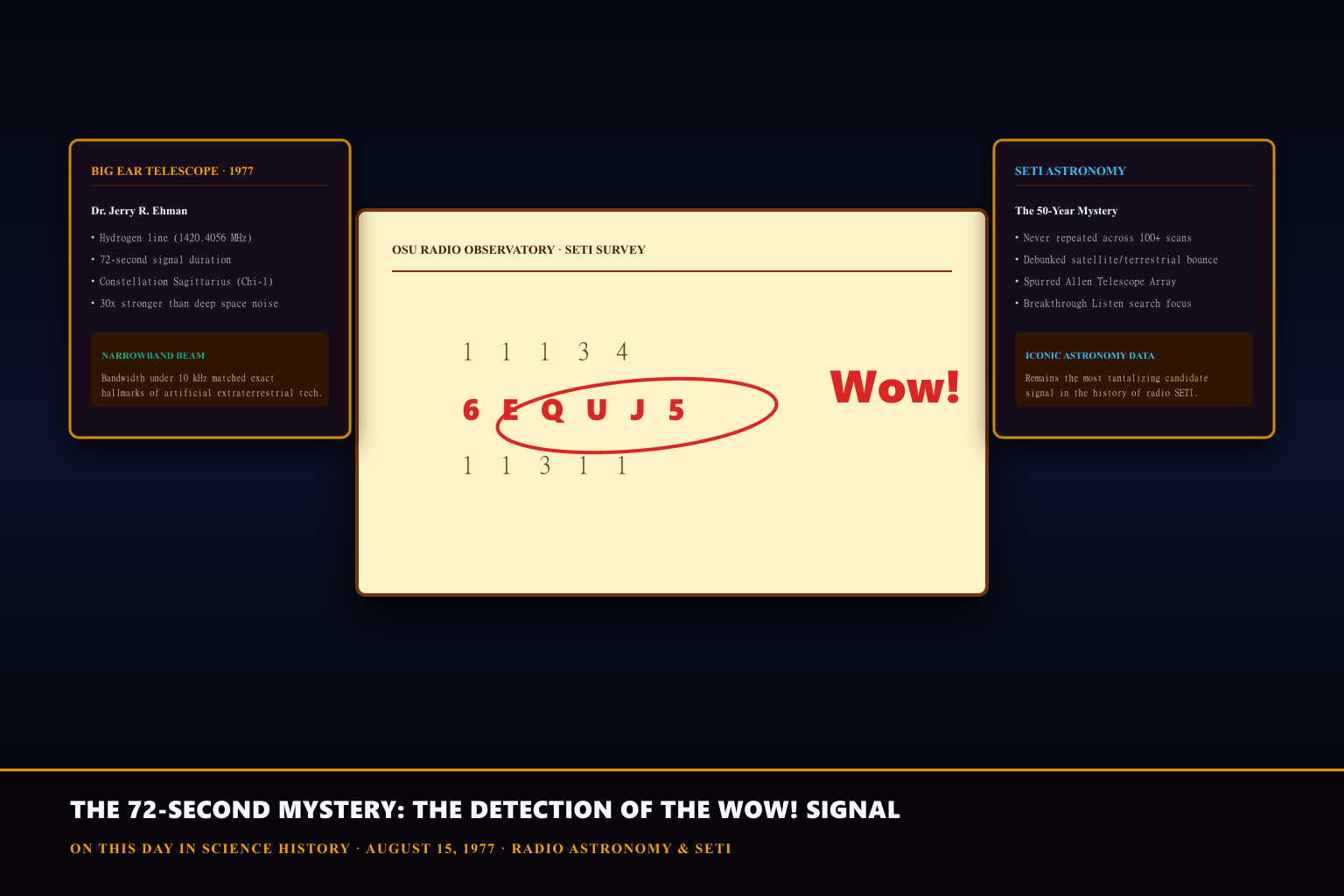
Scanning the constellation Sagittarius on a summer night in 1977, Ohio State's Big Ear radio telescope recorded a 72-second blast of narrowband radio energy matching the 1420 MHz hydrogen line. When astronomer Jerry Ehman spotted the alphanumeric sequence '6EQUJ5,' he circled it in red ink and wrote 'Wow!'
The Big Ear Architecture and the 1420 MHz Hydrogen Line
Designed by Dr. John Kraus, the Big Ear radio telescope was an enormous fixed transit antenna covering an area equivalent to three football fields. It utilized a massive flat tilting reflector and a curved parabolic reflector that focused incoming radio waves into two horn feeds. The telescope relied entirely on Earth's natural 24-hour sidereal rotation to sweep across the sky.
In 1959, physicists Giuseppe Cocconi and Philip Morrison published a groundbreaking paper in Nature arguing that if an advanced extraterrestrial civilization wished to communicate across interstellar distances, they would transmit at 1420.405 MHz (the 21-centimeter line)—the fundamental emission frequency of neutral hydrogen atoms, the most abundant element in the cosmos. Big Ear was tuned specifically to listen to this 'cosmic watering hole.'
Decoding the Famous '6EQUJ5' Computer Printout
Big Ear's 50-channel receiver converted signal intensity into numeric values printed on continuous green-bar paper by an IBM 1130 computer. To save horizontal page space, the software assigned numbers 0 to 9 for signal strengths, followed by letters A through Z for higher intensities (where 'Z' represented a signal 36 times above background noise).
The alphanumeric printout recorded the legendary sequence: 6, E, Q, U, J, 5, with the peak letter 'U' representing a signal-to-noise ratio of thirty standard deviations above empty space. Crucially, the signal intensity rose and fell over exactly 72 seconds in a perfect Gaussian bell curve—precisely the time it took Big Ear's fixed antenna beam to sweep across a stationary point in deep space.
Extensive Follow-Up and the Enduring Scientific Mystery
Astronomers immediately attempted to re-detect the transmission. Big Ear listened continuously for months, while more sensitive radio arrays—including the Very Large Array (VLA) in New Mexico and the Green Bank Telescope—conducted dozens of targeted sweeps across the same Sagittarius celestial coordinates without detecting any recurrence.
Over decades, researchers systematically ruled out human military transmitters, aircraft reflections, satellites, and planetary telemetry. While recent hypotheses have proposed passing comets (such as 266P/Christensen) or rare astrophysical hydrogen masers, the Wow! Signal remains officially unclassified: a brief, pristine 72-second whisper from the cosmos that remains unique in scientific history.
What the evidence does not settle
Because Big Ear utilized two dual horn receivers with a slight offset, an astronomical source should have produced two distinct signal detections spaced three minutes apart as the sky drifted past. The Wow! Signal appeared in only one of the two horns, suggesting the transmission either switched off or was an intermittent transient event.
PRODUCT IDEA 01
The SETI League Amateur Radio Astronomy Beginner Handbook
A practical, hands-on guide explaining the principles of radio astronomy, dipole antenna construction, software-defined radio (SDR) receivers, and deep-space signal monitoring.
Buying limit: Available in trade paperback and digital formats. High-quality amateur astronomy handbooks cost $20 to $38.
Original editorial illustration, not a retailer photograph. No exact Amazon offer passed our verification gate.PRODUCT IDEA 02
Vintage 6EQUJ5 Wow! Signal Ceramic Space Enthusiast Coffee Mug
A premium 15-ounce ceramic coffee mug featuring the authentic red-ink circled 6EQUJ5 computer printout and Big Ear radio telescope technical specifications.
Buying limit: Look for dishwasher and microwave-safe ceramic with permanent high-temperature glazed prints. Quality mugs trade between $14 and $24.
Original editorial illustration, not a retailer photograph. No exact Amazon offer passed our verification gate.SOURCES, METHOD, AND LIMITS
Researched using primary observation logbooks from the Ohio State University Radio Observatory, Dr. Jerry Ehman's technical retrospective papers, and peer-reviewed astronomical analyses published in the Astronomical Journal. No commercial products were physically tested.
- Ohio State Radio Observatory — The Big Ear Wow! Signal Official Technical Report — Official archive compiled by Dr. Jerry Ehman containing high-resolution scans of the original IBM 1130 printouts, receiver schematics, and frequency calibrations.
- SETI Institute — The Search for Extraterrestrial Intelligence & Historical Radio Anomalies — Curated research repository detailing 1420 MHz hydrogen line monitoring, narrowband signal verification criteria, and follow-up radio sweeps.