ON THIS DAY · JULY 2, 1900
Lifting Giants on Lake Constance: How the 1900 Flight of Zeppelin LZ 1 Pioneered Rigid Airship Engineering
Before the Wright brothers flew at Kitty Hawk, an enormous 420-foot aluminum cylinder lifted gently off the waters of Lake Constance. The maiden flight of Zeppelin LZ 1 proved that internal rigid skeletons could carry massive structural payloads across the sky.
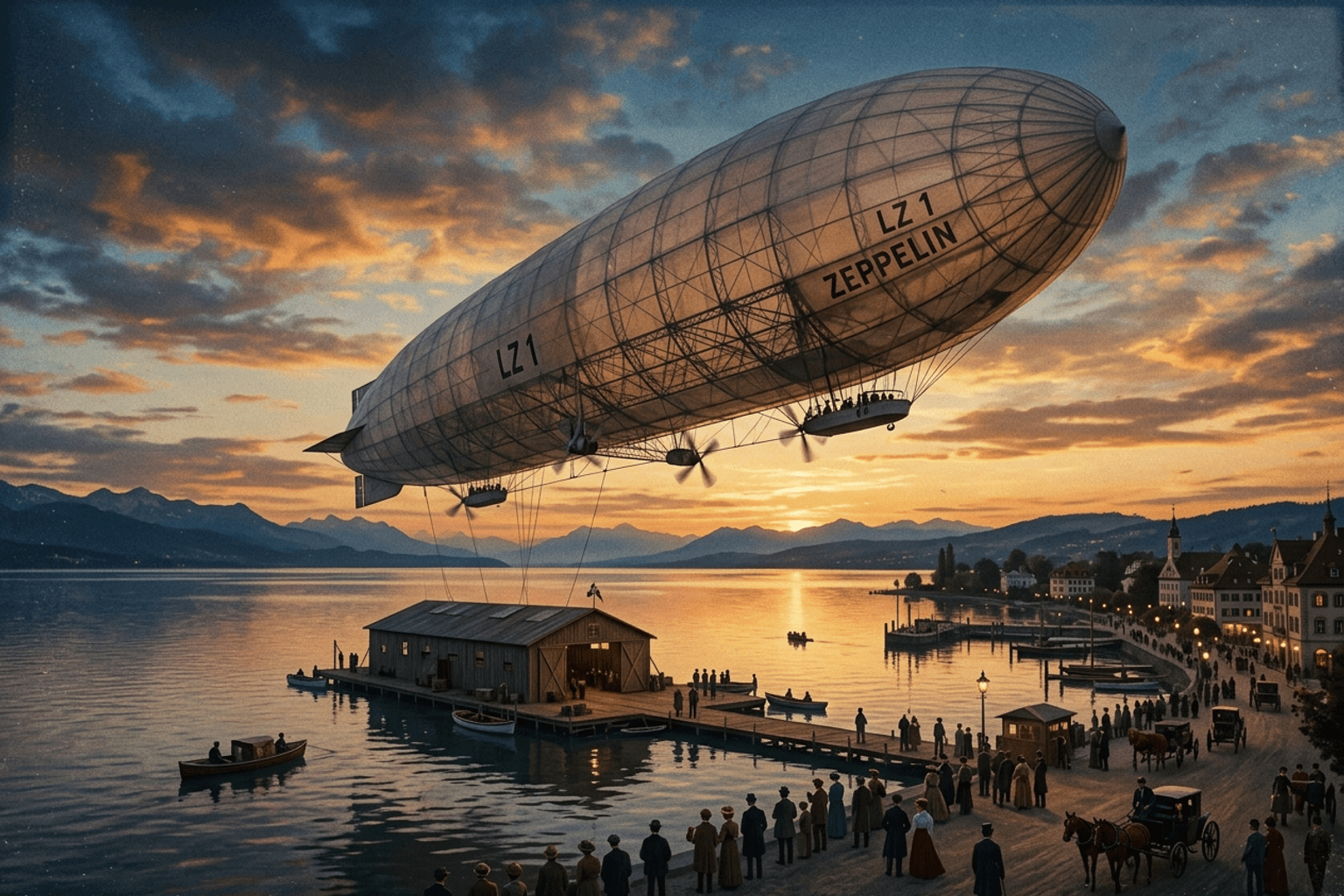
The Floating Hangar and the Lake Constance Launchpad
Count Zeppelin faced severe logistical skepticism in the late 1890s, with German scientific academies declaring large-scale rigid airships aerodynamically impossible. To safely launch and retrieve his massive prototype without risking crosswind damage, Zeppelin built a floating wooden shed anchored on Lake Constance near Manzell.
The 460-foot floating hangar was moored at only one end, allowing it to pivot freely with changing wind directions like a giant weather vane. This guaranteed that the airship could always emerge directly into the oncoming headwind, dramatically minimizing aerodynamic stress during ground and water handling.
Structural Architecture: The Rigid Aluminum Framework
Unlike non-rigid blimps that collapsed if gas pressure dropped, LZ 1 relied on a rigid internal framework engineered by Theodor Kober. The skeleton was constructed from triangular trusses made of lightweight aluminum—a relatively novel industrial metal in 1900.
Inside the skeletal frame were seventeen independent hydrogen gasbags sewn from rubberized cotton fabric, providing 11,300 cubic meters of lifting gas. This compartmentalized architecture ensured that a puncture in one gas cell would not cause catastrophic vehicle deflation, establishing a core structural redundancy standard for aerospace vehicles.
Propulsion, Flight Mechanics, and the Seventeen-Minute Flight
LZ 1 was powered by two Daimler water-cooled 4-cylinder internal combustion engines, each generating 14.2 horsepower and driving twin two-bladed aluminum propellers via long driveshafts. To adjust pitch trim in flight, the crew winched a 225-kilogram sliding lead weight forward and aft along an external keel cable.
At 8:03 PM on July 2, LZ 1 rose gracefully above Lake Constance to an altitude of 410 meters. Despite a winch failure that jammed the pitch weight and bent the main control truss, Count Zeppelin steered the craft across 3.5 miles at 17 km/h before making a smooth, controlled water landing, proving that giant rigid hulls were aerodynamically steerable.
What the evidence does not settle
LZ 1's underpowered 14-hp Daimler engines made it difficult to fly against moderate headwinds, and structural flexing during its initial water landing required extensive reinforcement. The prototype was scrapped in 1901 after three test flights due to lack of immediate private capital, prior to public lottery funding of the LZ 2 and LZ 3.
PRODUCT IDEA 01
Vintage 1900 Zeppelin LZ 1 Blueprint Schematic Framed Canvas Art

A high-resolution archival blueprint print detailing the triangular girder framework, hydrogen cell spacing, and Daimler engine mounts of the historic LZ 1.
Buying limit: Look for heavy poly-cotton canvas and fade-resistant pigment inks. Quality framed aeronautical prints cost $25 to $55.
Original editorial illustration, not a retailer photograph. No exact Amazon offer passed our verification gate.PRODUCT IDEA 02
Heavy-Duty Solid Anodized Aluminum Drafting Scale & Compass Set
A professional 12-inch triangular aluminum architect scale ruler paired with a precision geared drafting compass for engineering design sketches.
Buying limit: Select laser-etched imperial and metric scales that will not rub off over time. Quality drafting sets range from $18 to $35.
Original editorial illustration, not a retailer photograph. No exact Amazon offer passed our verification gate.SOURCES, METHOD, AND LIMITS
Researched using primary engineering logs from the Zeppelin Museum Friedrichshafen archives, Luftschiffbau Zeppelin historical technical documentation, and contemporary reports in the Zeitschrift des Vereins Deutscher Ingenieure. No commercial products were physically tested.
- Zeppelin Museum Friedrichshafen — LZ 1 Engineering Archives & Construction Records — Official museum historical monograph detailing Count Zeppelin's floating hangar patents, aluminum girder chemistry, and Bodensee test flights.
- Smithsonian National Air and Space Museum — Rigid Airship Structural Mechanics & LZ Series — Curatorial technical review comparing rigid framework truss design, hydrogen gas cell compartmentalization, and airship aerodynamics.