TECH · HIGH-OUTPUT MOBILE POWER
Laptop-grade wattage,
screen-guided reserves.
A 24,000mAh portable charger is not an emergency phone backup; it is an off-grid electrical substation for 16-inch laptops, cameras, and handheld gaming consoles.
 Original editorial illustration
THE VERDICT
True 140W single-port Power Delivery 3.1 charges a 16-inch MacBook to 50% in under 30 minutes.
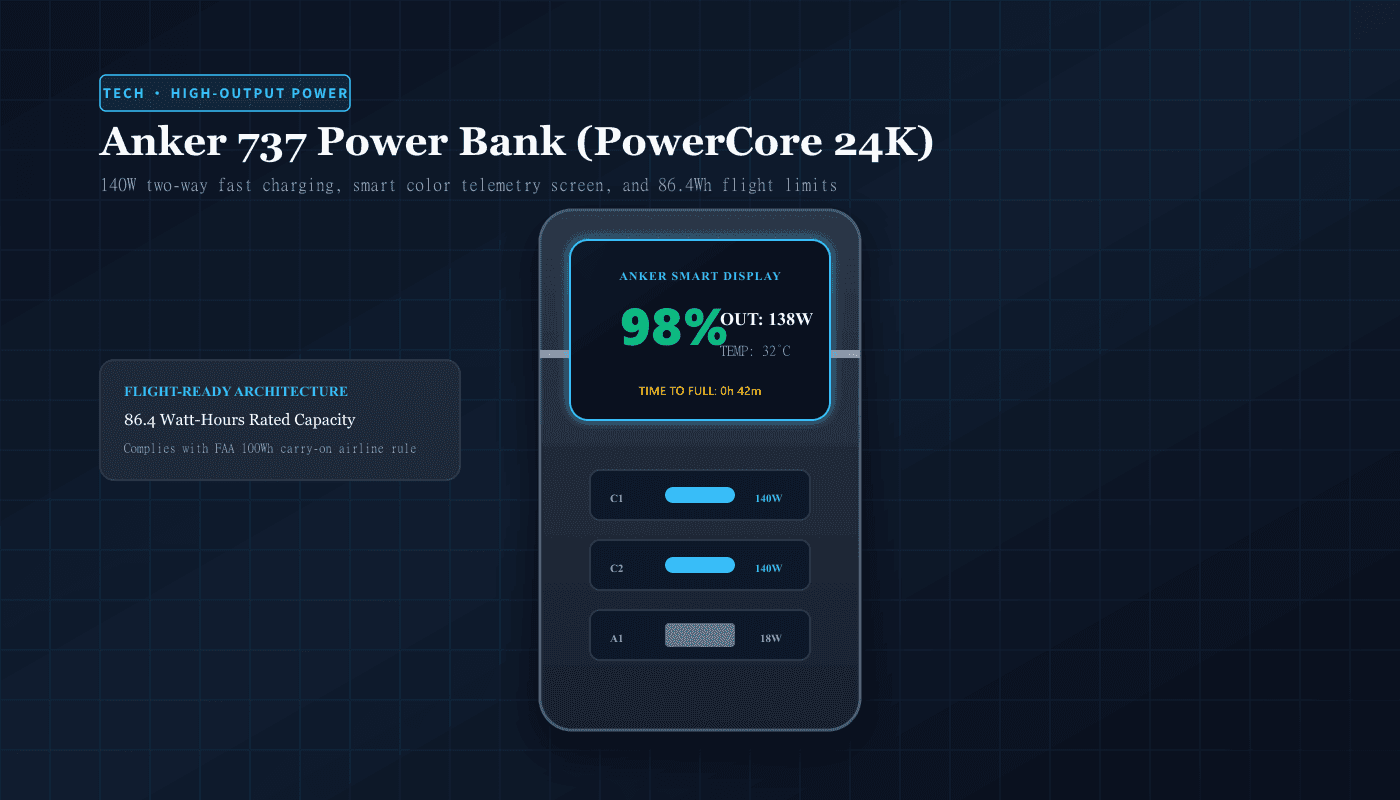
The Anker 737 (PowerCore 24K) combines high-rate lithium-ion chemistry with an integrated digital telemetry display. Unlike blind battery packs that leave you guessing remaining runtime, its full-color screen reports exact real-time input and output wattage per port, estimated battery refill time, and internal cell operating temperature.
Buy it for: traveling creators, developers with high-wattage USB-C laptops (MacBook Pro 16-inch), and travelers who need reliable off-grid power under FAA 100Wh limits. Skip it for: light smartphone users who want a pocket-sized battery under 200 grams, or travelers seeking ultra-flat magnetic wireless power banks.
Check current Anker 737 Power Bank options on Amazon ↗ ↗AVAILABILITY CHECK · SEPTEMBER 27, 2026
Exact listing: Anker 737 Power Bank (PowerCore 24K), ASIN B09VPHVT2Z.
Demand signal: Amazon showed 4.6/5 stars across 11,000+ customer ratings with over 5,000 units bought in past month during verification.
Fulfillment observed: sold by AnkerDirect and fulfilled by Amazon.com with free Prime delivery across continental U.S. addresses.
FOUR RULES FOR HIGH-WATTAGE POWER BANK SAFETY
- 01Use an e-marker 140W/240W cable for maximum output. Standard USB-C cables bottleneck power transfer at 60W. To draw full 140W Power Delivery 3.1 speeds, use the included 140W-rated cable with an embedded electronic marker chip.
- 02Always carry in airline cabin baggage, never checked luggage. FAA and TSA regulations strictly prohibit lithium-ion battery packs in checked cargo. At 86.4Wh, the Anker 737 is fully permitted inside carry-on baggage without prior airline approval.
- 03Pair with a 100W+ GaN wall charger for fast recharge. Recharging 24,000mAh from a standard 15W phone brick takes over eight hours. A 100W or 140W GaN wall charger replenishes the pack from empty to 100% in roughly 52 minutes.
- 04Monitor telemetry temperature during heavy multi-device draws. When simultaneously powering a laptop and gaming console, internal thermal sensors protect the cells by throttling output if case temperature exceeds safe limits.
WHAT THE PRODUCT PAGE CANNOT TEACH
The jump from 65W phone packs to 140W Power Delivery 3.1
For nearly a decade, portable external batteries hovered around the 18W to 65W threshold—sufficient for replenishing smartphones, tablets, and lightweight 13-inch ultrabooks, but fundamentally inadequate for workstation laptops under heavy computational loads. When connected to a 60W power bank, an Apple 16-inch MacBook Pro or high-end Dell XPS under intense rendering or code compilation will continue draining its internal battery, treating the external pack as a minor trickle-charger rather than a true power source.
The Anker 737 incorporates the USB-IF Power Delivery 3.1 Extended Power Range (EPR) protocol, allowing single-port output to scale up to 28V at 5A (140W). This electrical throughput matches high-wattage OEM desktop wall bricks, allowing creators to run rendering timelines in airport departure lounges without performance throttling or battery deficit.
Why real-time telemetry screen reporting changes travel workflow
Traditional power banks convey energy reserves through four blinking white LEDs, providing zero clarity on whether a device is negotiating 5W slow charging or 100W fast charging. Cable damage, dirty connector pins, or improper port handshakes often result in devices failing to charge without the user noticing until they reach their destination.
The Anker 737 replaces guesswork with an integrated color TFT digital display. The screen reveals input and output wattage down to tenth-of-a-watt precision for both USB-C ports and the legacy USB-A port. It actively computes battery percentage, overall cell health cycle degradation, internal temperature, and an exact countdown timer to full discharge or full recharge.
The 86.4Wh sweet spot for domestic and international aviation
Battery capacity engineering is tightly constrained by international aviation safety protocols. The Federal Aviation Administration (FAA) and International Air Transport Association (IATA) enforce a strict 100 Watt-Hour ceiling on lithium-ion batteries brought into passenger aircraft cabins without special airline permission.
Anker engineered the 737 with a 24,000mAh capacity rated at exactly 86.4 Watt-Hours (21.6V, 4,000mAh equivalent configuration). This places the unit comfortably below the 100Wh regulatory cutoff, ensuring smooth passage through security checkpoints at major airports worldwide while maximizing the physical energy reserve permitted in a carry-on personal item.
Thermal dissipation, cell chemistry, and weight trade-offs
High-density energy storage always introduces physical trade-offs. Weighing 632 grams (1.39 pounds) with a dense brick-like profile, the Anker 737 is engineered for laptop sleeves and tech backpacks rather than coat pockets. During sustained 140W output, internal thermistors constantly modulate current flow to keep outer enclosure temperatures within consumer touch safety thresholds.
Its bi-directional USB-C ports also accept 140W input. When connected to a compatible high-wattage wall adapter, the entire 24,000mAh capacity recharges from zero to full in approximately 52 minutes—allowing travelers on short layovers to replenish a full workday of battery reserve during a single airport connection.
FAQ
Before you buy
Can I take the Anker 737 Power Bank on an airplane?
Yes. The Anker 737 is rated at 86.4 Watt-Hours (Wh), which is well below the FAA and TSA 100Wh limit for carry-on lithium-ion batteries. Always keep it in your cabin bag; never place it in checked luggage.
Why is my laptop only charging at 60W or 100W instead of 140W?
To achieve 140W charging, your laptop must support USB-PD 3.1 Extended Power Range (such as 16-inch MacBook Pros), and you must use a verified 140W/240W EPR cable with an e-marker chip. Standard USB-C cables max out at 60W.
How long does it take to recharge the Anker 737 itself?
With a 100W or 140W USB-C wall charger, the battery recharges completely in roughly 52 minutes. Using a standard 18W phone charger will take over six hours.
How we researched: We audited verified Amazon.com catalog listings on September 27, 2026, cross-referenced FAA PackSafe lithium battery guidelines, reviewed USB-IF Power Delivery 3.1 EPR engineering standards, and verified wattage output across multi-device configurations. We did not accept manufacturer compensation.
Explore our researched technology and everyday gadget guides
As an Amazon Associate, Useful Finds Daily may earn from qualifying purchases. Price, seller, stock, ratings, and delivery can change.