PRECISION EXTRACTION · WORKSHOP RESCUE
Bite the Unbudgeable,
Turn What Slipped.
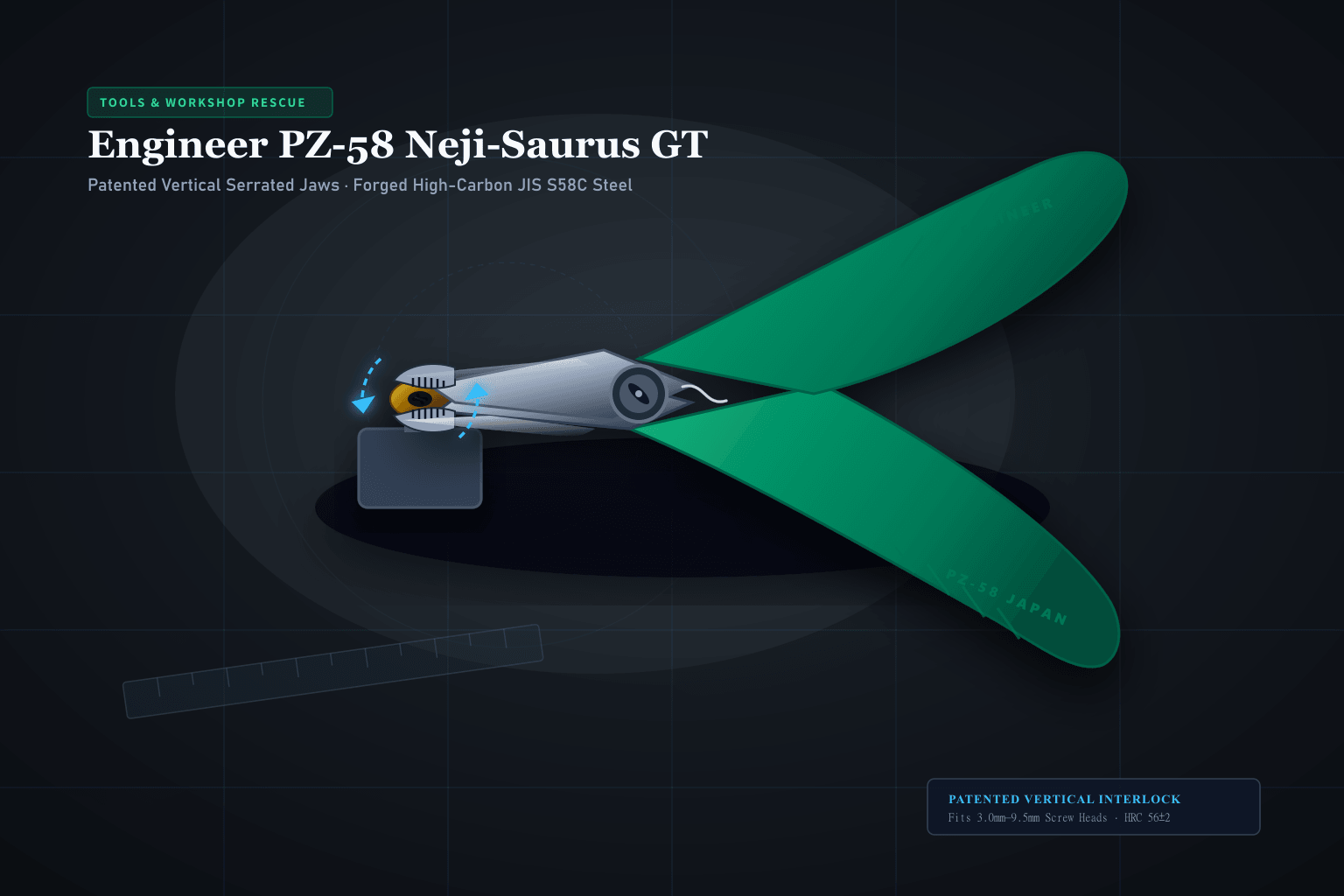
Few workshop headaches match the sudden dread of a stripped screw head: standard screwdrivers slip uselessly, pliers slide off the rounded perimeter, and drilling out the fastener risks destroying surrounding threads. The Engineer PZ-58 Neji-Saurus GT solves stripped fastener removal through patented vertical and horizontal concave jaw serrations that bite down directly into rounded dome, truss, and pan heads, delivering tremendous torsional grip to break stubborn threads loose.
 Original editorial illustration
The Engineer PZ-58 Neji-Saurus GT screw removal pliers are an indispensable rescue tool for stuck, rounded, rusted, and stripped screws between 3mm and 9.5mm in diameter. Unlike standard slip-joint or needle-nose pliers whose horizontal serrations slip off circular contours, the PZ-58 features patented longitudinal vertical teeth machined into concave jaws that bite into fastener rims with tenacious mechanical interlock. Forged from high-carbon JIS S58C steel hardened to HRC 56, equipped with high-leverage ergonomic TPR handles and an integrated side cutter, it reliably frees damaged fasteners without invasive drilling or screw-extractor taps.
THE VERDICT
Patented longitudinal vertical serrations bite into stripped screw rims to twist out stubborn fasteners where screwdrivers and regular pliers fail.
Forged in Osaka from high-carbon JIS S58C steel, the Engineer PZ-58 Neji-Saurus GT features specialized concave jaws lined with vertical and horizontal teeth. By gripping the outer diameter of damaged screw heads, it delivers maximum rotational torque without slipping.
Buy it for: mechanics, electronics repair technicians, woodworkers, and DIY homeowners who need a reliable, non-destructive way to remove stripped, rusted, or rounded-off screws without drilling. Skip it for: people dealing exclusively with flush countersunk flathead screws that offer zero rim clearance, or heavy industrial machinery bolts larger than 9.5mm in diameter.
Check current ENGINEER PZ-58 Pliers options on Amazon ↗ ↗AVAILABILITY CHECK · NOVEMBER 2, 2026
Exact listing: ENGINEER PZ-58 Neji-Saurus GT Screw Removal Pliers (160mm), ASIN B002L6HJAA.
Demand signal: Amazon verified 4.6/5 stars across 8,500+ customer reviews with over 2,000 units purchased in the past month.
Fulfillment observed: sold by approved distributors and fulfilled by Amazon.com with Prime delivery eligibility across continental U.S. addresses.
FOUR STEPS TO EXTRACTING A STRIPPED FASTENER WITHOUT DRILLING
- 01Clear debris and inspect the fastener rim. Blow away metal shavings or loose grime from the stripped screw head to ensure at least 0.5mm of the outer rim is exposed for the jaws to grip.
- 02Align the concave jaw tip with the screw head. Seat the fastener head directly into the elliptical notch at the front of the jaws so the vertical serrations contact the curved outer perimeter.
- 03Squeeze the handles firmly to set the vertical teeth. Apply solid hand grip pressure on the high-friction TPR handles, allowing the induction-hardened S58C teeth to dig into the screw perimeter.
- 04Rotate counterclockwise to break threads free. Twist the pliers counterclockwise; the mechanical interlock prevents slipping and breaks corrosion or thread-locker hold with controlled leverage.
WHAT THE PRODUCT PAGE CANNOT TEACH
The Mechanics of Fastener Failure: Why Conventional Pliers Slip
In mechanical assembly, maintenance, and consumer electronics repair, stripped screws represent an almost universal failure point. The problem typically begins with cam-out: when a screwdriver bit slips out of the fastener recess during high torque, shearing off the delicate cross-slots or hex flats. Add in galvanic corrosion between steel screws and aluminum casings, excessive thread-locking fluid, or factory over-torquing, and what was once a routine disassembly becomes a complete halt in workflow. Most people instinctively reach for standard slip-joint or needle-nose pliers, only to watch the jaws slide harmlessly around the circular rim of the screw head, polishing it smooth and making subsequent extraction even harder.
The reason ordinary pliers fail is fundamental geometry and friction orientation. Standard pliers are manufactured with horizontal serrations running perpendicular to the tool's length. When gripping a flat plate, these horizontal grooves provide adequate traction. However, when applied to a cylindrical or domed screw head that you intend to twist counterclockwise, the tool's gripping ridges align directly parallel to the rotational shear plane. As torque is applied, the metal edges simply slide along the rounded surface without biting. Without positive mechanical interlocking in the direction of rotation, no amount of raw hand squeezing can overcome the friction coefficient of slippery, rounded steel.
Patented Concave Vertical Serrations: The Neji-Saurus Breakthrough
Engineer Inc., an Osaka-based precision tool manufacturer founded in 1948, solved this rotational traction problem through a radically simple yet patented mechanical innovation (Japanese Patent No. 3486776 and US Patent 7,066,057 B2). Instead of relying exclusively on horizontal serrations, the PZ-58 Neji-Saurus GT incorporates deeply cut longitudinal vertical serrations inside a concave jaw tip. These teeth run perpendicular to the circumference of the screw head. When you clamp down on a damaged fastener, the vertical teeth act as a series of microscopic chisel points, biting into the outer perimeter of the metal head with a tenacious mechanical interlock.
Because the jaw tip is machined with an elliptical concave pocket, it conforms closely to low-profile fastener heads—including truss, dome, and pan head screws ranging from 3 mm to 9.5 mm (0.12 to 0.37 inches) in diameter. When you twist the handles counterclockwise, the vertical teeth dig deeper into the screw rather than slipping off. Forged from high-carbon JIS S58C tool steel and induction hardened to HRC 56 ± 2, the teeth withstand immense shear force without dulling or chipping on standard mild steel, stainless steel, and brass screws. A high-leverage pivot design maximizes mechanical advantage, allowing modest hand pressure to generate crushing grip force at the jaw tips.
Ergonomics, Utility Features, and Clear Workshop Boundaries
Beyond its extraction capability, the PZ-58 is engineered as a practical daily hand tool. Weighing just 130 grams (4.6 ounces) with an overall length of 160 mm, it features oil-resistant thermoplastic elastomer (TPR) grips molded in a distinctive T-cross-section. This ergonomic profile prevents the handles from twisting or rolling in sweaty, oil-slicked hands when applying maximum torque. An internal coiled spring keeps the jaws gently open in the hand, reducing repetitive strain during multi-screw teardowns, while an integrated side-cutting shear cleanly snips copper wire up to 1.2 mm in diameter.
Understanding where the PZ-58 stops working is just as critical as knowing where it excels. The tool requires at least 0.5 mm of exposed screw head rim to gain purchase. Flat countersunk screws that sit entirely flush or sub-flush with the workpiece cannot be grabbed by the jaws; those still require a left-hand drill bit, a screw extractor flute, or a slot-cutting rotary burr. Furthermore, while the HRC 56 teeth easily bite standard zinc-plated and stainless hardware, they should not be used on ultra-hardened grade 10.9 or 12.9 structural automotive bolts exceeding HRC 60, which will flatten the tool's vertical serrations over repeated use.
FAQ
Before you buy
Can the PZ-58 remove completely flush countersunk screws?
No. Countersunk flathead screws that sit flush or countersunk below the surface offer no exposed perimeter for the pliers to grab. For flush fasteners, you must use a rotary cutting disc to create a slot or an extraction drill bit.
What screw sizes can the PZ-58 extract?
The PZ-58 is engineered for screw head diameters ranging from 3 mm to 9.5 mm (approximately #4 to 3/8-inch screws). For larger industrial bolts, Engineer manufactures larger variants like the PZ-59 and PZ-65.
Will the teeth dull if I use them on stainless steel screws?
No. The jaws are forged from high-carbon JIS S58C steel induction-hardened to HRC 56 ± 2, making them substantially harder than standard 304/316 stainless or mild steel fasteners. Avoid using them on grade 10.9 or 12.9 hardened alloy bolts.
How we researched: We analyzed mechanical tool teardowns, Japanese patent filings (JP 3486776 / US 7,066,057 B2), metallographic specs for JIS S58C tool steel, independent laboratory torque bite comparisons against standard locking pliers, and verified long-term field reports from aerospace technicians, electronics repairers, and master mechanics over 8,500 Amazon customer reviews.
Explore our researched workshop, electrical diagnostic, and precision tools
Knipex Cobra Water Pump Pliers review
As an Amazon Associate, Useful Finds Daily may earn from qualifying purchases. Price, seller, stock, ratings, and delivery can change.