ON THIS DAY · NOVEMBER 6, 1980
The Contract That Sold an Operating System Microsoft Did Not Own.
On November 6, 1980, Bill Gates and Microsoft signed the landmark contract to deliver an operating system for the IBM Personal Computer—despite owning no operating system at the time—securing a non-exclusive licensing clause that launched the PC clone industry and propelled Microsoft into a software empire.
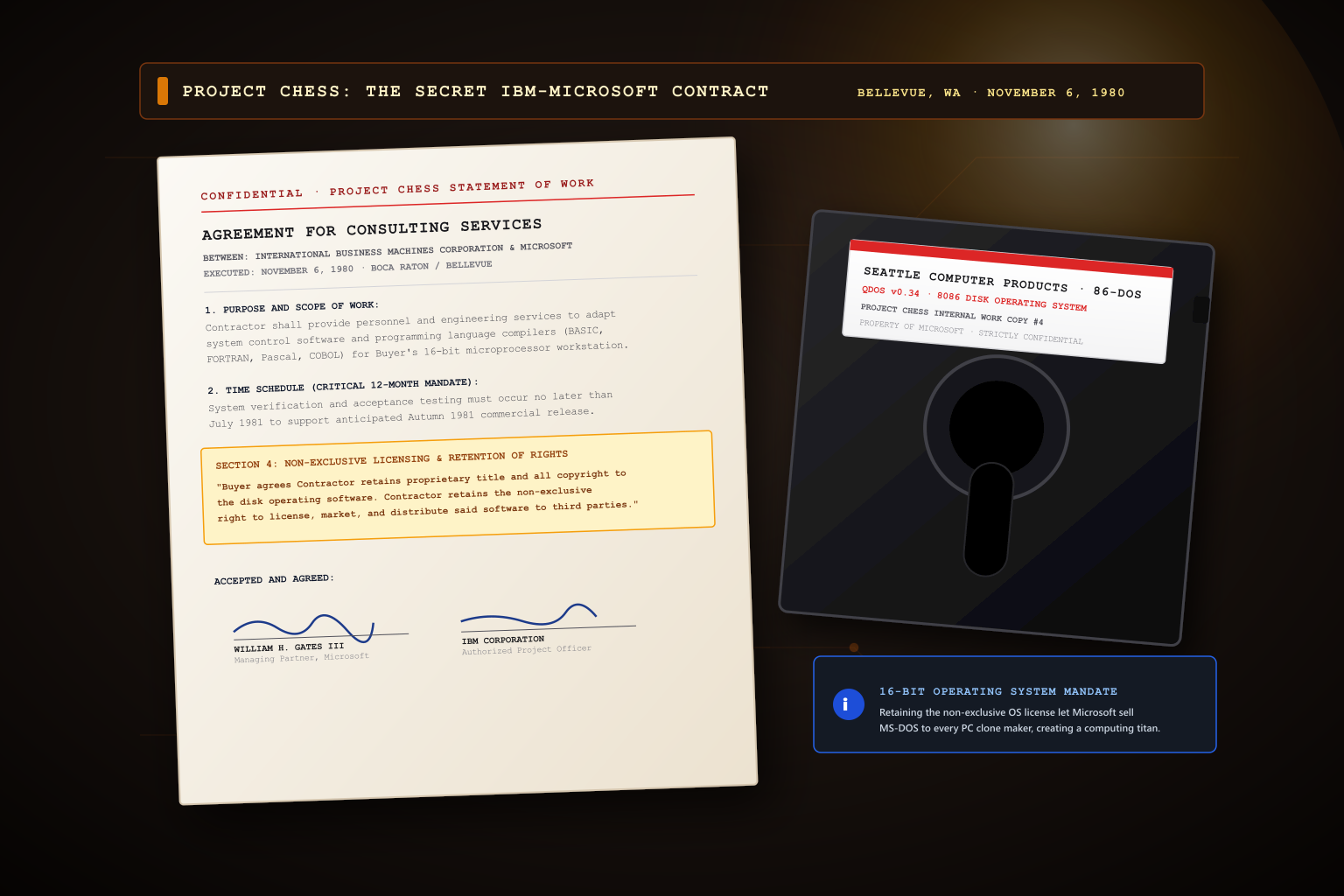
Project Chess and the 12-Month Boca Raton Mandate
In the summer of 1980, International Business Machines was an undisputed industrial titan, generating over twenty-six billion dollars in annual revenue through monolithic mainframe systems and enterprise lease contracts. Yet inside IBM's corporate headquarters in Armonk, New York, executive leadership watched with mounting anxiety as microcomputers from Apple, Tandy, and Commodore rapidly infiltrated corporate offices. In response, IBM Chief Executive Officer John Opel authorized a radical corporate experiment. He formed a skunkworks task force under engineering manager William C. Lowe at an isolated manufacturing facility in Boca Raton, Florida, codenaming the initiative 'Project Chess.'
Lowe presented IBM's Corporate Management Committee with a blunt ultimatum: if IBM followed its customary institutional protocol—designing proprietary silicon chips, engineering custom peripherals, and navigating multi-layered corporate review committees—developing a personal computer would consume at least four years and hundreds of millions of dollars, by which time the desktop market would be permanently surrendered to competitors. Lowe proposed an unprecedented exception to IBM orthodoxy: Boca Raton would construct the machine entirely out of commercial off-the-shelf hardware components within twelve months. They selected the Intel 8088 microprocessor, standard Tandon floppy disk drives, and an Epson dot-matrix printer. But hardware was only half the equation; the machine required an operating system and high-level programming languages, and IBM's internal software division estimated writing them from scratch would take thirty-six months. Boca Raton had no choice but to look outside the blue walls of IBM.
The Digital Research Impasse and the Myth of Kildall's Flight
To procure software, IBM representative Jack Sams initially traveled to Bellevue, Washington, in July 1980 to consult with twenty-four-year-old Bill Gates and Paul Allen at Microsoft. At the time, Microsoft was a thirty-person boutique software house celebrated for its BASIC, FORTRAN, and COBOL compilers, but Gates had never created a standalone operating system. Sams explained that IBM required a microcomputer operating system. Gates readily pointed IBM toward Pacific Grove, California, home of Digital Research Inc. (DRI) and its brilliant founder, Dr. Gary Kildall, whose CP/M (Control Program for Microcomputers) had become the reigning 8-bit industry standard running on thousands of hobbyist and commercial machines.
What occurred next became one of the most distorted legends in technology folklore. Popular myth long maintained that Gary Kildall casually blew off IBM's high-stakes delegation to go recreational flying in his private aircraft. Historical archives and IEEE retrospective investigations reveal a starkly different reality. Kildall, an accomplished licensed pilot, was flying a scheduled business trip to deliver software to another commercial account. While he was airborne, his wife and DRI business director, Dorothy McEwen, met with IBM's legal delegation. IBM's attorneys insisted that DRI sign an aggressive, one-sided non-disclosure agreement that forbade DRI from ever acknowledging that IBM had met with them, while simultaneously stipulating that IBM owed no duty of confidentiality to DRI. Advised by DRI counsel, McEwen refused to sign the draconian agreement without modifications. When Kildall returned later that afternoon, discussions stalled over IBM's proposal of a flat $250,000 buyout for CP/M rights versus DRI's traditional per-copy royalty model. Frustrated by the legal friction and strict secrecy constraints, IBM abandoned Pacific Grove and flew back to Washington.
The November 6 Contract and Paterson's 'Quick and Dirty' Fix
Returning to Bellevue in late October, IBM executives asked Gates and Allen if Microsoft could supply the operating system alongside the programming language compilers. Gates did not hesitate; he promised IBM that Microsoft could deliver a full 16-bit operating system by the summer of 1981, despite knowing that Microsoft did not actually own or possess one. What Gates and Allen knew—and IBM did not—was that just miles away in Tukwila, Washington, a brilliant twenty-seven-year-old hardware engineer named Tim Paterson at Seattle Computer Products (SCP) had developed a makeshift operating system to test SCP's 8086 add-on memory boards. Paterson called his software QDOS ('Quick and Dirty Operating System'), later rechristened 86-DOS. Because Paterson wanted existing 8-bit software to transition smoothly to the 8086, he modeled 86-DOS's application programming interface directly on CP/M's system calls and file control block architecture.
On Thursday, November 6, 1980, Bill Gates signed the historic Statement of Work and Consulting Agreement with IBM. The financial terms appeared remarkably advantageous to IBM: Microsoft accepted a fixed consulting fee of roughly $186,000 to deliver BASIC, FORTRAN, Pascal, COBOL, and the disk operating system. But hidden within the contract was an omission of colossal proportions: IBM, convinced that long-term enterprise profitability resided in proprietary hardware margins, had no desire to shoulder ongoing software maintenance and viewed the operating system as an interchangeable commodity. Microsoft successfully preserved the intellectual property ownership and secured a non-exclusive licensing clause, granting them the unilateral legal right to license the operating system to other computer manufacturers without sharing royalties with IBM.
One month later, on December 22, 1980, Microsoft paid Seattle Computer Products $25,000 for a non-exclusive license to 86-DOS. In July 1981, weeks before the IBM PC's official public unveiling, Microsoft bought all rights to 86-DOS outright for an additional $50,000, bringing Paterson onto Microsoft's payroll to finish adapting it into PC-DOS 1.0. When IBM announced the Personal Computer Model 5150 on August 12, 1981, the machine ignited a corporate computing revolution. Within eighteen months, rival manufacturers like Compaq reverse-engineered IBM's BIOS chip and began manufacturing identical 'IBM PC Compatible' clones. Because every clone required an operating system to run PC software, and because Microsoft had retained non-exclusive third-party licensing rights on November 6, 1980, every PC manufacturer on Earth had to buy MS-DOS from Microsoft. That single clause transformed a small microcomputer programming shop into the dominant monopoly of the digital age.
What the evidence does not settle
Our historical analysis is grounded in archival documents from the Computer History Museum, oral histories from Tim Paterson and Gary Kildall, and corporate retrospectives published by IEEE Annals of the History of Computing and IBM Corporate Archives. While popular mythology framed Gary Kildall's absence as casual negligence, institutional records demonstrate that contractual disagreements over IBM's one-sided nondisclosure agreements and buyout pricing were the actual catalysts for negotiations breaking down. Microsoft's fixed compensation from IBM ($186,000 for development plus stipends) was modest; the immense financial value lay entirely in the retention of non-exclusive third-party licensing rights.
PRODUCT IDEA 01
Idea Man: A Memoir by the Co-founder of Microsoft — Paul Allen
Paul Allen provides an unvarnished, firsthand insider account of Microsoft's early years, including the frantic weeks in the autumn of 1980 when IBM arrived in Bellevue. Allen recounts how he recognized that Tim Paterson's 86-DOS was the missing puzzle piece, negotiated the purchase from Seattle Computer Products, and worked alongside Gates to insist on retaining non-exclusive licensing rights. His memoir offers invaluable technical detail and candid psychological portraits of Gates, Steve Ballmer, and early microcomputer pioneers during computing's defining decade.
Buying limit: Available in paperback (ISBN-10: 1591845378), hardcover, and Kindle editions (384 pages, Portfolio/Penguin). Highly recommended for software developers, business strategists, and tech history enthusiasts seeking primary testimony on the founding of the personal computer industry. Does not include source code disassembly listings.
Original editorial illustration, not a retailer photograph. No exact Amazon offer passed our verification gate.PRODUCT IDEA 02
Fire in the Valley: The Making of The Personal Computer — Michael Swaine & Paul Freiberger
Originally published in 1984 and later updated into a definitive third edition, Swaine and Freiberger's 'Fire in the Valley' is widely considered the foundational narrative history of the personal computer revolution. Based on hundreds of contemporaneous interviews conducted throughout Silicon Valley and the Pacific Northwest, the book captures the chaotic transition from hobbyist garage clubs like Homebrew to industrial giants like IBM, Apple, and Microsoft. It delivers a masterclass in technology journalism, documenting the human ambitions, serendipitous meetings, and cutthroat rivalries that gave birth to personal computing.
Buying limit: Available in paperback (ISBN-10: 0071358927 / Pragmatic Bookshelf 3rd ed), hardcover, and digital formats. Indispensable reading for historians, technologists, and entrepreneurs who want to understand the cultural and industrial ferment of late-1970s and 1980s personal computing. Not a technical programming reference manual.
Original editorial illustration, not a retailer photograph. No exact Amazon offer passed our verification gate.SOURCES, METHOD, AND LIMITS
We cross-referenced primary contract documentation, statements of work, and institutional retrospectives preserved in the Computer History Museum archives, IEEE Computer Society historical publications, and firsthand memoirs including Paul Allen's 'Idea Man' and Swaine and Freiberger's 'Fire in the Valley'. We verified the exact sequence of events between August and November 1980, debunked enduring folklore surrounding the Digital Research negotiations, and audited early DOS architectural lineage without commercial sponsorship.
- Computer History Museum: Microsoft Agrees to Write Software for the IBM PC — Institutional milestone archive documenting the November 6 1980 contract signing between Microsoft and IBM for the IBM Personal Computer operating system and language compilers.
- IEEE Computer Society: The Origins of MS-DOS and the CP/M Controversy — Scholarly technical retrospective analyzing Tim Paterson's QDOS architecture, Digital Research's contractual impasse with IBM, and the legal foundations of personal computing licensing.
- Smithsonian National Museum of American History: IBM Personal Computer NMAH Collection — Curatorial archive detailing the Project Chess skunkworks development in Boca Raton, Florida, off-the-shelf component sourcing, and original PC-DOS 1.0 distribution.