ON THIS DAY · NOVEMBER 7, 1940
The Day the Wind Twisted Steel: The Collapse of Galloping Gertie.
On November 7, 1940, Puget Sound's newly opened Tacoma Narrows Bridge twisted violently under moderate 42-mile-per-hour winds before plunging into the waters below, exposing the fatal flaw of solid plate girders and permanently transforming modern aerodynamic civil engineering.
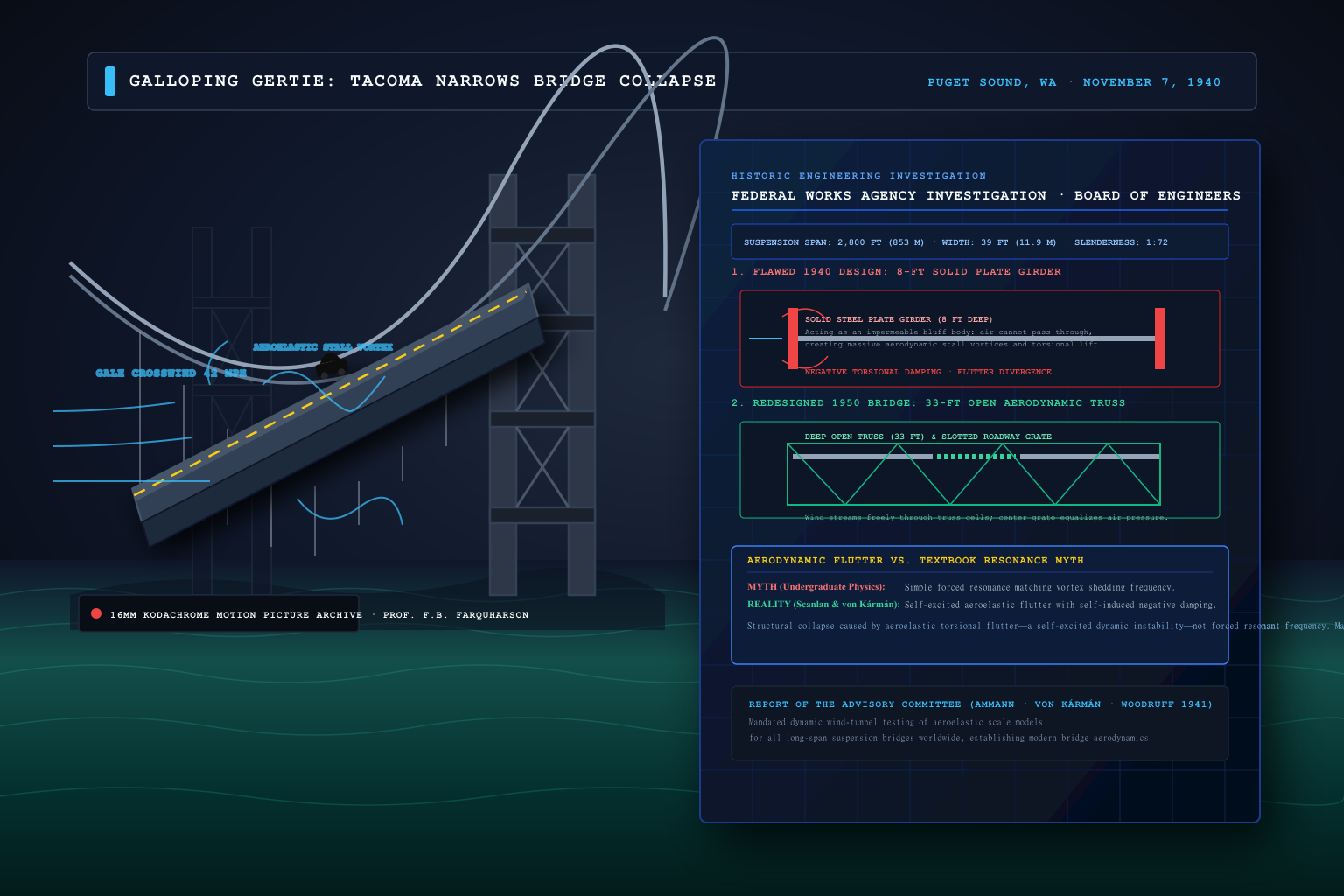
The Deflection Theory Gamble and the Obsession with Slenderness
In the late 1930s, American bridge engineering was captivated by an aesthetic and economic obsession with extreme architectural slenderness. The master theorist of this movement was Leon Moisseiff, a brilliant consulting engineer who had contributed mathematical calculations to the Manhattan Bridge, the Delaware River Bridge, and the Golden Gate Bridge. Moisseiff championed 'deflection theory,' an elegant mathematical formulation demonstrating that as suspension bridge spans grew longer and heavier, the enormous tension in the main suspension cables absorbed the vast majority of lateral wind forces and vertical loads, allowing engineers to design substantially lighter, shallower, and more flexible roadway decks.
When the Washington State Toll Bridge Authority sought federal financing from the Public Works Administration (PWA) to bridge the turbulent Tacoma Narrows strait connecting Tacoma with the Kitsap Peninsula, local engineer Clark Eldridge submitted a proven, conservative design featuring conventional 25-foot-deep open stiffening steel trusses at an estimated cost of eleven million dollars. Seeking federal approval, the PWA brought in Moisseiff, who proposed replacing Eldridge's bulky trusses with ultra-slender, eight-foot-deep solid steel plate girders. Moisseiff's design reduced the budget to just $6.4 million, presenting a sleek, ribbon-like crossing that captured the imagination of federal planners. With an unprecedented center span of 2,800 feet supported by a roadway just 39 feet wide—a width-to-span ratio of 1 to 72—the Tacoma Narrows Bridge became the most flexible, slender suspension span in human history.
Even before its official opening on July 1, 1940, the structure exhibited an unnerving tendency to undulate vertically under gentle breezes. Construction crews working on the deck experienced seasickness as rolling vertical waves rippled across the steel floor, prompting them to christen the structure 'Galloping Gertie.' Motorists soon traveled from across the state specifically to experience the thrill of driving over an undulating bridge where preceding automobiles would disappear from sight into the troughs of rolling steel waves. The Washington Toll Bridge Authority installed hydraulic shock absorbers and tied down tie-wires, yet the bridge continued its vertical gallop with stubborn indifference.
November 7, 1940: From Vertical Gallop to Destructive Torsion
The morning of Thursday, November 7, 1940, brought typical autumn weather to Puget Sound: an overcast sky, choppy cold waters, and steady, moderate winds blowing directly perpendicular to the bridge at 42 miles per hour (68 km/h). Such wind velocities were well within the static wind pressure limits engineered into Moisseiff's blueprints, which were certified to withstand horizontal hurricane forces exceeding 100 miles per hour. For several hours, Gertie oscillated in its customary vertical mode, rippling in eight to ten separate longitudinal wave crests with amplitudes of up to three feet.
Shortly after 10:00 AM, the dynamics altered catastrophically. A mid-span steel cable band connecting the north suspension cable to the center of the deck snapped under cyclic stress. This structural rupture instantly broke the symmetry of the span, transforming the relatively benign vertical bending motion into a violent, two-segment anti-symmetrical torsional twist. A rigid nodal line formed straight down the yellow center line of the roadway, while the two outer lanes pitched up and down in opposite directions at a frequency of 0.2 Hertz (twelve cycles per minute). At times, one curb rose twenty-eight feet above the other, tilting the two-lane roadway at an agonizing 45-degree angle.
Leonard Coatsworth, an editor for the Tacoma News Tribune, was driving across the bridge with his cocker spaniel, Tubby, when the violent twisting threw his automobile violently against the curb. Unable to drive as the car skidded sideways on the near-vertical surface, Coatsworth crawled hundreds of feet on his hands and knees, suffering severe abrasions before reaching the safety of the east tower. Professor F.B. Farquharson of the University of Washington, who had been studying the bridge's movements with scaled instrumentation, dashed onto the twisting deck with his 16mm motion picture camera, filming the horrific, mesmerizing undulations while Barney Elliott captured 16mm Kodachrome color footage from the bridge approach. Around 11:00 AM, the center-span suspender ropes began snapping like rifle shots. A 600-foot section of roadway tore loose from its hangers, flipped upside down, and plunged into Puget Sound, taking Coatsworth's car with it. Minutes later, the entire remaining center span collapsed into the roiling waters, leaving twisted hanger cables swinging helplessly against the Pacific sky.
Debunking the Textbook Myth: Resonance versus Aeroelastic Flutter
In the decades following the disaster, the collapse of Galloping Gertie entered global culture as the archetypal textbook example of mechanical resonance. Countless high school physics textbooks, introductory college engineering curricula, and popular science documentaries asserted that the 42-mph crosswind happened to shed vortices at an exact frequency that matched the bridge's natural resonant frequency, causing an external periodic driving force that pumped energy into the structure until it shook itself to pieces—analogous to an opera singer shattering a crystal wine glass.
This tidy explanation was fundamentally incorrect. In their seminal 1991 paper published in the American Journal of Physics, civil engineering scholars K. Yusuf Billah and Robert H. Scanlan conclusively debunked the forced resonance theory. If the disaster had been driven by von Kármán vortex shedding resonance (Strouhal frequency), the frequency of alternating shed eddies would have had to match the bridge's torsional vibration frequency. However, at a wind speed of 42 mph blowing across an eight-foot solid bluff girder, the natural vortex shedding frequency was approximately 1.0 Hertz, whereas the bridge was twisting at just 0.2 Hertz—a fivefold mismatch that made classic forced resonance physically impossible.
The true culprit was a complex aerodynamic instability known as self-excited aeroelastic flutter. Because Moisseiff had selected an unperforated, solid 8-foot steel plate girder, the roadway acted not as a porous truss, but as a bluff, impermeable airfoil. As crosswinds struck the solid girder, the airflow separated at the windward edge, creating massive vortices above and below the road deck. When the bridge twisted slightly, the altered angle of attack generated dynamic aerodynamic lift forces that pushed in the exact direction of the twisting motion, introducing negative aerodynamic damping into the equation. Rather than dissipating energy, each oscillation extracted aerodynamic kinetic energy from the continuous wind field, exponentially increasing the twisting amplitude until the structural limits of the steel were completely overwhelmed.
The Legacy: Wind Tunnels, Deep Trusses, and Resilient Civil Infrastructure
The collapse sent shockwaves through the civil engineering profession. Federal Works Administrator John Carmody immediately appointed an elite Board of Engineers—comprising Swiss-American bridge legend Othmar H. Ammann, Hungarian-American aerodynamicist Theodore von Kármán, and structural authority Glenn B. Woodruff—to conduct a rigorous forensic investigation. Their landmark 1941 report delivered an uncompromising indictment of static deflection theory, demonstrating that long-span suspension bridges could no longer be treated as static rigid bodies, but had to be analyzed as dynamic elastic systems interacting continuously with fluid airstreams.
The lessons of Tacoma Narrows prompted immediate, proactive retrofits on vulnerable suspension spans nationwide. The Golden Gate Bridge in San Francisco was retrofitted with lower lateral bracing and later stiffened with bottom chord trusses; the Bronx-Whitestone Bridge had its plate girders replaced with deep trusses and aerodynamic fairings; and the Deer Isle Bridge in Maine was stabilized with extensive cable stays. When the replacement Tacoma Narrows Bridge opened on October 14, 1950 (lovingly nicknamed 'Sturdy Gertie'), it embodied an entirely new engineering paradigm: the slender 8-foot solid girders were replaced with a massive, 33-foot-deep open Warren stiffening truss, the roadway was expanded to four lanes, and open steel gratings were cut directly into the center of the roadbed to allow wind pressure to equalize instantly between the top and bottom of the deck.
Most profoundly, Galloping Gertie established wind-tunnel testing as an immutable, mandatory mandate for every long-span bridge designed on Earth. From the Mackinac Bridge and the Verrazzano-Narrows to modern marvels like the Akashi Kaikyō and the 1915 Çanakkale Bridge, no major suspension span is ever erected without extensive aeroelastic scale model testing in boundary-layer wind tunnels. By exposing the lethal gap between static mathematics and dynamic aerodynamics, the tragedy of Galloping Gertie transformed civil engineering from a trade of static load calculations into a sophisticated science of aerodynamic resilience.
What the evidence does not settle
While the forensic investigation into Galloping Gertie revolutionized structural aerodynamics, mid-20th-century engineers lacked digital computational fluid dynamics (CFD) and non-linear finite element modeling tools. They had to rely entirely on empirical physical scale models tested in University of Washington and Caltech wind tunnels. Today, while digital simulations predict aeroelastic instability across complex wind spectra, physical wind-tunnel validation of scale section models remains an indispensable requirement for long-span bridges, as microclimatic wind shear, gust buffeting, and vortex-induced vibrations cannot be solved through static assumptions alone.
PRODUCT IDEA 01
To Engineer Is Human: The Role of Failure in Successful Design — Henry Petroski
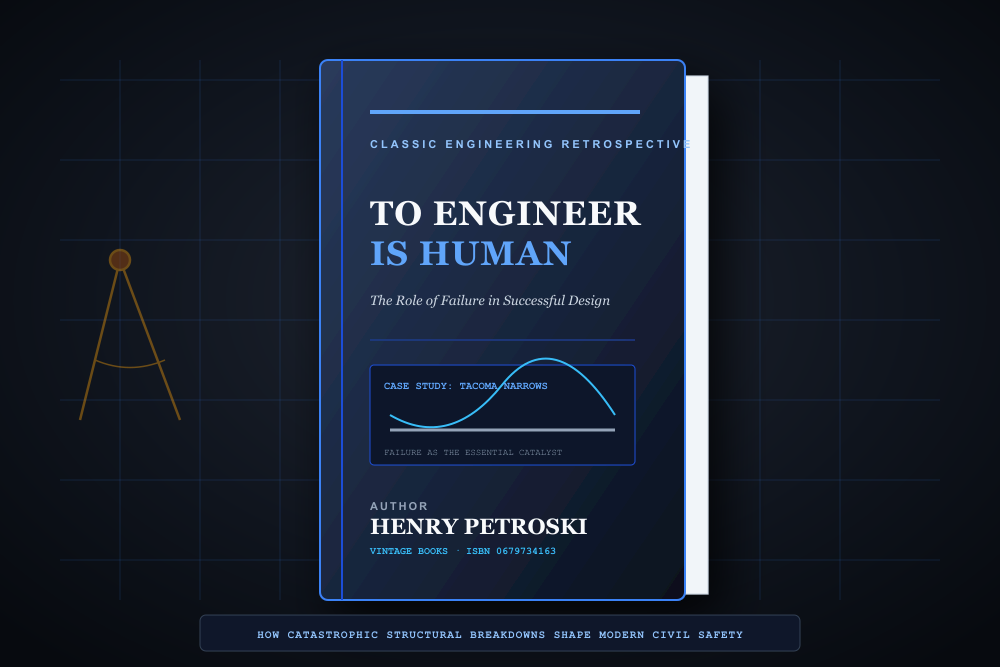
Civil engineer and historian Henry Petroski delivers a timeless philosophical and structural analysis of how catastrophic engineering failures—including the Tacoma Narrows Bridge, the Dee Bridge collapse, and the Hyatt Regency walkway disaster—drive human engineering progress far more than easy successes. Petroski illustrates why every new technological design is a hypothesis tested by reality, explaining how hubristic assumptions of material strength inevitably lead to disaster when dynamic environmental factors are overlooked.
Buying limit: Available in paperback (ISBN-10: 0679734163), hardcover, and Kindle editions (272 pages, Vintage Books). Essential reading for civil engineers, software architects, product designers, and general history enthusiasts seeking deep wisdom on the inevitability of structural error. Does not contain raw calculus derivations.
Original editorial illustration, not a retailer photograph. No exact Amazon offer passed our verification gate.PRODUCT IDEA 02
Why Buildings Fall Down: How Structures Fail — Matthys Levy & Mario Salvadori
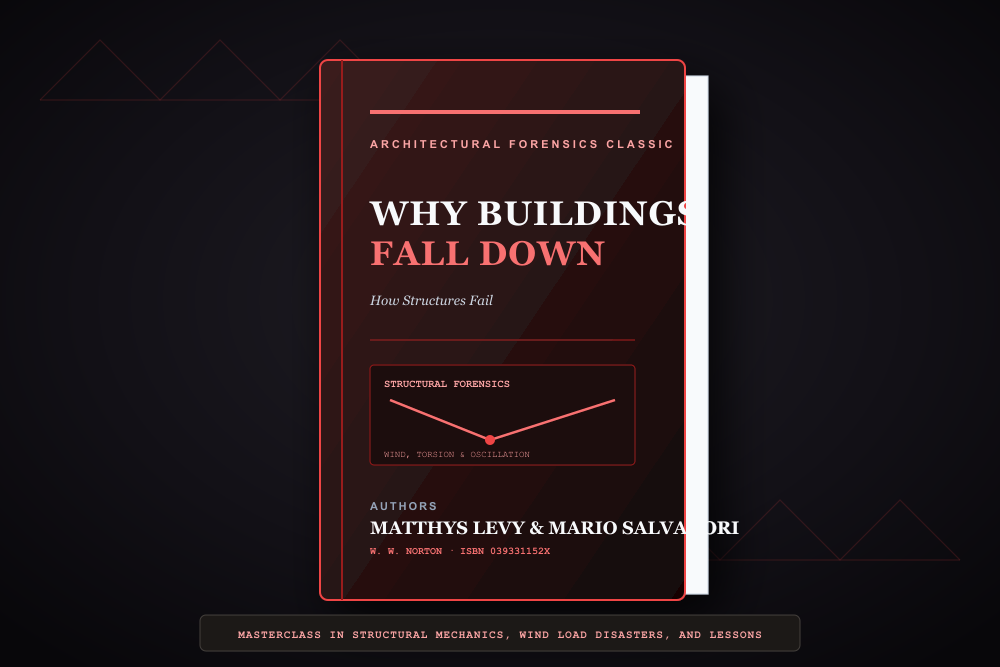
Renowned structural engineers Matthys Levy and Mario Salvadori provide an authoritative, engaging forensic walkthrough of the most famous structural collapses in world history. Featuring dedicated chapters on wind loads, aerodynamic oscillations, and the collapse of the Tacoma Narrows Bridge alongside failures of ancient Roman domes and modern skyscrapers, the authors demystify complex structural forces like tension, compression, torsion, and shear through clear diagrams and compelling investigative narratives.
Buying limit: Available in paperback (ISBN-10: 039331152X), hardcover, and e-book formats (368 pages, W. W. Norton & Company). Highly recommended for architecture students, practicing engineers, and readers interested in structural forensics and disaster investigation. Not a builder's construction manual.
Original editorial illustration, not a retailer photograph. No exact Amazon offer passed our verification gate.SOURCES, METHOD, AND LIMITS
Researched using primary engineering archives from the Washington State Department of Transportation (WSDOT), the 1941 Federal Works Agency Report on the Failure of the Tacoma Narrows Bridge (co-authored by Theodore von Kármán, Othmar Ammann, and Glenn Woodruff), Professor F.B. Farquharson's archival notes and 16mm motion picture records at the University of Washington, and the definitive aerodynamic breakdown by K. Yusuf Billah and Robert H. Scanlan published in the American Journal of Physics. All dates, aerodynamic formulas, and structural dimensions were verified against original state and federal engineering records.
- Washington State Department of Transportation (WSDOT): The 1940 Tacoma Narrows Bridge History and Engineering Archive — Primary state transportation archive documenting the planning, Moisseiff design modifications, PWA funding, motion picture records, and construction history of the original 1940 bridge.
- Federal Works Agency (FWA): The Failure of the Tacoma Narrows Bridge (Ammann, von Kármán, Woodruff Report) — Official 1941 federal investigative board report delivering comprehensive structural and aerodynamic calculations on torsional oscillation, plate girder aerodynamics, and flutter mechanics.
- American Journal of Physics: Resonance, Tacoma Narrows bridge failure, and undergraduate physics textbooks (K. Yusuf Billah & Robert H. Scanlan) — Seminal peer-reviewed aerodynamic paper proving self-excited aeroelastic flutter with negative aerodynamic damping and debunking the pervasive forced resonance myth in academic textbooks.
- University of Washington Libraries Special Collections: Professor F.B. Farquharson Tacoma Narrows Bridge Engineering Collection — Academic archival repository holding Professor Farquharson's original engineering instruments, motion picture logbooks, and wind tunnel scale test data from 1939 through 1941.