ON THIS DAY · NOVEMBER 3, 1971
The Ring Binder That Codified Modern Computing How Ken Thompson and Dennis Ritchie Published the First UNIX Manual on November 3, 1971
Written in secret on a surplus minicomputer and justified to Bell Labs management as a patent-formatting typewriter, the November 3, 1971 UNIX Programmer's Manual introduced the pipes, commands, and modular philosophy that underpin every smartphone, cloud server, and operating system on Earth.
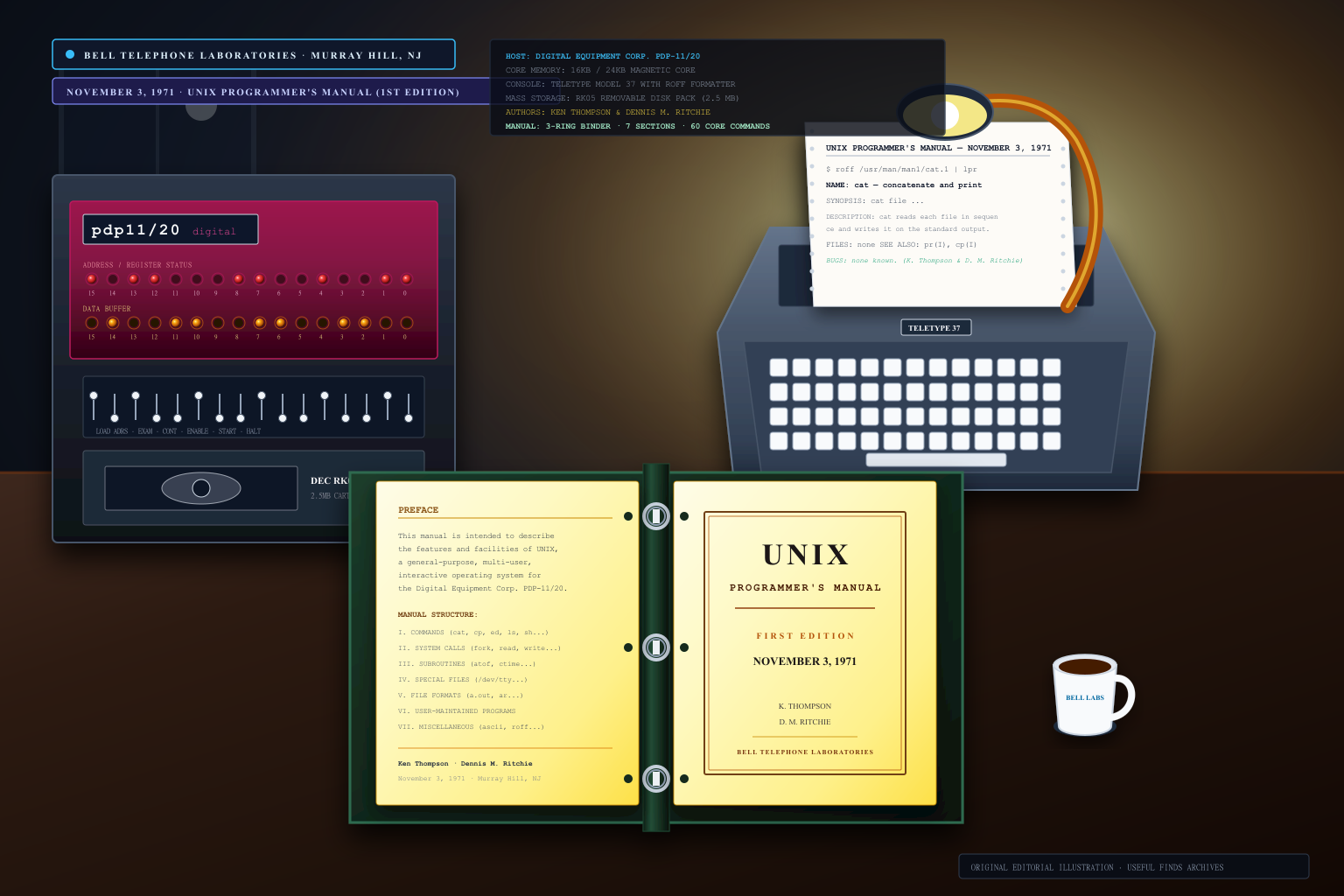
The Skunkworks System Born from Multics' Ashes
In the spring of 1969, Bell Telephone Laboratories made a quiet, painful executive decision: it withdrew entirely from the Multics (Multiplexed Information and Computing Service) consortium, an ambitious multi-institution joint venture with MIT and General Electric. Multics had aimed to create a commercial computing utility capable of serving hundreds of simultaneous time-shared users, but it had grown monstrously complex, painfully slow, and perpetually behind schedule. For Bell Labs researchers like Ken Thompson, Dennis Ritchie, Doug McIlroy, and Joe Ossanna, the cancellation was devastating. They had become accustomed to an interactive, multi-user software development environment, and suddenly they were thrown back onto rigid batch-processing mainframes where submitting a job meant handing punched card decks to an operator and waiting hours for printouts.
Frustrated by the loss of interactive computing—and wanting a comfortable platform to run 'Space Travel,' an orbital mechanics simulation game he had written—Ken Thompson went scouring the corridors of Murray Hill, New Jersey, for surplus hardware. In an alcove of the acoustics department, he discovered an abandoned Digital Equipment Corporation PDP-7 minicomputer equipped with a sluggish graphic display and a primitive 9-track tape drive, offering a meager 8,192 18-bit words of magnetic core memory. During the summer of 1969, while his wife and young son were away on a month-long vacation in California, Thompson allocated one week each to writing an operating system kernel, a command shell, an assembler, and a rudimentary file system. He designed a hierarchical directory structure where every file was simply an unformatted sequence of bytes—eliminating the complex record structures of mainframe operating systems—and unified device handling so that hardware terminals, tape drives, and storage blocks could be opened, read, and written using identical system calls.
Colleague Brian Kernighan jokingly suggested christening this lightweight, single-user rebuttal to Multics 'UNICS' (Uniplexed Information and Computing Service), an acronym that soon evolved into the canonical spelling 'UNIX.' But Bell Labs management, burned by the millions of dollars lost on Multics, had established an explicit corporate embargo against funding any new operating system research. The small group of researchers continued refining their creation informally as a skunkworks project, sharing terminals and operating entirely under the corporate radar.
The Patent Department Ruse and the $65,000 PDP-11
By late 1970, the humble PDP-7 was bursting at its physical seams. Thompson and Ritchie recognized that if Unix were to survive and support real work across Bell Labs, they needed modern hardware—specifically DEC's newly introduced 16-bit PDP-11/20 minicomputer, which carried a formidable price tag of approximately $65,000 (roughly $500,000 in contemporary purchasing power). Knowing that an overt request for an operating system research computer would be rejected outright by the computing committee, Joe Ossanna devised an ingenious bureaucratic strategy: they would pitch the PDP-11 not as a computer science project, but as an automated document-preparation system for the Bell Labs Patent Department.
At the time, Bell Telephone Laboratories filed hundreds of intricate patent applications each year, requiring teams of typists to repeatedly retype massive legal briefs whenever a single patent claim was revised. Thompson, Ritchie, and Ossanna promised that if management purchased a PDP-11/20 with 24 kilobytes of core memory and a 2.5-megabyte RK05 removable disk cartridge drive, they would deliver a turnkey text-editing and phototypesetting system that would dramatically accelerate patent filings. Management approved the requisition. The PDP-11/20 arrived in late 1970, and Thompson and Ritchie immediately ported their assembly kernel to the new architecture while simultaneously writing 'roff'—an unpretentious runoff text-formatting program based on Jerry Saltzer's earlier MIT utility—and the line editor 'ed'.
By early 1971, three administrative typists in the Patent Department were successfully preparing official patent applications directly on the PDP-11 through Teletype Model 37 terminals, completely unaware that the underlying software managing their files was an unauthorized, revolutionary operating system. Unix had fulfilled its commercial contract, securing its survival and establishing a symbiotic relationship between operating systems and text processing that would define digital communication for the next half-century.
November 3, 1971: The Genesis of the Man Page
With the PDP-11/20 supporting multiple simultaneous users and regular patent office workloads, Thompson and Ritchie faced a practical dilemma: other researchers across Bell Labs wanted to write software for the machine, but there was no comprehensive documentation explaining how to interact with the system. Working late into the autumn evenings of 1971, Thompson and Ritchie meticulously documented every program, routine, and architecture call available on the machine. On November 3, 1971, they printed and distributed the First Edition of the UNIX Programmer's Manual, assembled into durable three-ring binders.
The manual was extraordinary not merely for its content, but for its pioneering design. Formatted entirely by 'roff' and typeset on the Model 37 Teletype, the manual established a rigid, standardized anatomical format that remains universally recognizable to every Linux and Unix system administrator today: Name, Synopsis, Description, Files, See Also, Diagnostics, and the delightfully candid 'Bugs' section. Thompson and Ritchie organized the 300-page manual into seven logical sections: Commands (programs executed from the shell), System Calls (direct kernel traps), Subroutines, Special Files (device interfaces in /dev), File Formats, User-Maintained Programs, and Miscellaneous facilities.
The November 3, 1971 manual formally codified approximately 60 core commands that developers still type millions of times each day: 'cat' (concatenate files), 'cp' (copy), 'ls' (list directory contents), 'mkdir' (make directory), 'mv' (move/rename), 'rm' (remove), 'sh' (the shell command interpreter), 'wc' (word count), and 'who' (list logged-in users). Each manual page was strictly self-contained, explaining exactly what the tool did, how its flags behaved, and where its edge cases lay. The documentation was not an afterthought written by technical writers months after release; it was authored directly by the system's architects as an integral specification of the software interface.
The Modular Unix Philosophy and Its 55-Year Legacy
While the First Edition manual was written in PDP-11 assembly language—prior to Dennis Ritchie's creation of the C programming language in 1972 and Doug McIlroy's introduction of software pipes ('|') in the Third Edition in 1973—the November 3, 1971 document clearly articulated the intellectual soul of the Unix philosophy. It rejected the prevailing mainframe dogma of massive, monolithic applications with intricate internal menus. Instead, it championed three radical tenets: write programs that do one thing and do it well; write programs to work together by expecting the output of every program to become the input to another, yet unknown, program; and treat plain text as the universal interface of computing.
Because early Unix made no distinction between text stored on a magnetic disk, text typed at a keyboard, and text routed to a printer, software components could be composed dynamically. When Ritchie rewritten Unix in C in 1973, the operating system broke free from DEC hardware and became truly portable—the first modern platform that could be ported across entirely different microprocessor architectures simply by recompiling the source code. Under the terms of the 1956 Western Electric antitrust consent decree, AT&T was prohibited from commercializing software outside telecommunications, obligating Bell Labs to license Unix source code to universities for a nominal media distribution fee. This catalyzed an unprecedented explosion of computer science research at UC Berkeley (creating BSD), Stanford, and eventually Linus Torvalds' creation of Linux in 1991.
Fifty-five years after Ken Thompson and Dennis Ritchie snapped that first three-ring binder shut on November 3, 1971, the architectural descendants of their PDP-11 system govern global civilization. Every Linux web server in AWS and Google Cloud, every Apple iPhone and Mac running Darwin, every Android mobile device, and every network router routing transatlantic traffic traces its fundamental design—from fork/exec process models and hierarchical byte streams to terminal commands and man pages—directly back to that autumn evening in Murray Hill.
What the evidence does not settle
While the First Edition UNIX Programmer's Manual established the enduring structure of Unix man pages and fundamental command-line utilities, the 1971 system was written in PDP-11 assembly language rather than C (which was developed shortly afterward in 1972–1973). The 1971 release lacked software pipes (introduced in the Third Edition by Doug McIlroy in 1973) and was constrained by the PDP-11/20's 16-bit architecture and 24KB of core memory. Furthermore, early Unix was distributed freely to universities under AT&T consent-decree restrictions without commercial support, which later precipitated the fragmented 'Unix wars' and commercial licensing battles of the 1980s before open-source implementations (BSD and Linux) restored universal public access.
PRODUCT IDEA 01
UNIX: A History and a Memoir — Brian W. Kernighan
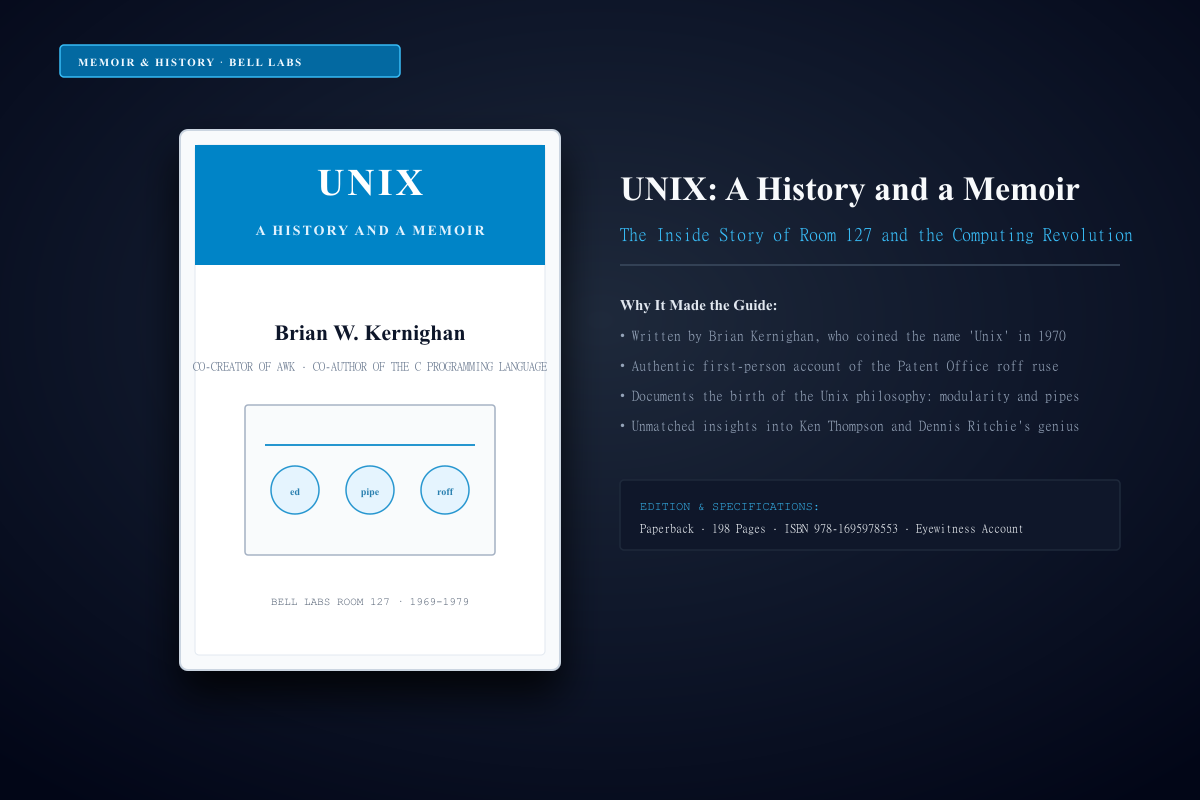
To understand how two programmers operating without management approval built the foundation of contemporary computing, Brian Kernighan's 'UNIX: A History and a Memoir' provides an unmatched, humorous, and deeply technical first-person narrative. Kernighan was working in Room 127 alongside Thompson, Ritchie, McIlroy, and Ossanna throughout the pivotal 1970s. His memoir reveals the human realities behind the technical breakthroughs: the patent office ruse that paid for the PDP-11, how the name Unix was coined over coffee, the intense debates that produced software pipes, and why the culture of Bell Labs fostered bottom-up autonomy that modern corporate tech incubators still struggle to replicate.
Buying limit: Exact paperback edition published by Kindle Direct Publishing (ISBN-13: 978-1695978553, 198 pages, ASIN: 1695978552); verified active U.S. fulfillment on Amazon.com; essential reading for systems programmers, tech historians, and engineering team leads seeking insight into high-trust creative cultures.
Original editorial illustration, not a retailer photograph. No exact Amazon offer passed our verification gate.PRODUCT IDEA 02
The Linux Programming Interface: A Linux and UNIX System Programming Handbook — Michael Kerrisk
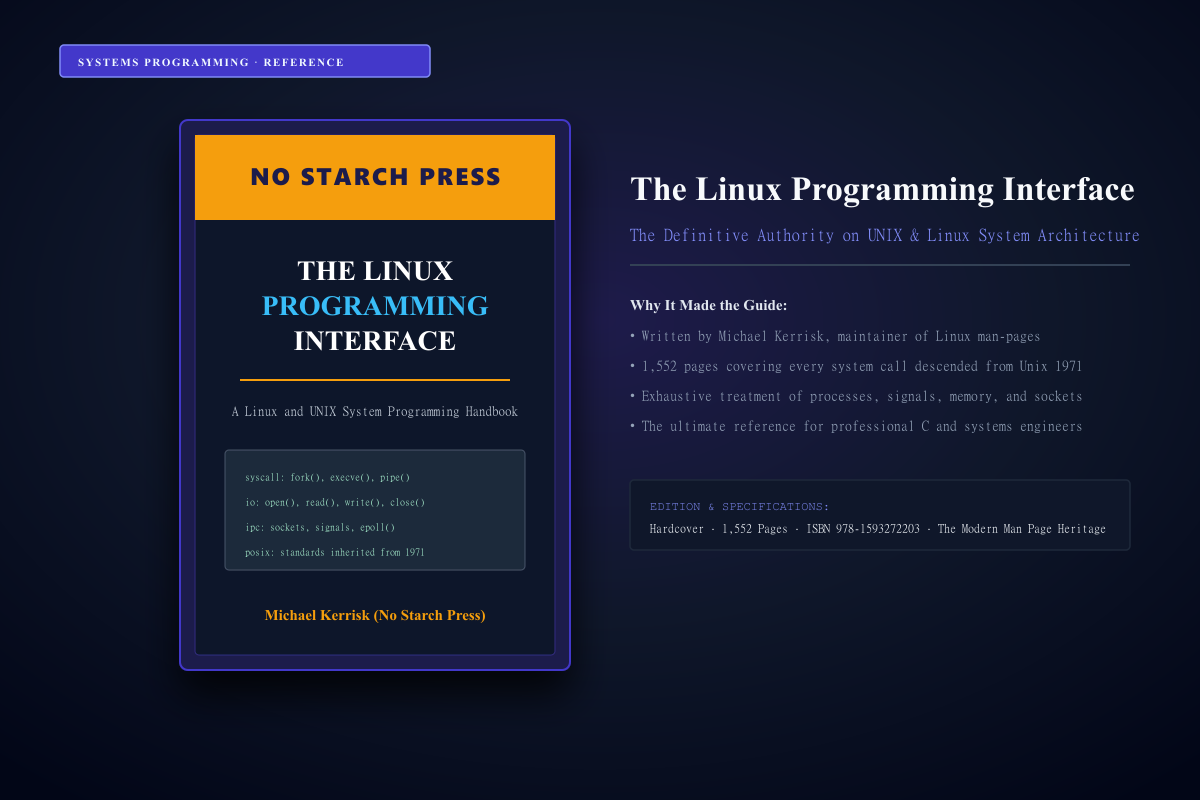
The direct evolutionary descendant of the seven-section manual published on November 3, 1971 is Michael Kerrisk's monumental work, 'The Linux Programming Interface' (No Starch Press). Kerrisk, the longtime maintainer of the official Linux man-pages project, delivers the definitive reference manual for systems engineers writing code that interfaces directly with the Unix and Linux kernel. Spanning 1,552 exhaustive pages, the handbook details the precise mechanics of file I/O, process creation, signal handling, memory allocation, interprocess communication, and network sockets—demonstrating how the fundamental system calls defined by Thompson and Ritchie on the PDP-11 continue to dictate high-performance software engineering today.
Buying limit: Definitive hardcover reference edition published by No Starch Press (ISBN-13: 978-1593272203, 1,552 pages, ASIN: 1593272200); verified active U.S. stock on Amazon.com; recommended for serious backend software engineers, kernel contributors, and computer science graduate students.
Original editorial illustration, not a retailer photograph. No exact Amazon offer passed our verification gate.SOURCES, METHOD, AND LIMITS
Useful Finds evaluated primary archival documentation from the Bell Telephone Laboratories Computing Sciences Research Center, including high-resolution facsimile scans of the November 3, 1971 First Edition UNIX Programmer's Manual preserved by The Unix Heritage Society (TUHS) and Dennis Ritchie's archival web papers. Historical timelines, technical specifications, and development narratives were corroborated against Dennis Ritchie's 1974/1984 Communications of the ACM paper 'The Evolution of the Unix Time-Sharing System,' oral histories archived at the Computer History Museum, and eyewitness accounts recorded in Brian Kernighan's memoir. Commercial links are limited strictly to verified foundational texts with active U.S. fulfillment and established pedagogical value for modern software engineers.
- UNIX Programmer's Manual, First Edition (November 3, 1971) — Bell Telephone Laboratories — Primary facsimile archive and digitized manual pages maintained by The Unix Heritage Society (TUHS) and Bell Labs Computing Sciences Research Center.
- The Evolution of the Unix Time-Sharing System — Dennis M. Ritchie (ACM/Bell Labs) — Authoritative primary technical history authored by co-creator Dennis Ritchie detailing the transition from Multics, PDP-7 skunkworks, and PDP-11 patent office funding.
- Computer History Museum: Oral History of Ken Thompson and Dennis Ritchie — Institutional oral history archives documenting the creation of Unix, C, and early Bell Labs Computing Sciences division milestones.
- UNIX: A History and a Memoir — Brian W. Kernighan (Princeton University) — Firsthand eyewitness memoir documenting daily operations in Bell Labs Room 127, the roff text processing implementation, and the birth of Unix culture.